



 Chat with AI
Exam 20: World Trade Equilibrium

Exam 1: Economics: The World Around You90 Questions
Exam 2: Choice, opportunity Costs, and Specialization95 Questions
Exam 3: Markets, Demand and Supply, and the Price System98 Questions
Exam 4: The Market System and the Private and Public Sector100 Questions
Exam 5: Elasticity: Demand and Supply132 Questions
Exam 6: Consumer Choice142 Questions
Exam 7: Supply: The Costs of Doing Business106 Questions
Exam 8: Profit Maximization122 Questions
Exam 9: Perfect Competition135 Questions
Exam 10: Monopoly118 Questions
Exam 11: Monopolistic Competition and Oligopoly114 Questions
Exam 12: Antitrust and Regulation100 Questions
Exam 13: Market Failures, Government Failures, and Rent Seeking121 Questions
Exam 14: Resource Markets112 Questions
Exam 15: The Labor Market117 Questions
Exam 16: Capital Markets100 Questions
Exam 17: The Land Market and Natural Resources55 Questions
Exam 18: Aging, Social Security and Health Care88 Questions
Exam 19: Income Distribution,Poverty and Government Policy115 Questions
Exam 20: World Trade Equilibrium112 Questions
Exam 21: International Trade Restrictions109 Questions
Exam 22: Exchange Rates and Financial Links Between Countries132 Questions
Select questions type


According to the Heckscher-Ohlin theory,comparative advantage is based on:
(Multiple Choice)
4.8/5  (88)
(88) The most heavily traded category of goods in the world is:
(Multiple Choice)
4.8/5 (86)
(86) If the world price of steel is greater than the U.S."no-trade" domestic equilibrium price of steel,the United States:
(Multiple Choice)
4.8/5 (74)
(74) The table below shows units of wheat and cloth produced by each worker per day in both the countries. Table 20.1 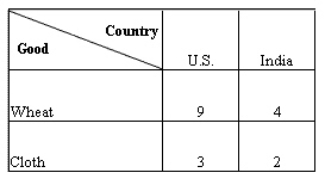 -Refer to Table 20.1.Which of the following statements is true?
 (Multiple Choice)
4.9/5 (84)
(84) The comparative advantage in a specific good can shift over time from one country to another,as the other countries can produce it at a cheaper cost after imitating the technology.
(True/False)
4.8/5 (77)
(77) The international equilibrium price is the point at which:
(Multiple Choice)
4.8/5 (85)
(85) The table below shows units of wheat and cloth produced by each worker per day in both the countries. Table 20.1 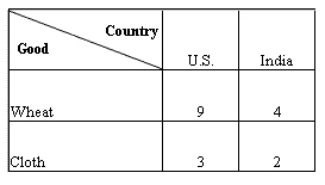 -Refer to Table 20.1.Which of the following assumptions holds true for the example?
 (Multiple Choice)
4.9/5 (76)
(76) The export supply and import demand curves measure the domestic shortage and surplus,respectively,at different world prices.
(True/False)
4.8/5 (74)
(74) The first panel in the following figure shows the domestic demand (D) and supply (S) curves of Columbian coffee and the second panel shows the import demand and export supply of Columbian coffee in the international market. Figure 20.1 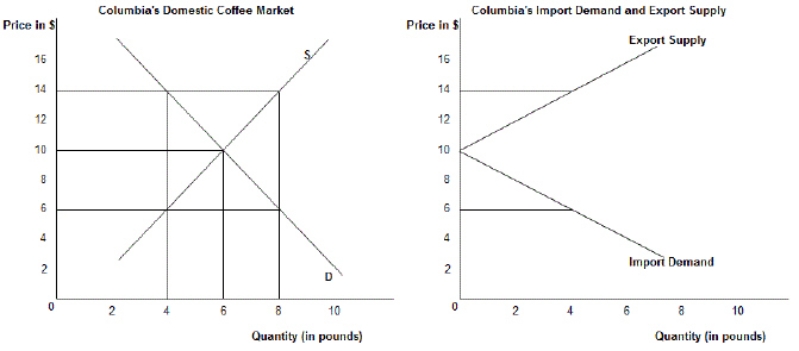 - Refer to Figure 20.1.If the price of Columbian coffee in the international market is $10,Columbia will export _____ pound(s) of coffee.
 (Multiple Choice)
4.8/5 (80)
(80) Scenario 20.2 Suppose labor productivity differences are the only determinants of comparative advantage,and both Egypt and produce only corn and cocoa.In Egypt,10 bushels of corn or 15 pounds of cocoa can be produced in a day.In Ghana,one day of labor can be used to produce either 2 bushels of corn or 8 pounds of cocoa.
-Based on Scenario 20.2,which of the following terms of trade would benefit both countries?
(Multiple Choice)
4.9/5 (76)
(76) A country can benefit by indulging in international trade when:
(Multiple Choice)
4.8/5 (84)
(84) The following table shows the units of calculators and rice produced by a laborer in a day in Japan and Korea. Table 20.3 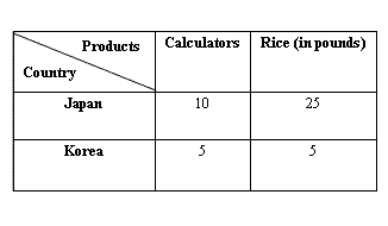 - Refer to Table 20.3.Determine the limits on the terms of trade for 1 pound of rice.
 (Multiple Choice)
5.0/5 (78)
(78) 
Filters
- Essay(0)
- Multiple Choice(0)
- Short Answer(0)
- True False(0)
- Matching(0)