



 Chat with AI
Exam 20: World Trade Equilibrium

Exam 1: Economics: The World Around You90 Questions
Exam 2: Choice, opportunity Costs, and Specialization95 Questions
Exam 3: Markets, Demand and Supply, and the Price System98 Questions
Exam 4: The Market System and the Private and Public Sector100 Questions
Exam 5: Elasticity: Demand and Supply132 Questions
Exam 6: Consumer Choice142 Questions
Exam 7: Supply: The Costs of Doing Business106 Questions
Exam 8: Profit Maximization122 Questions
Exam 9: Perfect Competition135 Questions
Exam 10: Monopoly118 Questions
Exam 11: Monopolistic Competition and Oligopoly114 Questions
Exam 12: Antitrust and Regulation100 Questions
Exam 13: Market Failures, Government Failures, and Rent Seeking121 Questions
Exam 14: Resource Markets112 Questions
Exam 15: The Labor Market117 Questions
Exam 16: Capital Markets100 Questions
Exam 17: The Land Market and Natural Resources55 Questions
Exam 18: Aging, Social Security and Health Care88 Questions
Exam 19: Income Distribution,Poverty and Government Policy115 Questions
Exam 20: World Trade Equilibrium112 Questions
Exam 21: International Trade Restrictions109 Questions
Exam 22: Exchange Rates and Financial Links Between Countries132 Questions
Select questions type


Scenario 20.2 Suppose labor productivity differences are the only determinants of comparative advantage,and both Egypt and produce only corn and cocoa.In Egypt,10 bushels of corn or 15 pounds of cocoa can be produced in a day.In Ghana,one day of labor can be used to produce either 2 bushels of corn or 8 pounds of cocoa.
-Refer to Scenario 20.2.Ghana will be willing to trade cocoa for Egyptian corn if in the international market,1 pound of cocoa can be exchanged for:
(Multiple Choice)
4.9/5  (85)
(85) The principle of comparative advantage states that a country should specialize in the production of those goods that have the highest opportunity costs.
(True/False)
4.9/5 (75)
(75) Trade between industrial countries account for the majority of international trade.
(True/False)
4.8/5 (82)
(82) If the world price of a good is equal to its no-trade equilibrium price,the country will import more of the good from other nations.
(True/False)
4.9/5 (70)
(70) The following table shows that in one day poultry farmers in Arkansas can produce 3 cartons of eggs,while poultry farmers in Idaho can produce 2 cartons of eggs.It takes Arkansas potato farmers one day to produce 30 tons of potatoes,while Idaho potato farmers produce 10 tons of potatoes in that same time. Table 20.4 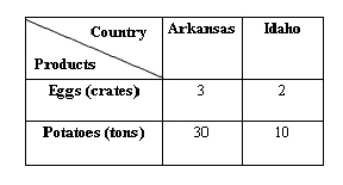 - According to Table 20.4,the limits to the terms of trade in eggs are 1 carton of eggs in exchange for:
 (Multiple Choice)
4.7/5 (84)
(84) The data in the table below assumes that with the same quantity of resources,both Australia and Philippines produces food and computers.Australia can make 1,000 computers or 2,000 units of food in a day,and the Philippines can make 200 computers or 1,200 units of food in a day. Table 20.2 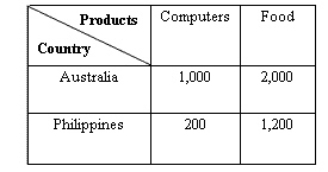 -According to Table 20.2,what is the opportunity cost of 1 computer in the Philippines?
 (Multiple Choice)
4.7/5 (81)
(81) Workers in industrial countries earn much higher wages than workers in developing countries because:
(Multiple Choice)
4.7/5 (79)
(79) The first panel in the following figure shows the domestic demand (D) and supply (S) curves of Columbian coffee and the second panel shows the import demand and export supply of Columbian coffee in the international market. Figure 20.1 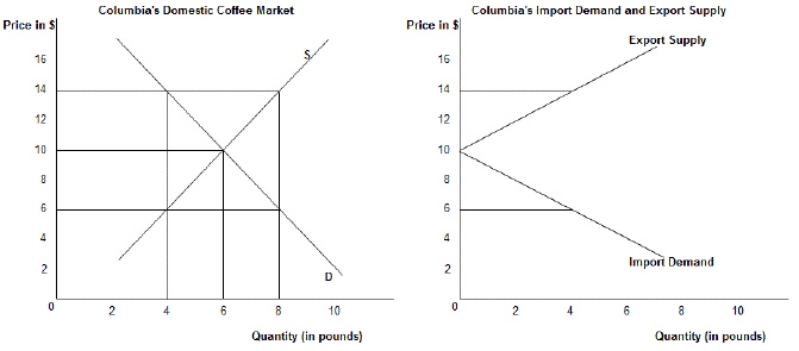 - Refer to Figure 20.1.The autarky equilibrium price of coffee in Columbia is:
 (Multiple Choice)
4.9/5 (90)
(90) The product life cycle theory predicts that comparative advantage shifts away from the country of origin if:
(Multiple Choice)
4.9/5 (86)
(86) The first panel in the following figure shows the domestic demand (D) and supply (S) curves of Columbian coffee and the second panel shows the import demand and export supply of Columbian coffee in the international market. Figure 20.1 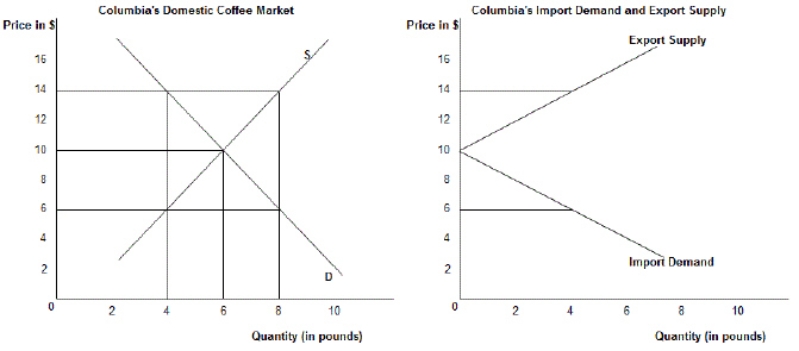 - Refer to Figure 20.1.If the price of Columbian coffee falls to $6 in the international market:
 (Multiple Choice)
4.8/5 (74)
(74) Which of the following looks at the demand side of the market to explain some of the observed international trade patterns?
(Multiple Choice)
4.7/5 (69)
(69) International equilibrium occurs if the quantity of imports demanded by one country is equal to the quantity of exports supplied by the other country.
(True/False)
4.9/5 (71)
(71) For purposes of determining comparative advantage,the cost of producing a good in each of two countries is measured in terms of:
(Multiple Choice)
4.8/5 (61)
(61) The standard interpretation of the Ricardian model is that differences in factor endowments between countries account for differences in labor productivity.
(True/False)
4.9/5 (88)
(88) The following table shows the units of calculators and rice produced by a laborer in a day in Japan and Korea. Table 20.3 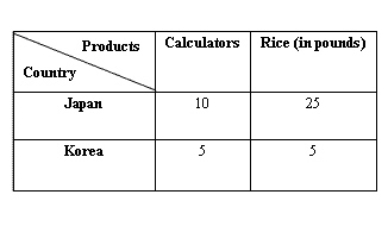 -According to Table 20.3,what is the greatest amount Korea is willing to pay for 1 calculator?
 (Multiple Choice)
4.9/5 (90)
(90) 
Filters
- Essay(0)
- Multiple Choice(0)
- Short Answer(0)
- True False(0)
- Matching(0)