



 Chat with AI
Exam 20: Communities and Ecosystems

Exam 1: Introduction: Biology Today50 Questions
Exam 2: Essential Chemistry for Biology46 Questions
Exam 3: The Molecules of Life49 Questions
Exam 4: A Tour of the Cell52 Questions
Exam 5: The Working Cell52 Questions
Exam 6: Cellular Respiration: Obtaining Energy From Food51 Questions
Exam 7: Photosynthesis: Using Light to Make Food53 Questions
Exam 8: Cellular Reproduction: Cells From Cells51 Questions
Exam 9: Patterns of Inheritance49 Questions
Exam 10: The Structure and Function of Dna53 Questions
Exam 11: How Genes Are Controlled49 Questions
Exam 12: DNA Technology50 Questions
Exam 13: How Populations Evolve50 Questions
Exam 14: How Biological Diversity Evolves46 Questions
Exam 15: The Evolution of Microbial Life58 Questions
Exam 16: The Evolution of Plants and Fungi53 Questions
Exam 17: The Evolution of Animals58 Questions
Exam 18: An Introduction to Ecology and the Biosphere53 Questions
Exam 19: Population Ecology47 Questions
Exam 20: Communities and Ecosystems52 Questions
Exam 21: Unifying Concepts of Animal Structure and Function49 Questions
Exam 22: Nutrition and Digestion57 Questions
Exam 23: Circulation and Respiration61 Questions
Exam 24: The Bodys Defenses57 Questions
Exam 25: Hormones52 Questions
Exam 26: Reproduction and Development53 Questions
Exam 27: Nervous,Sensory,and Locomotor Systems62 Questions
Exam 28: The Life of a Flowering Plant68 Questions
Exam 29: The Working Plant57 Questions
Select questions type


Use the following information to answer the following questions.
Malaria is an infectious disease caused by a unicellular eukaryotic organism belonging to the genus Plasmodium.These eukaryotic organisms are transmitted from one person to another by the female Anopheles mosquito when it feeds on human blood.Within humans,the Plasmodium species destroy red blood cells and,without effective treatment,serious infections can lead to death.Currently,more than 400 million people are afflicted with malaria and between 1 and 3 million people die from it each year.Historically,a chemical compound called quinine has been used in developing effective drugs against malaria.In its natural environment,quinine is produced by certain trees native to South America.This chemical is synthesized in the outer layer of tree trunks and acts as an herbivore deterrent.
-Humans,mosquitoes,and Plasmodium together would be considered a(n)________.
(Multiple Choice)
4.8/5  (81)
(81) Use the following information to answer the following questions.
In East Java,Indonesia,a mud volcano has been erupting since 2006.One controversial hypothesis is that the mud volcano in East Java is erupting because a gas mining company was drilling a deep hole nearby.When a mud volcano erupts,hot water deep below the earth's surface mixes with various minerals,and this mud spews out over the surface of the earth.The hot mud flow destroys organismal habitats,including the homes and livelihoods of people.
-When the mud volcano stops erupting,colonization of the disturbed area would be ________.
(Multiple Choice)
4.9/5 (69)
(69) Two lakes have the same number of species.Most of the fish in Lake 1 are of a single species,with a few individuals each for the remaining species.Lake 2,on the other hand,has about equal numbers of each species.Which lake has higher species diversity?
(Multiple Choice)
4.9/5 (84)
(84) Please refer to the following art to answer the following questions.
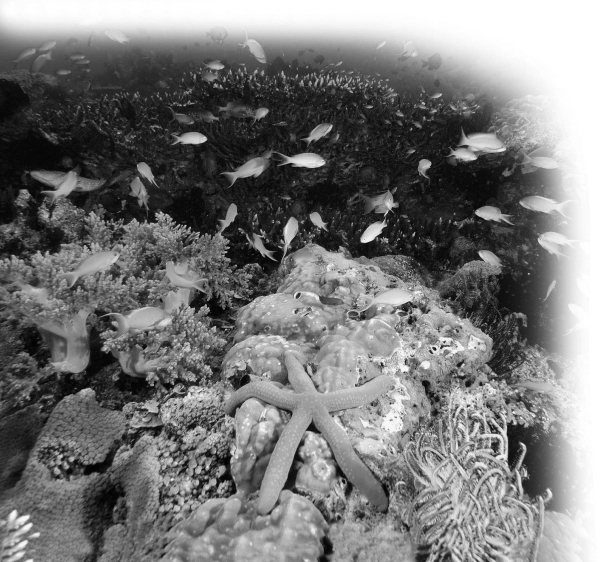 -Refer to the accompanying figure.All of the living components of the coral reef represent a(n)________.
 (Multiple Choice)
4.9/5 (73)
(73) Please refer to the following art to answer the following questions.
-Refer to the following figure.If there were an additional trophic level that consisted of organisms that prey on snakes,about how much energy would be available to organisms at that trophic level? 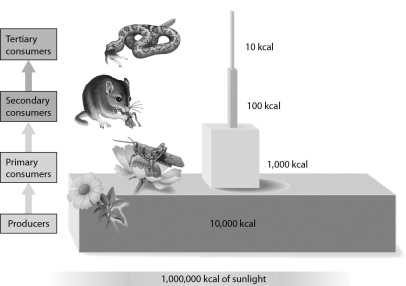
-Refer to the following figure.If there were an additional trophic level that consisted of organisms that prey on snakes,about how much energy would be available to organisms at that trophic level? (Multiple Choice)
4.9/5 (86)
(86) As a result of a severe disturbance,a community will ________.
(Multiple Choice)
4.8/5 (88)
(88) Approximately what percentage of the visible light that reaches Earth's producers is converted to chemical energy?
(Multiple Choice)
4.8/5 (91)
(91) In Yellowstone National Park,wolves were hunted to extinction in the 1920s.A current restoration project has reintroduced wolves to Yellowstone National Park.Predict the response of the Yellowstone ecological community if wolves are a keystone species.
(Multiple Choice)
4.9/5 (94)
(94) Use the following information to answer the following questions.
In East Java,Indonesia,a mud volcano has been erupting since 2006.One controversial hypothesis is that the mud volcano in East Java is erupting because a gas mining company was drilling a deep hole nearby.When a mud volcano erupts,hot water deep below the earth's surface mixes with various minerals,and this mud spews out over the surface of the earth.The hot mud flow destroys organismal habitats,including the homes and livelihoods of people.
-When the mud volcano stops erupting,the disturbed area will be colonized by a variety of species.This process of colonization is called ________.
(Multiple Choice)
4.7/5 (91)
(91) In the food chain grass → antelope → human → lion,the antelope is ________.
(Multiple Choice)
4.8/5 (79)
(79) Sustainable development ________. I)will require making difficult decisions regarding the environment and lifestyle
II)must be achieved if the human species is to survive
III)will require global,multinational cooperation
(Multiple Choice)
4.8/5 (89)
(89) Please refer to the following art to answer the following questions.
-In the ecosystem shown above,a toxin that accumulates in body tissues would have the largest effect on ________.
-In the ecosystem shown above,a toxin that accumulates in body tissues would have the largest effect on ________. (Multiple Choice)
4.9/5 (70)
(70) Populations of two coexisting species are both tertiary consumers in a community.What relationship may exist between these two organisms?
(Multiple Choice)
4.9/5 (88)
(88) 
Filters
- Essay(0)
- Multiple Choice(0)
- Short Answer(0)
- True False(0)
- Matching(0)