



 Chat with AI
Exam 20: Communities and Ecosystems

Exam 1: Introduction: Biology Today50 Questions
Exam 2: Essential Chemistry for Biology46 Questions
Exam 3: The Molecules of Life49 Questions
Exam 4: A Tour of the Cell52 Questions
Exam 5: The Working Cell52 Questions
Exam 6: Cellular Respiration: Obtaining Energy From Food51 Questions
Exam 7: Photosynthesis: Using Light to Make Food53 Questions
Exam 8: Cellular Reproduction: Cells From Cells51 Questions
Exam 9: Patterns of Inheritance49 Questions
Exam 10: The Structure and Function of Dna53 Questions
Exam 11: How Genes Are Controlled49 Questions
Exam 12: DNA Technology50 Questions
Exam 13: How Populations Evolve50 Questions
Exam 14: How Biological Diversity Evolves46 Questions
Exam 15: The Evolution of Microbial Life58 Questions
Exam 16: The Evolution of Plants and Fungi53 Questions
Exam 17: The Evolution of Animals58 Questions
Exam 18: An Introduction to Ecology and the Biosphere53 Questions
Exam 19: Population Ecology47 Questions
Exam 20: Communities and Ecosystems52 Questions
Exam 21: Unifying Concepts of Animal Structure and Function49 Questions
Exam 22: Nutrition and Digestion57 Questions
Exam 23: Circulation and Respiration61 Questions
Exam 24: The Bodys Defenses57 Questions
Exam 25: Hormones52 Questions
Exam 26: Reproduction and Development53 Questions
Exam 27: Nervous,Sensory,and Locomotor Systems62 Questions
Exam 28: The Life of a Flowering Plant68 Questions
Exam 29: The Working Plant57 Questions
Select questions type


Which of these convert organic matter to inorganic matter by breaking down dead organisms?

Free
(Multiple Choice)
5.0/5  (75)
(75) Correct Answer: Verified
C
A regional assemblage of interacting ecosystems is a ________.
Free
(Multiple Choice)
4.7/5 (101)
(101) Correct Answer:Verified
VerifiedB
An example of a mutualism,or +/+ relationship,is ________.
Free
(Multiple Choice)
4.9/5 (74)
(74) Correct Answer:Verified
VerifiedA
Several years ago,I was crossing the border from Canada to the United States and I had a bag of Washington State apples with me.The customs officer at the border would not let me take the apples with me into the United States (and I really hated the idea of getting rid of a bag of perfectly good apples).Why did the customs officer refuse to allow me to cross the border with my apples?
(Multiple Choice)
4.8/5 (75)
(75) Use the following information to answer the following questions.
Malaria is an infectious disease caused by a unicellular eukaryotic organism belonging to the genus Plasmodium.These eukaryotic organisms are transmitted from one person to another by the female Anopheles mosquito when it feeds on human blood.Within humans,the Plasmodium species destroy red blood cells and,without effective treatment,serious infections can lead to death.Currently,more than 400 million people are afflicted with malaria and between 1 and 3 million people die from it each year.Historically,a chemical compound called quinine has been used in developing effective drugs against malaria.In its natural environment,quinine is produced by certain trees native to South America.This chemical is synthesized in the outer layer of tree trunks and acts as an herbivore deterrent.
-Despite being used for many years,quinine-based drugs have not led to the eradication of malaria and currently there are parasites that are resistant to the compound.Which of the following were likely important in the development of this resistance to quinine?
(Multiple Choice)
4.9/5 (78)
(78) Species found in only one place on Earth are called ________ species.
(Multiple Choice)
4.8/5 (84)
(84) Use the following information to answer the following questions.
Malaria is an infectious disease caused by a unicellular eukaryotic organism belonging to the genus Plasmodium.These eukaryotic organisms are transmitted from one person to another by the female Anopheles mosquito when it feeds on human blood.Within humans,the Plasmodium species destroy red blood cells and,without effective treatment,serious infections can lead to death.Currently,more than 400 million people are afflicted with malaria and between 1 and 3 million people die from it each year.Historically,a chemical compound called quinine has been used in developing effective drugs against malaria.In its natural environment,quinine is produced by certain trees native to South America.This chemical is synthesized in the outer layer of tree trunks and acts as an herbivore deterrent.
-Based on the relationship between Plasmodium spp.and humans,Plasmodium would be considered ________.
(Multiple Choice)
4.8/5 (73)
(73) One problem with eradicating invasive species is that sometimes the disturbed area is unable to be colonized by native species.For example,in forests where the invasive plant garlic mustard has been removed,native plants and animals do not recolonize because they are extinct in that patch of forest.How should restoration ecologists increase species diversity and recover ecosystem function?
(Multiple Choice)
4.7/5 (74)
(74) Plants can most readily utilize the ________ form of nitrogen.
(Multiple Choice)
4.9/5 (73)
(73) Which type of ecosystem has low primary production but nonetheless contributes a large proportion of Earth's total net primary production?
(Multiple Choice)
4.7/5 (86)
(86) What is one way in which energy flow differs from chemical cycling?
(Multiple Choice)
4.8/5 (78)
(78) On average,what percentage of the energy in one trophic level becomes incorporated into the next higher trophic level?
(Multiple Choice)
4.8/5 (89)
(89) Which of these organisms convert atmospheric nitrogen gas to a form that can be utilized by plants?
(Multiple Choice)
4.7/5 (68)
(68) The rate at which an ecosystem's producers convert solar energy to chemical energy stored in biomass is called ________.
(Multiple Choice)
4.8/5 (80)
(80) Small areas that have a large number of endangered and threatened species are referred to as ________.
(Multiple Choice)
4.7/5 (82)
(82) Please refer to the following art to answer the following questions.
 -The figure below shows the growth curves of two populations of Paramecium,P.aurelia and P.caudatum.From the data,we can conclude that ________.
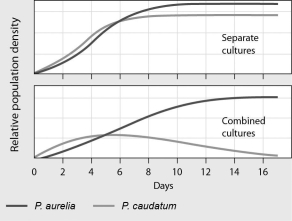
-The figure below shows the growth curves of two populations of Paramecium,P.aurelia and P.caudatum.From the data,we can conclude that ________. (Multiple Choice)
4.8/5 (88)
(88) Besides the atmosphere,abiotic reservoirs of carbon dioxide include ________.
(Multiple Choice)
5.0/5 (77)
(77) 
Filters
- Essay(0)
- Multiple Choice(0)
- Short Answer(0)
- True False(0)
- Matching(0)