



 Chat with AI
Exam 19: Population Ecology

Exam 1: Introduction: Biology Today50 Questions
Exam 2: Essential Chemistry for Biology46 Questions
Exam 3: The Molecules of Life49 Questions
Exam 4: A Tour of the Cell52 Questions
Exam 5: The Working Cell52 Questions
Exam 6: Cellular Respiration: Obtaining Energy From Food51 Questions
Exam 7: Photosynthesis: Using Light to Make Food53 Questions
Exam 8: Cellular Reproduction: Cells From Cells51 Questions
Exam 9: Patterns of Inheritance49 Questions
Exam 10: The Structure and Function of Dna53 Questions
Exam 11: How Genes Are Controlled49 Questions
Exam 12: DNA Technology50 Questions
Exam 13: How Populations Evolve50 Questions
Exam 14: How Biological Diversity Evolves46 Questions
Exam 15: The Evolution of Microbial Life58 Questions
Exam 16: The Evolution of Plants and Fungi53 Questions
Exam 17: The Evolution of Animals58 Questions
Exam 18: An Introduction to Ecology and the Biosphere53 Questions
Exam 19: Population Ecology47 Questions
Exam 20: Communities and Ecosystems52 Questions
Exam 21: Unifying Concepts of Animal Structure and Function49 Questions
Exam 22: Nutrition and Digestion57 Questions
Exam 23: Circulation and Respiration61 Questions
Exam 24: The Bodys Defenses57 Questions
Exam 25: Hormones52 Questions
Exam 26: Reproduction and Development53 Questions
Exam 27: Nervous,Sensory,and Locomotor Systems62 Questions
Exam 28: The Life of a Flowering Plant68 Questions
Exam 29: The Working Plant57 Questions
Select questions type


Kudzu,an Asian vine introduced to the United States in the 1930s as a means to control erosion,is referred to as "the plant that ate the South" because it grows so fast and overtakes most plant species in its path.A recent and unusual way that some people are using to control kudzu growth is to allow goats to graze their land and eat the kudzu,roots and all.This is considered by some to be the most environment-friendly way to eliminate this invasive vine.How can we best describe the goats in this situation?
(Multiple Choice)
4.8/5  (74)
(74) If a population's growth rate decreases as the population size approaches carrying capacity,the population's growth follows a(n)________ model.
(Multiple Choice)
4.9/5 (80)
(80) Non-native species can have important effects on biological communities by ________.
(Multiple Choice)
4.7/5 (70)
(70) Chinese privet is a plant that is native to China.Over 150 years ago,Chinese privet was introduced to the United States as a fast-growing shrub that serves as an excellent privacy hedge.With no natural predators,Chinese privet quickly established itself and spread in natural areas throughout the southeast and eastern seaboard of the United States.Its dominance in these areas has jeopardized the survival of native plant species.Chinese privet provides evidence that ________.
(Multiple Choice)
4.9/5 (79)
(79) The Endangered Species Act aims to help protect species that ________.
(Multiple Choice)
4.8/5 (78)
(78) A study of the human ecological footprint conducted by the World Wildlife Fund in 2008 shows that ________.
(Multiple Choice)
4.8/5 (90)
(90) Please read the following scenario to answer the following questions.
Michigan's Isle Royale is an island located in Lake Superior that is 45 miles long and 9 miles wide.Ecologists estimate that the moose population on the island has been there since around 1900.The wolf population on the island,on the other hand,has been there only since the winter of 1949.Weather conditions had to be calm and cold enough for the lake to freeze and the first wolves to make the passage over to the island.When the wolves arrived,they were greeted with a large moose population that had no predators.The moose population was at a dangerously high level,but was kept in check by the arrival of the wolves.This "harmonious" pattern continued for at least 20 years.
In 1982,the wolf population suddenly crashed.The problem was a new canine virus.This virus surfaced around the world in 1978 and spread rapidly in about 6 months.Infected animals can survive,but they have to be treated immediately.Ecologists hypothesized that the virus arrived on the island carried on the shoe of a human traveler.The wolf population decreased from 50 to 14 individuals in a year.While the wolf population dropped,the moose population increased.However,the winter of 1996 was extremely harsh and the moose population experienced a major crash.More than 500 animals died during the winter months,reducing the population to less than 800 animals.
-During a 1-year study,a graduate student attempted to count the wolves and moose on the island.He estimated that there were 950 moose and 120 wolves.How many organisms,populations,and species were included in this study?
(Multiple Choice)
4.9/5 (75)
(75) You arrive back in the United States after having visited a foreign country located on another continent.The customs agent stops the person in front of you and confiscates the fruit basket this person is bringing home.Being the knowledgeable person you are,you calmly explain to your enraged fellow traveler that the reason for the detainment is that the fruit basket may be ________.
(Multiple Choice)
4.7/5 (75)
(75) Type I survivorship curves are typical of species that exhibit ________.
(Multiple Choice)
4.9/5 (80)
(80) The red-cockaded woodpecker,an endangered species,is dependent upon ________ for maintenance of its source habitat.
(Multiple Choice)
4.8/5 (77)
(77) In an ideal,unlimited environment,a population's growth follows a(n)________ model.
(Multiple Choice)
5.0/5 (83)
(83) This graph represents three different populations.Use it to answer the following questions.
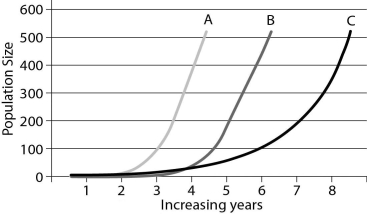 -If all populations occupy different areas that are approximately the same size,which population will have the lowest density after 3 years?
 (Multiple Choice)
4.9/5 (82)
(82) In an ideal,unlimited environment,what shape does a population's growth curve most closely resemble?
(Multiple Choice)
4.9/5 (84)
(84) During the Pleistocene era,many large mammal species went extinct.Their permanent disappearance occurred in a short period of time when humans were expanding across North America.In this situation,how do many scientists view humans?
(Multiple Choice)
4.9/5 (80)
(80) According to the logistic growth model,what happens to a population when the size of the population reaches carrying capacity?
(Multiple Choice)
4.7/5 (87)
(87) 
Filters
- Essay(0)
- Multiple Choice(0)
- Short Answer(0)
- True False(0)
- Matching(0)