



 Chat with AI
Exam 17: The Evolution of Animals

Exam 1: Introduction: Biology Today50 Questions
Exam 2: Essential Chemistry for Biology46 Questions
Exam 3: The Molecules of Life49 Questions
Exam 4: A Tour of the Cell52 Questions
Exam 5: The Working Cell52 Questions
Exam 6: Cellular Respiration: Obtaining Energy From Food51 Questions
Exam 7: Photosynthesis: Using Light to Make Food53 Questions
Exam 8: Cellular Reproduction: Cells From Cells51 Questions
Exam 9: Patterns of Inheritance49 Questions
Exam 10: The Structure and Function of Dna53 Questions
Exam 11: How Genes Are Controlled49 Questions
Exam 12: DNA Technology50 Questions
Exam 13: How Populations Evolve50 Questions
Exam 14: How Biological Diversity Evolves46 Questions
Exam 15: The Evolution of Microbial Life58 Questions
Exam 16: The Evolution of Plants and Fungi53 Questions
Exam 17: The Evolution of Animals58 Questions
Exam 18: An Introduction to Ecology and the Biosphere53 Questions
Exam 19: Population Ecology47 Questions
Exam 20: Communities and Ecosystems52 Questions
Exam 21: Unifying Concepts of Animal Structure and Function49 Questions
Exam 22: Nutrition and Digestion57 Questions
Exam 23: Circulation and Respiration61 Questions
Exam 24: The Bodys Defenses57 Questions
Exam 25: Hormones52 Questions
Exam 26: Reproduction and Development53 Questions
Exam 27: Nervous,Sensory,and Locomotor Systems62 Questions
Exam 28: The Life of a Flowering Plant68 Questions
Exam 29: The Working Plant57 Questions
Select questions type


The figure below shows a simple worm.Bilateral symmetry and a highly branched gastrovascular cavity all suggest that the worm is a(n)________. 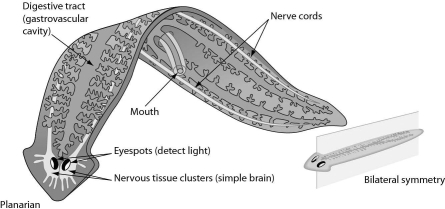
(Multiple Choice)
4.7/5  (74)
(74) The process of biological evolution often allows humans to survive consistent environmental stresses that occur across multiple generations.As humans colonized Earth's diverse environments,they encountered hot,dry areas and decided to settle.What trait likely offered an advantage in this environment?
(Multiple Choice)
4.9/5 (86)
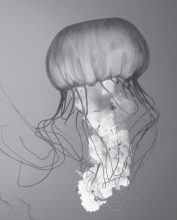
(86) ________ are characterized by stinging cells used for defense and for capturing prey.
(Multiple Choice)
4.9/5 (77)
(77) A(n)________ is an example of a mollusc that does not have a shell.
(Multiple Choice)
4.7/5 (61)
(61) The mobile stage of the cnidarian life cycle is the ________ stage.
(Multiple Choice)
4.8/5 (96)
(96) While on an archaeology expedition,you unearth a skeleton with the following characteristics: four long,slender finger bones and a smaller opposable thumb bone,long arm bones,fingernails,and eye sockets close together on a skull.What type of organism do you suspect you may have found?
(Multiple Choice)
4.8/5 (88)
(88) 
Among vertebrates,the unique feature of lampreys and hagfish is the ________.
(Multiple Choice)
4.8/5 (84)
(84) Which of the following is one way in which scientists can test hypotheses about events that occurred in the distant past?
(Multiple Choice)
4.9/5 (87)
(87) A(n)________ is an example of a chordate that is not a vertebrate.
(Multiple Choice)
4.9/5 (88)
(88) Unique features of vertebrates include the presence of a(n)________.
(Multiple Choice)
4.8/5 (75)
(75) A characteristic that is shared by snakes and birds is ________.
(Multiple Choice)
4.8/5 (81)
(81) 
Filters
- Essay(0)
- Multiple Choice(0)
- Short Answer(0)
- True False(0)
- Matching(0)