



 Chat with AI
Exam 19: Comparative Advantage, International Trade, and Exchange Rates

Exam 1: Economics: Foundations and Models459 Questions
Exam 2: Trade-Offs, Comparative Advantage, and the Market System495 Questions
Exam 3: Where Prices Come From: The Interaction of Demand and Supply476 Questions
Exam 4: Market Efficiency and Market Failure464 Questions
Exam 5: The Economics of Health Care337 Questions
Exam 6: Firms, The Stock Market, and Corporate Governance456 Questions
Exam 7: Consumer Choice and Elasticity384 Questions
Exam 8: Technology,Production,and Costs274 Questions
Exam 9: Firms in Perfectly Competitive Markets297 Questions
Exam 10: Monopoly and Antitrust Policy279 Questions
Exam 11: Monopolistic Competition and Oligopoly410 Questions
Exam 12: GDP: Measuring Total Production and Income261 Questions
Exam 13: Unemployment and Inflation290 Questions
Exam 14: Economic Growth, The Financial System, and Business Cycles251 Questions
Exam 15: Aggregate Demand and Aggregate Supply Analysis286 Questions
Exam 16: Money,Banks,and the Federal Reserve System278 Questions
Exam 17: Monetary Policy280 Questions
Exam 18: Fiscal Policy292 Questions
Exam 19: Comparative Advantage, International Trade, and Exchange Rates443 Questions
Select questions type


Figure 19-3
 Since 1953 the United States has imposed a quota to limit the imports of peanuts. Figure 19-3 illustrates the impact of the quota.
-Refer to Figure 19-3.With a quota in place,what is the quantity supplied by domestic producers?
Since 1953 the United States has imposed a quota to limit the imports of peanuts. Figure 19-3 illustrates the impact of the quota.
-Refer to Figure 19-3.With a quota in place,what is the quantity supplied by domestic producers? (Multiple Choice)
4.7/5  (81)
(81) The United States has developed a comparative advantage in film production due to the film industry being long-established in southern California,and lower costs result from the size of the industry in the area.This source of comparative advantage is referred to as
(Multiple Choice)
4.8/5 (91)
(91) Figure 19-11
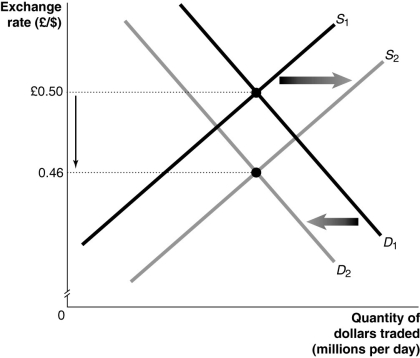 -Refer to Figure 19-11.Which of the events below cause the shifts in the supply and demand curves in the market for dollars against the British pound shown in the graph above?
 (Multiple Choice)
4.7/5 (93)
(93) Table 19-6
Saddles Spurs (pairs) Mateo 75 225 Celeste 100 225 Mateo and Celeste produce custom saddles and spurs. Table 19-6 lists the number of saddles and pairs of spurs Mateo and Celeste can each produce in one month.
-Refer to Table 19-6.Select the statement that accurately interprets the data in the table.
(Multiple Choice)
4.9/5 (81)
(81) Figure 19-1
 Figure 19-1 shows the U.S. demand and supply for leather footwear.
-Refer to Figure 19-1.Suppose the government allows imports of leather footwear into the United States.The market price falls to $18.What is the value of consumer surplus?
Figure 19-1 shows the U.S. demand and supply for leather footwear.
-Refer to Figure 19-1.Suppose the government allows imports of leather footwear into the United States.The market price falls to $18.What is the value of consumer surplus? (Multiple Choice)
5.0/5 (87)
(87) If a country has an absolute advantage in producing a product,it must also have a comparative advantage in producing that product.
(True/False)
4.8/5 (77)
(77) Table 19-11
Output per hour Production and Production
of work Consumption without Trade with Trade
Clocks Hats Clocks Hats Clocks Hats Denmark 6 3 900 150 1,200 0 Belize 1 2 150 100 0 400 Denmark and Belize can produce both clocks and hats. Each country has a total of 200 available labor hours for the production of clocks and hats. Table 19-11 shows the output per hour of work, the production and consumption quantities without trade, and the production numbers with trade.
-Refer to Table 19-11.What is the opportunity cost to produce 1 clock in Denmark?
(Multiple Choice)
4.9/5 (78)
(78) When the market value of the dollar falls relative to other currencies around the world,we say that
(Multiple Choice)
4.8/5 (83)
(83) Since 1999,________ U.S.manufacturing jobs may have been lost to Chinese imports,and trade with China has ________ throughout the United States
(Multiple Choice)
4.8/5 (75)
(75) As percentage of imports,the largest product category of U.S.imports from China is
(Multiple Choice)
4.7/5 (77)
(77) Table 19-12
Output per hour Production and Production
of work Consumption without Trade with Trade
Swords Belts Swords Belts Swords Belts Estonia 5 3 100 40 200 0 Morocco 2 2 60 60 0 120 Estonia and Morocco can produce both swords and belts. Each country has a total of 40 available labor hours for the production of swords and belts. Table 19-12 shows the output per hour of work, the production and consumption quantities without trade, and the production numbers with trade.
-Refer to Table 19-12.What is the opportunity cost to produce 1 sword in Morocco?
(Multiple Choice)
4.9/5 (85)
(85) Figure 19-2
 Suppose the U.S. government imposes a $0.40 per pound tariff on rice imports. Figure 19-2 shows the impact of this tariff.
-Refer to Figure 19-2.Without the tariff in place,the United States produces
Suppose the U.S. government imposes a $0.40 per pound tariff on rice imports. Figure 19-2 shows the impact of this tariff.
-Refer to Figure 19-2.Without the tariff in place,the United States produces (Multiple Choice)
4.8/5 (79)
(79) Table 19-6
Saddles Spurs (pairs) Mateo 75 225 Celeste 100 225 Mateo and Celeste produce custom saddles and spurs. Table 19-6 lists the number of saddles and pairs of spurs Mateo and Celeste can each produce in one month.
-Refer to Table 19-6.Select the statement that accurately interprets the data in the table.
(Multiple Choice)
4.9/5 (76)
(76) In the 1980s,Japan agreed to limit the quantity of automobiles it would export to the United States.Why did the Japanese government agree to this trade restriction?
(Multiple Choice)
4.8/5 (86)
(86) Figure 19-5
 Suppose the U.S. government imposes a $0.75 per pound tariff on coffee imports. Figure 19-5 shows the impact of this tariff.
-Refer to Figure 19-5.Without the tariff in place,the United States consumes
Suppose the U.S. government imposes a $0.75 per pound tariff on coffee imports. Figure 19-5 shows the impact of this tariff.
-Refer to Figure 19-5.Without the tariff in place,the United States consumes (Multiple Choice)
4.7/5 (70)
(70) The process of countries becoming more open to foreign trade and investment is known as
(Multiple Choice)
4.9/5 (89)
(89) Figure 19-2
Suppose the U.S. government imposes a $0.40 per pound tariff on rice imports. Figure 19-2 shows the impact of this tariff.
-Refer to Figure 19-2.The tariff revenue collected by the government equals the area
Suppose the U.S. government imposes a $0.40 per pound tariff on rice imports. Figure 19-2 shows the impact of this tariff.
-Refer to Figure 19-2.The tariff revenue collected by the government equals the area (Multiple Choice)
4.8/5 (82)
(82) Figure 19-4
 Figure 19-4 shows the U.S. demand and supply for leather footwear.
-Refer to Figure 19-4.Under autarky,the producer surplus is area
Figure 19-4 shows the U.S. demand and supply for leather footwear.
-Refer to Figure 19-4.Under autarky,the producer surplus is area (Multiple Choice)
4.7/5 (81)
(81) 
Filters
- Essay(0)
- Multiple Choice(0)
- Short Answer(0)
- True False(0)
- Matching(0)