



 Chat with AI
Exam 19: Comparative Advantage, International Trade, and Exchange Rates

Exam 1: Economics: Foundations and Models459 Questions
Exam 2: Trade-Offs, Comparative Advantage, and the Market System495 Questions
Exam 3: Where Prices Come From: The Interaction of Demand and Supply476 Questions
Exam 4: Market Efficiency and Market Failure464 Questions
Exam 5: The Economics of Health Care337 Questions
Exam 6: Firms, The Stock Market, and Corporate Governance456 Questions
Exam 7: Consumer Choice and Elasticity384 Questions
Exam 8: Technology,Production,and Costs274 Questions
Exam 9: Firms in Perfectly Competitive Markets297 Questions
Exam 10: Monopoly and Antitrust Policy279 Questions
Exam 11: Monopolistic Competition and Oligopoly410 Questions
Exam 12: GDP: Measuring Total Production and Income261 Questions
Exam 13: Unemployment and Inflation290 Questions
Exam 14: Economic Growth, The Financial System, and Business Cycles251 Questions
Exam 15: Aggregate Demand and Aggregate Supply Analysis286 Questions
Exam 16: Money,Banks,and the Federal Reserve System278 Questions
Exam 17: Monetary Policy280 Questions
Exam 18: Fiscal Policy292 Questions
Exam 19: Comparative Advantage, International Trade, and Exchange Rates443 Questions
Select questions type


How have U.S.imports and exports,as a fraction of GDP,changed from 1970 to the present?
(Essay)
4.8/5  (76)
(76) Figure 19-12
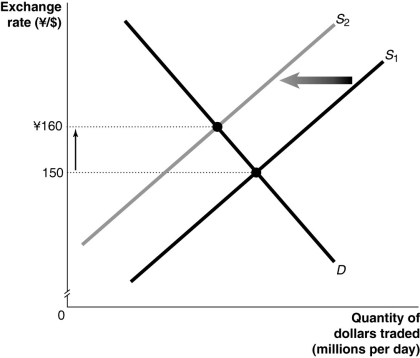 -Refer to Figure 19-12.Consider the market for U.S.dollars against the Japanese yen shown above.An event which could have caused the changes shown in the graph would be
 (Multiple Choice)
4.9/5 (71)
(71) Holding all else constant,an economic expansion in Mexico should decrease the demand for U.S.dollars.
(True/False)
4.7/5 (77)
(77) The concept of ________ explains how trade between two countries can make each better off.
(Multiple Choice)
4.9/5 (82)
(82) The recession of 2007-2009 decreased the demand for imports in Japan,which caused the ________ curve for the yen to shift to the ________,increasing the exchange rate and the value of the yen.
(Multiple Choice)
4.8/5 (73)
(73) An economic principle that explains why people pursue different occupations is
(Multiple Choice)
4.8/5 (78)
(78) Assume that China has a comparative advantage in producing corn and exports corn to Japan.We can conclude that
(Multiple Choice)
4.9/5 (76)
(76) One of the main sources of comparative advantage is natural resources.
(True/False)
4.8/5 (83)
(83) Figure 19-4
 Figure 19-4 shows the U.S. demand and supply for leather footwear.
-Refer to Figure 19-4.Suppose the government allows imports of leather footwear into the United States.What will be the quantity demanded?
Figure 19-4 shows the U.S. demand and supply for leather footwear.
-Refer to Figure 19-4.Suppose the government allows imports of leather footwear into the United States.What will be the quantity demanded? (Multiple Choice)
5.0/5 (89)
(89) In the 1930s,the United States charged an average tariff rate ________.Today,the rate is ________.
(Multiple Choice)
4.9/5 (87)
(87) Table 19-11
Output per hour Production and Production
of work Consumption without Trade with Trade
Clocks Hats Clocks Hats Clocks Hats Denmark 6 3 900 150 1,200 0 Belize 1 2 150 100 0 400 Denmark and Belize can produce both clocks and hats. Each country has a total of 200 available labor hours for the production of clocks and hats. Table 19-11 shows the output per hour of work, the production and consumption quantities without trade, and the production numbers with trade.
-Refer to Table 19-11.Which country has a comparative advantage in producing clocks?
(Multiple Choice)
4.8/5 (84)
(84) Figure 19-2
 Suppose the U.S. government imposes a $0.40 per pound tariff on rice imports. Figure 19-2 shows the impact of this tariff.
-Refer to Figure 19-2.As a result of the tariff,domestic producers increase their quantity supplied by
Suppose the U.S. government imposes a $0.40 per pound tariff on rice imports. Figure 19-2 shows the impact of this tariff.
-Refer to Figure 19-2.As a result of the tariff,domestic producers increase their quantity supplied by (Multiple Choice)
4.9/5 (94)
(94) One reason a country does not specialize completely in production is that not all goods and services are traded internationally.
(True/False)
4.9/5 (62)
(62) How will contractionary monetary policy in Japan affect the demand and supply of the yen in the foreign exchange market?
(Multiple Choice)
4.9/5 (92)
(92) If the exchange rate between the Mexican peso and the U.S.dollar expressed in terms of pesos per dollar is 13.5 pesos = 1 dollar,what is the exchange rate when expressed in terms of dollars per peso?
(Essay)
4.8/5 (70)
(70) Table 19-12
Output per hour Production and Production
of work Consumption without Trade with Trade
Swords Belts Swords Belts Swords Belts Estonia 5 3 100 40 200 0 Morocco 2 2 60 60 0 120 Estonia and Morocco can produce both swords and belts. Each country has a total of 40 available labor hours for the production of swords and belts. Table 19-12 shows the output per hour of work, the production and consumption quantities without trade, and the production numbers with trade.
-Refer to Table 19-12.Which country has an absolute advantage in producing swords?
(Multiple Choice)
4.9/5 (82)
(82) a.Distinguish between a tariff and a quota.
b.In what ways are tariffs and quotas similar?
c.In what ways are tariffs and quotas different?
d.Why might a foreign producer prefer a quota rather than a tariff?
(Essay)
4.8/5 (79)
(79) Figure 19-1
 Figure 19-1 shows the U.S. demand and supply for leather footwear.
-Refer to Figure 19-1.Under autarky,the producer surplus is
Figure 19-1 shows the U.S. demand and supply for leather footwear.
-Refer to Figure 19-1.Under autarky,the producer surplus is (Multiple Choice)
4.8/5 (85)
(85) Table 19-7
Output Per Hour of Work
Handbags Jackets Cambodia 15 3 Thailand 24 6 Table 19-7 shows the output per hour of work for handbags and jackets in Cambodia and in Thailand.
-Refer to Table 19-7.
a.Which country has an absolute advantage in the production of handbags and jackets?
b.Which country has a comparative advantage in the production of handbags?
c.Which country has a comparative advantage in the production of jackets?
(Essay)
4.8/5 (83)
(83) 
Filters
- Essay(0)
- Multiple Choice(0)
- Short Answer(0)
- True False(0)
- Matching(0)