



 Chat with AI
Exam 10: Monopoly and Antitrust Policy

Exam 1: Economics: Foundations and Models459 Questions
Exam 2: Trade-Offs, Comparative Advantage, and the Market System495 Questions
Exam 3: Where Prices Come From: The Interaction of Demand and Supply476 Questions
Exam 4: Market Efficiency and Market Failure464 Questions
Exam 5: The Economics of Health Care337 Questions
Exam 6: Firms, The Stock Market, and Corporate Governance456 Questions
Exam 7: Consumer Choice and Elasticity384 Questions
Exam 8: Technology,Production,and Costs274 Questions
Exam 9: Firms in Perfectly Competitive Markets297 Questions
Exam 10: Monopoly and Antitrust Policy279 Questions
Exam 11: Monopolistic Competition and Oligopoly410 Questions
Exam 12: GDP: Measuring Total Production and Income261 Questions
Exam 13: Unemployment and Inflation290 Questions
Exam 14: Economic Growth, The Financial System, and Business Cycles251 Questions
Exam 15: Aggregate Demand and Aggregate Supply Analysis286 Questions
Exam 16: Money,Banks,and the Federal Reserve System278 Questions
Exam 17: Monetary Policy280 Questions
Exam 18: Fiscal Policy292 Questions
Exam 19: Comparative Advantage, International Trade, and Exchange Rates443 Questions
Select questions type


Firms that face downward-sloping demand curves for their output in the product market are called
(Multiple Choice)
4.8/5  (71)
(71) Figure 10-14
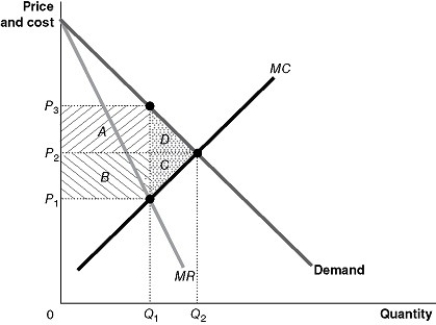 -Refer to Figure 10-14.From the monopoly graph above,identify the following:
a.The profit maximizing price
b.The profit maximizing quantity
c.The area representing deadweight loss
d.The area representing the transfer of consumer surplus to the monopoly
-Refer to Figure 10-14.From the monopoly graph above,identify the following:
a.The profit maximizing price
b.The profit maximizing quantity
c.The area representing deadweight loss
d.The area representing the transfer of consumer surplus to the monopoly (Essay)
4.8/5 (83)
(83) Relative to a perfectly competitive market,a monopoly results in
(Multiple Choice)
4.8/5 (79)
(79) What is a monopoly? Can a firm be a monopoly if close substitutes for its product exists?
(Essay)
4.8/5 (79)
(79) A vertical merger is one that takes place between two companies producing different goods or services for one specific finished product.
(True/False)
4.8/5 (80)
(80) Figure 10-4
 Figure 10-4 shows the demand and cost curves for a monopolist.
-Refer to Figure 10-4.What is likely to happen to this monopoly in the long run if costs and demand stay the same?
Figure 10-4 shows the demand and cost curves for a monopolist.
-Refer to Figure 10-4.What is likely to happen to this monopoly in the long run if costs and demand stay the same? (Multiple Choice)
4.7/5 (83)
(83) In discussions of barriers to entry,what is meant by the term "virtuous cycle"?
(Multiple Choice)
4.9/5 (79)
(79) If a monopolist's price is $50 at the output where marginal revenue equals marginal cost and average total cost is $43,then the incremental profit from the last unit sold is $7.
(True/False)
4.8/5 (95)
(95) Consider an industry that is made up of nine firms each with a market share (percent of sales)as follows:
A.Firm A: 30%
B.Firm B: 20%
C.Firms C,D,and E: 10% each
D.Firms F,G,H,and J: 5% each
What is the value of the four-firm concentration ratio and how is the industry categorized?
(Multiple Choice)
4.9/5 (66)
(66) A firm that has the ability to control to some degree the price of the product it sells
(Multiple Choice)
4.8/5 (80)
(80) Figure 10-10
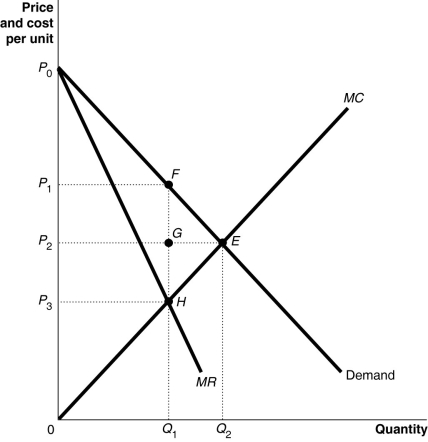 -Refer to Figure 10-10.The deadweight loss due to a monopoly is represented by the area
 (Multiple Choice)
4.9/5 (82)
(82) Figure 10-11
 In 2011, Verizon was granted permission to enter the market for cable TV in Upstate New York, ending the virtual monopoly that Time Warner Cable had in most local communities in the region. Figure 10-11 shows the cable television market in Upstate New York.
-Refer to Figure 10-11.What is the size of the deadweight loss prior to Verizon entering the market and what happens to this deadweight loss after Verizon does enter the market?
In 2011, Verizon was granted permission to enter the market for cable TV in Upstate New York, ending the virtual monopoly that Time Warner Cable had in most local communities in the region. Figure 10-11 shows the cable television market in Upstate New York.
-Refer to Figure 10-11.What is the size of the deadweight loss prior to Verizon entering the market and what happens to this deadweight loss after Verizon does enter the market? (Multiple Choice)
4.9/5 (82)
(82) Figure 10-19
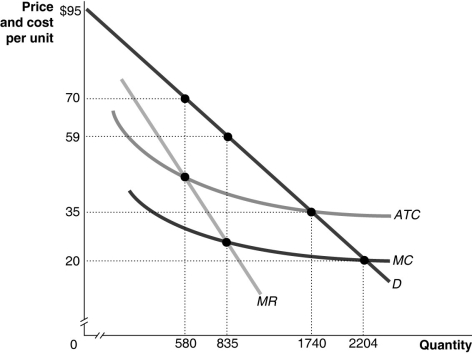 -Refer to Figure 10-19 to answer the following questions.
a.What quantity will this monopoly produce and what price will it charge?
b.Suppose the monopoly is regulated.If the regulatory agency wants to achieve economic efficiency,what price should it require the monopoly to charge?
c.To achieve economic efficiency,what quantity will the regulated monopoly produce?
d.Will the regulated monopoly make a profit if it charges the price that will achieve economic efficiency?
e.Suppose the government decides to regulate the monopoly by imposing a price ceiling of $35.What quantity will the monopoly produce and what price will the monopoly charge?
f.With the price ceiling of $35,what profit will the monopoly earn?
-Refer to Figure 10-19 to answer the following questions.
a.What quantity will this monopoly produce and what price will it charge?
b.Suppose the monopoly is regulated.If the regulatory agency wants to achieve economic efficiency,what price should it require the monopoly to charge?
c.To achieve economic efficiency,what quantity will the regulated monopoly produce?
d.Will the regulated monopoly make a profit if it charges the price that will achieve economic efficiency?
e.Suppose the government decides to regulate the monopoly by imposing a price ceiling of $35.What quantity will the monopoly produce and what price will the monopoly charge?
f.With the price ceiling of $35,what profit will the monopoly earn? (Essay)
4.8/5 (95)
(95) Figure 10-11
In 2011, Verizon was granted permission to enter the market for cable TV in Upstate New York, ending the virtual monopoly that Time Warner Cable had in most local communities in the region. Figure 10-11 shows the cable television market in Upstate New York.
-Refer to Figure 10-11.Suppose the local government imposes a $2.50 per month tax on cable companies.What happens to the price charged by the cable company following the imposition of this tax?
In 2011, Verizon was granted permission to enter the market for cable TV in Upstate New York, ending the virtual monopoly that Time Warner Cable had in most local communities in the region. Figure 10-11 shows the cable television market in Upstate New York.
-Refer to Figure 10-11.Suppose the local government imposes a $2.50 per month tax on cable companies.What happens to the price charged by the cable company following the imposition of this tax? (Multiple Choice)
4.9/5 (77)
(77) 
Filters
- Essay(0)
- Multiple Choice(0)
- Short Answer(0)
- True False(0)
- Matching(0)