



 Chat with AI
Exam 10: Monopoly and Antitrust Policy

Exam 1: Economics: Foundations and Models459 Questions
Exam 2: Trade-Offs, Comparative Advantage, and the Market System495 Questions
Exam 3: Where Prices Come From: The Interaction of Demand and Supply476 Questions
Exam 4: Market Efficiency and Market Failure464 Questions
Exam 5: The Economics of Health Care337 Questions
Exam 6: Firms, The Stock Market, and Corporate Governance456 Questions
Exam 7: Consumer Choice and Elasticity384 Questions
Exam 8: Technology,Production,and Costs274 Questions
Exam 9: Firms in Perfectly Competitive Markets297 Questions
Exam 10: Monopoly and Antitrust Policy279 Questions
Exam 11: Monopolistic Competition and Oligopoly410 Questions
Exam 12: GDP: Measuring Total Production and Income261 Questions
Exam 13: Unemployment and Inflation290 Questions
Exam 14: Economic Growth, The Financial System, and Business Cycles251 Questions
Exam 15: Aggregate Demand and Aggregate Supply Analysis286 Questions
Exam 16: Money,Banks,and the Federal Reserve System278 Questions
Exam 17: Monetary Policy280 Questions
Exam 18: Fiscal Policy292 Questions
Exam 19: Comparative Advantage, International Trade, and Exchange Rates443 Questions
Select questions type


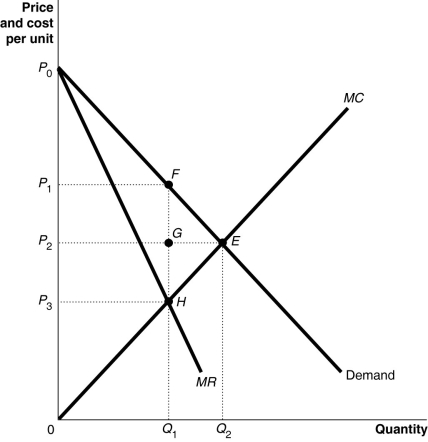
Figure 10-16
 Figure 10-16 shows the market demand and cost curves facing a natural monopoly.
-Refer to Figure 10-16.In the absence of any government regulation,the profit-maximizing owners of this firm will produce ________ units and charge a price of ________.
Figure 10-16 shows the market demand and cost curves facing a natural monopoly.
-Refer to Figure 10-16.In the absence of any government regulation,the profit-maximizing owners of this firm will produce ________ units and charge a price of ________. (Multiple Choice)
4.8/5  (86)
(86) Equilibrium in a perfectly competitive market results in the greatest amount of economic surplus,or total benefit to society,from the production of a good.Why,then,did Joseph Schumpeter argue that an economy may benefit more from firms that have market power than from firms that are perfectly competitive?
(Essay)
4.9/5 (70)
(70) Figure 10-6
 Figure 10-6 shows the cost and demand curves for a monopolist.
-Refer to Figure 10-6.The monopolist's total revenue is
Figure 10-6 shows the cost and demand curves for a monopolist.
-Refer to Figure 10-6.The monopolist's total revenue is (Multiple Choice)
4.9/5 (74)
(74) Consider two industries,industry W and industry X.In industry W there are five companies,each with a market share of 20% of total sales.In industry X,there are six companies.One company has a 50% market share and each of the other five firms has a market share of 10%.
a.Calculate the four-firm concentration ratio for each industry.
b.Calculate the Herfindahl-Hirschman Index (HHI)for each industry.
c.What do the values of the two concentration measures imply about the degree of market power in the two industries?
(Essay)
4.9/5 (86)
(86) BHP Billiton is a Canadian company that owns mines in Canada that
(Multiple Choice)
4.9/5 (89)
(89) Wendell can sell five motor homes per week at a price of $22,000.If he lowers the price of motor homes to $20,000 per week he will sell six motor homes.What is the marginal revenue of the sixth motor home?
(Multiple Choice)
4.8/5 (79)
(79) If a monopolist's price is $50 and average total cost is $43,then the average profit is $7.
(True/False)
4.9/5 (80)
(80) A natural monopoly is most likely to occur in which of the following industries?
(Multiple Choice)
4.8/5 (75)
(75) Economists played a key role in the development of merger guidelines by the Department of Justice and the Federal Trade Commission in 1982.These guidelines have three main parts.What are these parts?
(Multiple Choice)
4.8/5 (75)
(75) Figure 10-17
 Your college decides to offer a psychology course as a MOOC that can be taken by students anywhere in the world, whether they are actually enrolled in your college or not. The demand and cost situation for the MOOC is shown in the figure.
-Refer to Figure 10-17.The faculty member who designed the course argues: "I think the course should be priced so that the maximum number of students enroll." How much profit (or loss)will the college make on the course if it charges this price?
Your college decides to offer a psychology course as a MOOC that can be taken by students anywhere in the world, whether they are actually enrolled in your college or not. The demand and cost situation for the MOOC is shown in the figure.
-Refer to Figure 10-17.The faculty member who designed the course argues: "I think the course should be priced so that the maximum number of students enroll." How much profit (or loss)will the college make on the course if it charges this price? (Multiple Choice)
4.9/5 (78)
(78) The first important federal law passed to regulate monopolies in the United States was the
(Multiple Choice)
4.8/5 (81)
(81) Figure 10-10
 -Refer to Figure 10-10.What is the area that represents producer surplus under a monopoly?
 (Multiple Choice)
5.0/5 (77)
(77) Which of the following statements applies to a monopolist but not to a perfectly competitive firm at their profit-maximizing outputs?
(Multiple Choice)
4.9/5 (83)
(83) Which of the following statements is consistent with the views of Joseph Schumpeter?
(Multiple Choice)
4.8/5 (71)
(71) Unlike a perfect competitor,a monopolist faces the market demand curve.
(True/False)
4.9/5 (81)
(81) In reality,because few markets are perfectly competitive,some loss of economic efficiency occurs in the market for nearly every good or service.
(True/False)
5.0/5 (90)
(90) Figure 10-17
Your college decides to offer a psychology course as a MOOC that can be taken by students anywhere in the world, whether they are actually enrolled in your college or not. The demand and cost situation for the MOOC is shown in the figure.
-Refer to Figure 10-17.You are a member of a student government and are asked to recommend a price for the course and you argue: "I think the college should charge a price so that it just breaks even on the course." How much profit (or loss)will the college make on the course if it charges this price?
Your college decides to offer a psychology course as a MOOC that can be taken by students anywhere in the world, whether they are actually enrolled in your college or not. The demand and cost situation for the MOOC is shown in the figure.
-Refer to Figure 10-17.You are a member of a student government and are asked to recommend a price for the course and you argue: "I think the college should charge a price so that it just breaks even on the course." How much profit (or loss)will the college make on the course if it charges this price? (Multiple Choice)
4.9/5 (67)
(67) 
Filters
- Essay(0)
- Multiple Choice(0)
- Short Answer(0)
- True False(0)
- Matching(0)