



 Chat with AI
Exam 15: The Origin of the Solar System

Exam 1: Here and Now97 Questions
Exam 2: A Users Guide to the Sky116 Questions
Exam 3: Cycles of the Sun and Moon154 Questions
Exam 4: The Origin of Modern Astronomy144 Questions
Exam 5: Light and Telescopes156 Questions
Exam 6: Atoms and Spectra125 Questions
Exam 7: The Sun146 Questions
Exam 8: The Family of Stars190 Questions
Exam 9: The Formation and Structure of Stars136 Questions
Exam 10: The Deaths of Stars127 Questions
Exam 11: Neutron Stars and Black Holes99 Questions
Exam 12: The Milky Way Galaxy117 Questions
Exam 13: Galaxies: Normal and Active151 Questions
Exam 14: Modern Cosmology112 Questions
Exam 15: The Origin of the Solar System108 Questions
Exam 16: Earth and Moon: Bases for Comparative Planetology98 Questions
Exam 17: Mercury, Venus, and Mars83 Questions
Exam 18: The Outer Solar System136 Questions
Exam 19: Meteorites, Asteroids, and Comets91 Questions
Exam 20: Astrobiology: Life on Other Worlds97 Questions
Select questions type


After the first solid grains formed in our solar system, these particles could then grow by the process of ____________, the collision and sticking of one particle with another to continue the formation of planetesimals. Each of these has many atoms or molecules.
(Multiple Choice)
4.9/5  (79)
(79) What observation made of other stars seems to suggest the solar nebula theory is correct
(Multiple Choice)
4.9/5 (87)
(87) If a star is found with five planets orbiting it, and a process like that described in the solar nebula theory formed the planets, which of the planets would be expected to have the greatest uncompressed density
(Multiple Choice)
4.8/5 (80)
(80) Describe some characteristics that the terrestrial planets have in common. Use the solar nebula theory to explain the commonality.
(Essay)
4.7/5 (81)
(81) Evolutionary hypotheses suggest that planets form by natural and gradual processes.
(True/False)
4.9/5 (74)
(74)  -After 3 half-lives, what percent of the original radioactive atoms are still in the sample as shown in the graph above
 (Multiple Choice)
4.9/5 (86)
(86) The iron in our solar system was created from smaller-mass atomic nuclei in
(Multiple Choice)
4.9/5 (85)
(85) One common technique used to discover the presence of an extrasolar planet around a star is to detect how they tug their stars about, creating small Doppler shifts in the stars' spectra.
(True/False)
4.8/5 (76)
(76) Jovian worlds that orbit close to their host stars are called ____________.
(Short Answer)
4.7/5 (74)
(74) A(n) ____________ is a solar-system object that enters Earth's atmosphere and becomes very hot due to friction between the object and Earth's atmosphere and does not survive to reach the surface.
(Multiple Choice)
5.0/5 (78)
(78) Using the above photo only, the solar wind is moving parallel to the comet. 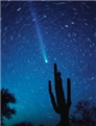
(True/False)
4.8/5 (73)
(73) The hydrogen in our solar system was created from subatomic particles in
(Multiple Choice)
4.7/5 (76)
(76) The asteroid belt is found between which two planets' orbits
(Multiple Choice)
4.8/5 (87)
(87) A future news release might report that a new planet has been found around a star very similar to our Sun. The system contains other planets as well like our solar system. This newly discovered planet is claimed to have a mass 40 times that of Earth and is located nearly 25 AU from the star it orbits. Which of the following would be a reasonable prediction about this planet, assuming it formed like our solar system
I.The planet will probably have a mean density of around 5 g/cm3.
II.The planet will probably have a radius of around five to ten times greater than Earth's.
III.The planet will probably have several satellites.
IV.The planet will probably have a composition that is mostly hydrogen and helium.
(Multiple Choice)
4.7/5 (81)
(81) The present motions of the planets were inherited from the rotation of the solar nebula.
(True/False)
4.8/5 (83)
(83) Comets are rocky bodies that orbit the Sun beyond the orbit of Neptune.
(True/False)
4.8/5 (77)
(77) The large planetesimals would have grown faster than the smaller planetesimals because
(Multiple Choice)
4.8/5 (88)
(88) The age of the solar system is believed to be approximately 4.6 billion years based on the data from
(Multiple Choice)
5.0/5 (74)
(74) 
Filters
- Essay(0)
- Multiple Choice(0)
- Short Answer(0)
- True False(0)
- Matching(0)