



 Chat with AI
Exam 14: Modern Cosmology

Exam 1: Here and Now97 Questions
Exam 2: A Users Guide to the Sky116 Questions
Exam 3: Cycles of the Sun and Moon154 Questions
Exam 4: The Origin of Modern Astronomy144 Questions
Exam 5: Light and Telescopes156 Questions
Exam 6: Atoms and Spectra125 Questions
Exam 7: The Sun146 Questions
Exam 8: The Family of Stars190 Questions
Exam 9: The Formation and Structure of Stars136 Questions
Exam 10: The Deaths of Stars127 Questions
Exam 11: Neutron Stars and Black Holes99 Questions
Exam 12: The Milky Way Galaxy117 Questions
Exam 13: Galaxies: Normal and Active151 Questions
Exam 14: Modern Cosmology112 Questions
Exam 15: The Origin of the Solar System108 Questions
Exam 16: Earth and Moon: Bases for Comparative Planetology98 Questions
Exam 17: Mercury, Venus, and Mars83 Questions
Exam 18: The Outer Solar System136 Questions
Exam 19: Meteorites, Asteroids, and Comets91 Questions
Exam 20: Astrobiology: Life on Other Worlds97 Questions
Select questions type


Evidence for a very early "super rapid" inflation of the universe is that the 3-K radiation from opposite sides of the sky (i.e., 180 degrees or about 28 billion light years apart) is of nearly ___________ intensity. Time for light to travel this distance is ___________ the age of the universe in years.
(Multiple Choice)
4.8/5  (78)
(78) Current observations indicate that the amount of baryonic matter and dark matter in the Universe
(Multiple Choice)
4.9/5 (69)
(69) If a galaxy is located at a distance of 18 Mpc and is found to have recessional velocity of 1170 km/s, what is Hubble's constant based only on this galaxy
(Multiple Choice)
4.8/5 (85)
(85) The resolution of Olbers's paradox suggests that it gets dark at night because
(Multiple Choice)
4.8/5 (78)
(78) Measured ages of globular clusters suggests that the Universe is about
(Multiple Choice)
5.0/5 (77)
(77) We are among the products of nuclear fusion and gravitational contraction.
(True/False)
4.8/5 (75)
(75) Why would a value of 500 km/s/Mpc for the Hubble constant contradict theories of stellar evolution
(Essay)
4.9/5 (80)
(80) In the late 1990's, it was discovered from distances of ___________ in distant galaxies that the expansion of the Universe is ___________.
(Multiple Choice)
4.9/5 (81)
(81) One explanation of the dark sky Olbers's Paradox is that light can reach us only from objects in space out to a distance in light years _______ the age of the universe in years.
(Multiple Choice)
4.7/5 (81)
(81) If the Universe were infinitely large, infinitely old, and static, then the CMB would appear uniform (i.e., homogenous and isotropic).
(True/False)
4.8/5 (82)
(82) The observable Universe changes with the usage of new and better telescopes like the current Hubble and the future James Webb.
(True/False)
4.8/5 (76)
(76) Cosmetologists are the astronomers and physicists who do research in cosmology.
(True/False)
4.8/5 (78)
(78) 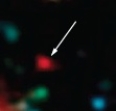 -If the galaxy shown above has a 6.964 redshift, the galaxy is __________ and __________.
 (Multiple Choice)
4.9/5 (79)
(79) 
Filters
- Essay(0)
- Multiple Choice(0)
- Short Answer(0)
- True False(0)
- Matching(0)