



 Chat with AI
Exam 10: The Deaths of Stars

Exam 1: Here and Now97 Questions
Exam 2: A Users Guide to the Sky116 Questions
Exam 3: Cycles of the Sun and Moon154 Questions
Exam 4: The Origin of Modern Astronomy144 Questions
Exam 5: Light and Telescopes156 Questions
Exam 6: Atoms and Spectra125 Questions
Exam 7: The Sun146 Questions
Exam 8: The Family of Stars190 Questions
Exam 9: The Formation and Structure of Stars136 Questions
Exam 10: The Deaths of Stars127 Questions
Exam 11: Neutron Stars and Black Holes99 Questions
Exam 12: The Milky Way Galaxy117 Questions
Exam 13: Galaxies: Normal and Active151 Questions
Exam 14: Modern Cosmology112 Questions
Exam 15: The Origin of the Solar System108 Questions
Exam 16: Earth and Moon: Bases for Comparative Planetology98 Questions
Exam 17: Mercury, Venus, and Mars83 Questions
Exam 18: The Outer Solar System136 Questions
Exam 19: Meteorites, Asteroids, and Comets91 Questions
Exam 20: Astrobiology: Life on Other Worlds97 Questions
Select questions type


If the stars at the turnoff point of a cluster have a mass of 3M, what is the age of the cluster
(Multiple Choice)
4.8/5  (78)
(78) In the diagram below, which point indicates the location on the H-R diagram of a one-solar-mass star when it undergoes helium flash 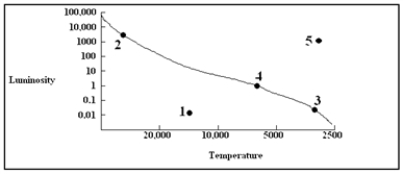
(Multiple Choice)
4.7/5 (63)
(63) In A.D. 1054, Chinese astronomers observed the appearance of a new star, whose location is now occupied by
(Multiple Choice)
4.9/5 (87)
(87) Stars with ˜0.4-4 solar masses swell into giants when hydrogen is exhausted in their centers.
(True/False)
4.9/5 (72)
(72) 
Filters
- Essay(0)
- Multiple Choice(0)
- Short Answer(0)
- True False(0)
- Matching(0)