



 Chat with AI
Exam 4: The Origin of Modern Astronomy

Exam 1: Here and Now97 Questions
Exam 2: A Users Guide to the Sky116 Questions
Exam 3: Cycles of the Sun and Moon154 Questions
Exam 4: The Origin of Modern Astronomy144 Questions
Exam 5: Light and Telescopes156 Questions
Exam 6: Atoms and Spectra125 Questions
Exam 7: The Sun146 Questions
Exam 8: The Family of Stars190 Questions
Exam 9: The Formation and Structure of Stars136 Questions
Exam 10: The Deaths of Stars127 Questions
Exam 11: Neutron Stars and Black Holes99 Questions
Exam 12: The Milky Way Galaxy117 Questions
Exam 13: Galaxies: Normal and Active151 Questions
Exam 14: Modern Cosmology112 Questions
Exam 15: The Origin of the Solar System108 Questions
Exam 16: Earth and Moon: Bases for Comparative Planetology98 Questions
Exam 17: Mercury, Venus, and Mars83 Questions
Exam 18: The Outer Solar System136 Questions
Exam 19: Meteorites, Asteroids, and Comets91 Questions
Exam 20: Astrobiology: Life on Other Worlds97 Questions
Select questions type


The Copernican model of the solar system has the planets orbit the Sun along elliptical paths.
(True/False)
4.9/5  (71)
(71) When two objects of unequal masses orbit each other, the center of mass is
(Multiple Choice)
4.8/5 (79)
(79) Which law refers to a planet sweeping out equal areas in equal times as it orbits its host star
(Multiple Choice)
4.9/5 (80)
(80) The purpose of using epicycles and deferents to explain the motion of the planets in the night sky was to account for
(Multiple Choice)
4.8/5 (70)
(70) You and your friend put the palms of your hands together and push equally on each other so your hands don't move. Which law(s) does this follow Choose the best answer.
I. Newton's first
II. Newton's second
III) Newton's third
IV) Newton's law of gravitation
(Multiple Choice)
4.9/5 (86)
(86) 
Using the definitions for neap and spring tides, explain when is the best time to go surfing in one 24-hour day on Earth.
(Essay)
4.9/5 (82)
(82) According to Kepler's third law, a planet's orbital period ____________________ is equal to its average distance from the Sun ____________________.
(Short Answer)
4.9/5 (84)
(84) ____________________ is a description of the Ptolemaic model of the solar system.
(Short Answer)
4.8/5 (80)
(80) What is the circular velocity of an object orbiting Earth at a distance of 100,000 km from Earth's center 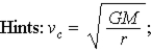 G = m3⋅kg−1⋅s−2; MEarth = kg
 (Multiple Choice)
4.8/5 (67)
(67) Newton used only the work of Kepler to discover his three laws of motion and the law of gravity.
(True/False)
4.8/5 (78)
(78) If an object's orbital velocity is greater than its escape velocity, then the shape of the path is a/an __________________ and the orbit is____________.
(Multiple Choice)
4.8/5 (83)
(83) If a satellite is in orbit around Earth and the satellite's altitude increases, then the circular velocity __________________.
(Multiple Choice)
4.7/5 (83)
(83) ____________________ made very accurate observations of the positions and movements of the planets that were later used to help develop the Rudolphine Tables.
(Short Answer)
4.9/5 (88)
(88) A(n) ____ is a small circle whose center is located on the circumference of another larger circle.
(Multiple Choice)
4.9/5 (77)
(77) Kepler's second law is about the speed of planets, where planets move faster at perihelion and slower at aphelion.
(True/False)
4.9/5 (66)
(66) 
Filters
- Essay(0)
- Multiple Choice(0)
- Short Answer(0)
- True False(0)
- Matching(0)