



 Chat with AI
Exam 1: Here and Now

Exam 1: Here and Now97 Questions
Exam 2: A Users Guide to the Sky116 Questions
Exam 3: Cycles of the Sun and Moon154 Questions
Exam 4: The Origin of Modern Astronomy144 Questions
Exam 5: Light and Telescopes156 Questions
Exam 6: Atoms and Spectra125 Questions
Exam 7: The Sun146 Questions
Exam 8: The Family of Stars190 Questions
Exam 9: The Formation and Structure of Stars136 Questions
Exam 10: The Deaths of Stars127 Questions
Exam 11: Neutron Stars and Black Holes99 Questions
Exam 12: The Milky Way Galaxy117 Questions
Exam 13: Galaxies: Normal and Active151 Questions
Exam 14: Modern Cosmology112 Questions
Exam 15: The Origin of the Solar System108 Questions
Exam 16: Earth and Moon: Bases for Comparative Planetology98 Questions
Exam 17: Mercury, Venus, and Mars83 Questions
Exam 18: The Outer Solar System136 Questions
Exam 19: Meteorites, Asteroids, and Comets91 Questions
Exam 20: Astrobiology: Life on Other Worlds97 Questions
Select questions type


Figure 1-11 is an example of a/an __________________. Choose the best answer.
(Multiple Choice)
4.8/5  (68)
(68) The speed of light is km/s, and it takes 1.3 s for light to travel from the Moon to Earth. From this information, what is the distance to the Moon
(Multiple Choice)
4.8/5 (58)
(58) The scientific method is a ___________________ by which scientists form hypotheses and test them agains evidence gathered by observation or experiment.
(Short Answer)
4.9/5 (73)
(73) Using the scale in the diagram below, what is the diameter of Mercury 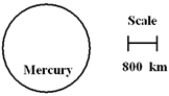
(Multiple Choice)
4.9/5 (72)
(72) Which of the following is ordered correctly from largest to smallest planet
(Multiple Choice)
4.8/5 (93)
(93) Order the following from most recent to least.
I. Big Bang
II. Age of quasars
III. First humans
IV. Cambrian explosion
V. Formation of the solar system
VI. First life
VII. Recombination Period
(Multiple Choice)
4.9/5 (88)
(88) Assume a textbook shows a diagram of the solar system on, say, a standard notebook-sized sheet. The orbits of eight planets are sketched around the Sun at the center. The planets and orbits are drawn large enough that features like continents on Earth or the rings of Saturn are clearly visible. The Sun is drawn large enough that sunspots are clearly visible. Discuss what is wrong or right with this diagram.
(Essay)
4.8/5 (89)
(89) If the field of view (FOV) in Figure 1-1 is 50 ft and the distance is widened by a factor of 100, how large is the FOV in Figure 1-2 Choose the best answer.
(Multiple Choice)
4.9/5 (74)
(74) The scientific method is a simple, mechanical way of grinding facts into understanding.
(True/False)
4.8/5 (75)
(75) From what you know about astronomical units and light-years, how would you define a light-minute
(Essay)
4.9/5 (84)
(84) If light travels 63,000 AU in 1 year at m/s, which of these best represents the unit of a light-year
(Multiple Choice)
4.9/5 (74)
(74) 
Filters
- Essay(0)
- Multiple Choice(0)
- Short Answer(0)
- True False(0)
- Matching(0)