



 Chat with AI
Exam 11: Monopoly and Monopsony

Exam 1: Introduction43 Questions
Exam 2: Supply and Demand226 Questions
Exam 3: A Consumers Constrained Choice129 Questions
Exam 4: Demand123 Questions
Exam 5: Consumer Welfare and Policy Analysis73 Questions
Exam 6: Firms and Production111 Questions
Exam 7: Costs132 Questions
Exam 8: Competitive Firms and Markets112 Questions
Exam 9: Properties and Applications of the Competitive Model101 Questions
Exam 10: General Equilibrium and Economic Welfare108 Questions
Exam 11: Monopoly and Monopsony141 Questions
Exam 12: Pricing and Advertising91 Questions
Exam 13: Game Theory84 Questions
Exam 14: Oligopoly and Monopolistic Competition114 Questions
Exam 15: Factor Markets115 Questions
Exam 16: Uncertainty103 Questions
Exam 17: Property Rights, externalities, rivalry, and Exclusion105 Questions
Exam 18: Asymmetric Information85 Questions
Exam 19: Contracts and Moral Hazards79 Questions
Select questions type


If the inverse demand curve a monopoly faces is p = 100 - 2Q,and MC is constant at 16,then profit maximization
(Multiple Choice)
4.8/5  (70)
(70) Suppose that market demand for a good is Q = 480 - 2p.The marginal cost is MC = 2Q.Calculate the deadweight loss resulting from a monopoly in this market.
(Essay)
4.9/5 (92)
(92) If the inverse demand function for a monopoly's product is p = 100 - 2Q,then the firm's marginal revenue function is
(Multiple Choice)
4.8/5 (75)
(75) 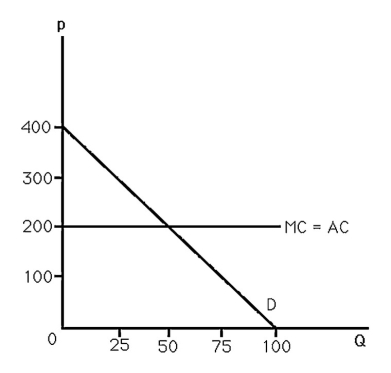 -The above figure shows the demand and cost curves facing a monopoly.If a $100 per unit tax is charged,the loss in welfare resulting from the tax is
 (Multiple Choice)
4.7/5 (73)
(73) In the early 1900s,U.S.Steel acted as a dominant firm with over sixty percent (60%)of the market.Many,including the Supreme Court in 1920,viewed U.S.Steel as a "good" monopolist since competitive fringe firms prospered under this arrangement.Graph the market for steel as it might have existed at this time showing that being a member of the competitive fringe can be profitable.Assume a linear market demand and linear MC and AC that slope upward.
(Essay)
5.0/5 (88)
(88) What is the advantage of the government imposing an ad valorem tax over a specific tax when facing a monopoly?
(Essay)
4.8/5 (79)
(79) 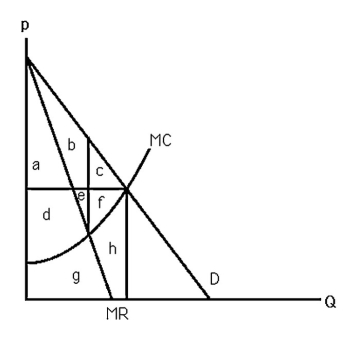 -The above figure shows the demand and marginal cost curves for a monopoly.Under monopoly,consumer surplus equals
 (Multiple Choice)
5.0/5 (95)
(95) If the government regulates the price a monopoly can charge,and the price ceiling is set below what the competitive market price would be,then
(Multiple Choice)
4.8/5 (74)
(74) 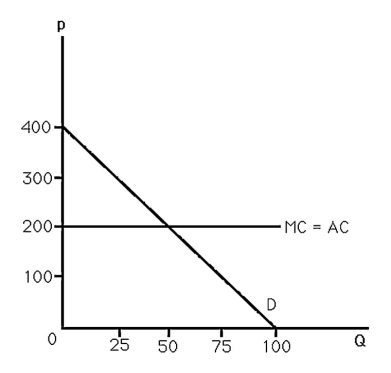 -The above figure shows the demand and cost curves facing a monopoly.If the firm is a profit maximizer,its Lerner Index will equal
 (Multiple Choice)
4.9/5 (72)
(72) 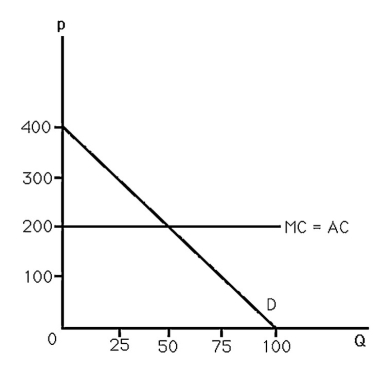 -The above figure shows the demand and cost curves facing a monopoly.The deadweight loss of this monopoly is
 (Multiple Choice)
4.8/5 (76)
(76) For the following, please answer "True" or "False" and explain why.
-If the government's goal is to generate a certain amount of tax revenue,a specific tax and an ad valorem tax on a monopoly have the same impact on social welfare.
(True/False)
4.8/5 (84)
(84) For the following, please answer "True" or "False" and explain why.
-The telephone is an example of a product with network externalities.
(True/False)
4.8/5 (88)
(88) The average cost for a typical electric-power-production firm is AC = 100 - 10Q + Q² where Q is measured in billion kilowatt hours per day.At the current regulated price,consumers demand 4 billion kilowatt hours per day.Is this market a natural monopoly? If demand increases to 10 billion kilowatt hours,is this market a natural monopoly? Explain.
(Essay)
4.7/5 (83)
(83) A monopsonist purchaser of labor that could negotiate a different wage for each worker could
(Multiple Choice)
4.8/5 (90)
(90)
-The above figure shows the demand and cost curves facing a monopoly.A $100 per unit tax would raise price by
-The above figure shows the demand and cost curves facing a monopoly.A $100 per unit tax would raise price by (Multiple Choice)
4.9/5 (82)
(82) The introduction of satellite television systems would cause the Lerner Index for cable television to
(Multiple Choice)
4.8/5 (76)
(76) A monopolist faces the inverse demand for its output:
p = 30 - Q
The monopolist also has a constant marginal and average cost of $4/unit.The government is seeking ways to collect tax revenue from the monopolist and faces two proposals:
i.Impose a specific tax of t on the monopolist.
ii.Impose an ad valorem tax of a on the monopolist.
a.Suppose the government imposes a 20% ad valorem tax on the monopolist.What price and quantity does the monopolist choose and how much revenue does the government generate from the tax?
b.Rather than an ad valorem tax,what is the government's revenue from a specific tax of t imposed on the monopolist? Your answer should be in terms of t.
c.Show that a specific tax of $3.70/unit generates the same revenue as a 20% ad valorem tax (approximately).
d.Which tax has a greater distortion on the monopoly output?
(Essay)
4.8/5 (75)
(75) A monopsonist faces an upward-sloping labor supply curve.This means that his marginal expenditures on labor are
(Multiple Choice)
4.7/5 (83)
(83)
-The above figure shows the demand and marginal cost curves for a monopoly.The deadweight loss of this monopoly equals
-The above figure shows the demand and marginal cost curves for a monopoly.The deadweight loss of this monopoly equals (Multiple Choice)
4.8/5 (86)
(86) 
Filters
- Essay(0)
- Multiple Choice(0)
- Short Answer(0)
- True False(0)
- Matching(0)