



 Chat with AI
Exam 11: Monopoly and Monopsony

Exam 1: Introduction43 Questions
Exam 2: Supply and Demand226 Questions
Exam 3: A Consumers Constrained Choice129 Questions
Exam 4: Demand123 Questions
Exam 5: Consumer Welfare and Policy Analysis73 Questions
Exam 6: Firms and Production111 Questions
Exam 7: Costs132 Questions
Exam 8: Competitive Firms and Markets112 Questions
Exam 9: Properties and Applications of the Competitive Model101 Questions
Exam 10: General Equilibrium and Economic Welfare108 Questions
Exam 11: Monopoly and Monopsony141 Questions
Exam 12: Pricing and Advertising91 Questions
Exam 13: Game Theory84 Questions
Exam 14: Oligopoly and Monopolistic Competition114 Questions
Exam 15: Factor Markets115 Questions
Exam 16: Uncertainty103 Questions
Exam 17: Property Rights, externalities, rivalry, and Exclusion105 Questions
Exam 18: Asymmetric Information85 Questions
Exam 19: Contracts and Moral Hazards79 Questions
Select questions type


The ability of a monopoly to charge a price that exceeds marginal cost depends on
(Multiple Choice)
4.8/5  (71)
(71) For the following, please answer "True" or "False" and explain why.
-The less elastic is the demand for a firm's product,the greater is that firm's market power.
(True/False)
4.9/5 (80)
(80) At the current level of output,a firm's marginal cost equals 16 and marginal revenue equals 10.The firm
(Multiple Choice)
4.7/5 (66)
(66) A monopoly sets a price of $50 per unit for an item that has a marginal cost of $10.Assuming profit maximization,the implicit demand elasticity is
(Multiple Choice)
4.8/5 (89)
(89) Consider a monopolist facing a linear (inverse)demand curve given by:
p = a - bQ
Show with calculus that the marginal revenue in fact has the same price-axis intercept but twice the slope as the inverse demand curve above.
(Short Answer)
4.9/5 (84)
(84)
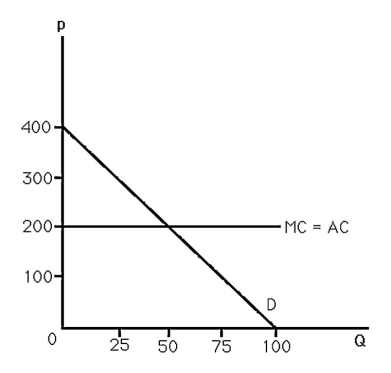 -The above figure shows the demand and cost curves facing a monopoly.At the profit-maximizing price,the elasticity of demand equals
 (Multiple Choice)
4.8/5 (89)
(89) The situation in which one firm can produce the total output of the market at lower cost than several firms is called
(Multiple Choice)
4.9/5 (100)
(100) Which of the following would be most able to act like a monopsonist?
(Multiple Choice)
4.8/5 (73)
(73) 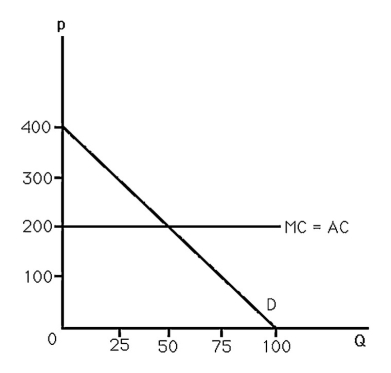 -The above figure shows the demand and cost curves facing a monopoly.The monopoly maximizes profit by setting price equal to
 (Multiple Choice)
4.9/5 (66)
(66)
-The above figure shows the demand and cost curves facing a monopoly.Maximum profit equals
-The above figure shows the demand and cost curves facing a monopoly.Maximum profit equals (Multiple Choice)
4.7/5 (70)
(70) Which of the following average cost functions suggests the presence of a natural monopoly?
(Multiple Choice)
4.7/5 (81)
(81) Suppose that a mining company employs 80% of the available laborers in a town.Explain what will happen to the number of laborers hired and the wage rate paid by the mine if a minimum wage is set at the competitive level.
(Essay)
4.9/5 (79)
(79) The SSS Co.has a patent on a particular medication.The medication sells for $1 per daily dose and marginal cost is estimated to be a constant at 20¢.Assuming linear demand and marginal cost curves,use this information to estimate the deadweight loss from monopoly pricing if the firm currently sells 1,000 doses per day.Can this loss be justified?
(Essay)
4.9/5 (75)
(75) If the government attempts to force a natural monopoly to charge a price equal to marginal cost,
(Multiple Choice)
4.8/5 (80)
(80) It is a conventional practice among apparel retailers to set the retail price of clothing at twice the cost paid to the manufacturer.For example,if the retailer pays $7 for a pair of jeans,the jeans will retail for $14.What must the price elasticity of demand be for this practice to be profit maximizing?
(Essay)
5.0/5 (77)
(77) If the supply of labor to a monopsonist is everywhere unit elastic,then the wage will equal
(Multiple Choice)
4.8/5 (85)
(85) If the government wants to regulate a natural monopoly,it will force the firm to set price equal to
(Multiple Choice)
4.9/5 (64)
(64) 
Filters
- Essay(0)
- Multiple Choice(0)
- Short Answer(0)
- True False(0)
- Matching(0)