



 Chat with AI
Exam 4: Demand

Exam 1: Introduction43 Questions
Exam 2: Supply and Demand226 Questions
Exam 3: A Consumers Constrained Choice129 Questions
Exam 4: Demand123 Questions
Exam 5: Consumer Welfare and Policy Analysis73 Questions
Exam 6: Firms and Production111 Questions
Exam 7: Costs132 Questions
Exam 8: Competitive Firms and Markets112 Questions
Exam 9: Properties and Applications of the Competitive Model101 Questions
Exam 10: General Equilibrium and Economic Welfare108 Questions
Exam 11: Monopoly and Monopsony141 Questions
Exam 12: Pricing and Advertising91 Questions
Exam 13: Game Theory84 Questions
Exam 14: Oligopoly and Monopolistic Competition114 Questions
Exam 15: Factor Markets115 Questions
Exam 16: Uncertainty103 Questions
Exam 17: Property Rights, externalities, rivalry, and Exclusion105 Questions
Exam 18: Asymmetric Information85 Questions
Exam 19: Contracts and Moral Hazards79 Questions
Select questions type


Suppose the typical consumer only purchases food and clothing,and her utility can be expressed as ?U = F ∗ C.Currently,food costs $5 per unit and clothing costs $2 per unit.Her income is $70.If the price of food increases to $6,compare the resulting Laspyre's price index with a true cost of living index.
(Essay)
4.9/5  (86)
(86) Under which of the following conditions will there be no substitution bias in the CPI?
(Multiple Choice)
4.7/5 (82)
(82) George's parent's let him use the family car whenever he wants,but require that he pays for all gas he uses.George has been driving the car 100 miles per week.His parents want to limit how much he drives the family car,but don't want to impose a major burden on his finances.Mom's plan is to charge him a dollar for each ten miles he drives the car (per week),but to increase his allowance by $10.Dad thinks this plan will have no effect on his driving since he is going to get the money back at the end of the week.Who is right? Explain.
(Essay)
4.9/5 (82)
(82) The Slutsky equation shows that,holding the total effect constant,the income effect will be larger for goods that
(Multiple Choice)
4.8/5 (80)
(80) Bob's winery sells bottles of their expensive,high-quality wine and a cheaper low-quality wine.Visitors have to drive 45 minutes to get to Bob's winery.Bob also sells his wine at a shop in the city where consumers don't have to drive a long distance and charges the same prices.Assuming the preferences of the clients that come to the winery and the city store are the same,explain why Bob tends to sell the expensive wine in a greater proportion in the winery than the urban store.
(Essay)
4.9/5 (84)
(84) If consumer income and prices increase by the same percentage,
(Multiple Choice)
4.8/5 (83)
(83) Suppose that the interest rate paid to savers increases.As a result,Tom wishes to save more.This suggests that,for Tom,
(Multiple Choice)
4.8/5 (86)
(86) Suppose the only goods you consume are apples and peaches.One day the price of apples goes up and the price of peaches goes down,and you find that you can still just afford to buy the same combination of peaches and apples that you were buying all along.The price changes leave you neither better nor worse off.
(Essay)
4.9/5 (81)
(81) 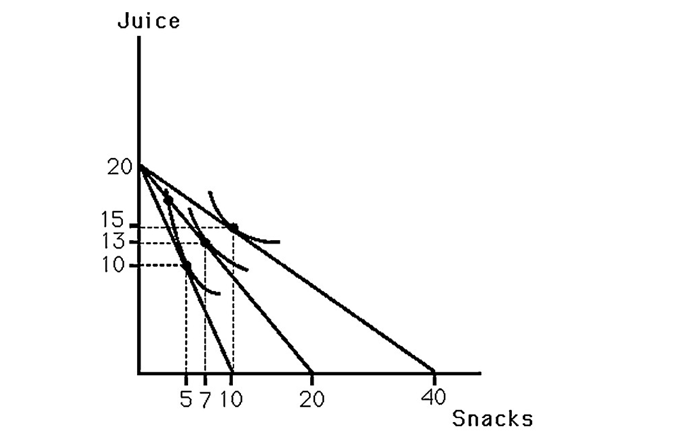 -The above figure shows Bobby's indifference map for juice and snacks.Also shown are three budget lines resulting from different prices for snacks assuming he has $20 to spend on these goods.What is MRS for the point on Bobby's demand curve for snacks where price of snacks is $0.5?
 (Multiple Choice)
4.8/5 (83)
(83) Use the Slutsky equation to show that a Giffen good must be an inferior good,BUT an inferior good need not be a Giffen good.
(Essay)
5.0/5 (73)
(73) There are only two goods for John to consume: food and clothing.If clothing is an inferior good for John when his income rises to $100,000,then food is
(Multiple Choice)
4.8/5 (87)
(87) Consider a consumer that only purchases two goods,X and Y.The government wishes to collect revenue from taxing this consumer and is considering two policies.The first policy is to only tax good X.The second policy will tax both goods by the same percentage.Assume that the tax rates in each policy are selected such that they collect the same amount of revenue.Which policy will have a smaller reduction in the consumer's well-being? (Use a graph of indifference curves and budget constraints to illustrate your answer)
(Essay)
4.9/5 (96)
(96) According to Revealed Preferences,if a Consumer chooses a more expensive bundle of goods over a cheaper bundle of goods,we can conclude
(Multiple Choice)
4.8/5 (70)
(70) An individual's demand curve for a good can be derived by measuring the quantities selected as
(Multiple Choice)
4.8/5 (90)
(90) Many manufacturers sell products labeled as having imperfections at a discount at their factory outlets but do not ship these imperfect goods to regular retail outlets.Why?
(Essay)
4.8/5 (84)
(84) 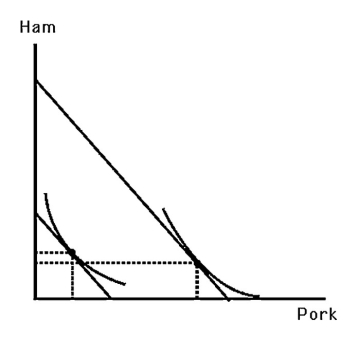 -The above figure shows Larry's indifference map and budget lines for ham and pork.Which of the following statements is TRUE?
 (Multiple Choice)
4.9/5 (75)
(75)
-The above figure shows Bobby's indifference map for juice and snacks.Also shown are three budget lines resulting from different prices for snacks.This information could be used to determine
-The above figure shows Bobby's indifference map for juice and snacks.Also shown are three budget lines resulting from different prices for snacks.This information could be used to determine (Multiple Choice)
4.7/5 (87)
(87) Suppose Joe earns $1,000 in year 1 and $0 in year 2.Any amount he saves will earn interest at a rate of 0%.Draw Joe's budget line.(Hint: He can either consume all $1000 this year or consume nothing this year and have $1,100 next year.)Assuming convex indifference curves,show that an increase in the rate of interest can cause Joe's savings to either increase or decrease.Explain in terms of income and substitution effect.
(Essay)
4.9/5 (79)
(79) 
Filters
- Essay(0)
- Multiple Choice(0)
- Short Answer(0)
- True False(0)
- Matching(0)