



 Chat with AI
Exam 12: Hunger, Eating, and Health

Exam 1: Biopsychology As a Neuroscience89 Questions
Exam 2: Evolution, Genetics, and Experience143 Questions
Exam 3: The Anatomy of the Nervous System153 Questions
Exam 4: Neural Conduction and Synaptic Transmission152 Questions
Exam 5: The Research Methods of Biopsychology161 Questions
Exam 6: The Visual System149 Questions
Exam 7: Mechanisms of Perception150 Questions
Exam 8: The Sensorimotor System119 Questions
Exam 9: Development of the Nervous System125 Questions
Exam 10: Brain Damage and Neuroplasticity185 Questions
Exam 11: Learning, Memory, and Amnesia147 Questions
Exam 12: Hunger, Eating, and Health145 Questions
Exam 13: Hormones and Sex157 Questions
Exam 14: Sleep, Dreaming, and Circadian Rhythms186 Questions
Exam 15: Drug Addiction and the Brains Reward Circuits153 Questions
Exam 16: Lateralization, Language, and the Split Brain170 Questions
Exam 17: Biopsychology of Emotion, Stress, and Health154 Questions
Exam 18: Biopsychology of Psychiatric Disorders137 Questions
Select questions type


The surgical treatment for extreme obesity that is portrayed in this illustration is __________ surgery.
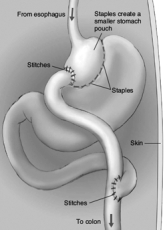
(Short Answer)
4.8/5  (78)
(78) Although __________ agonists are effective in the treatment of obesity, they are currently not in wide use because they tend to have dangerous side effects.
(Multiple Choice)
4.9/5 (78)
(78) The first phase of energy metabolism, the one that occurs before the food is absorbed, is the __________ phase.
(Short Answer)
4.9/5 (83)
(83) Demonstrations that small amounts of food increase hunger are referred to as the __________ effect.
(Short Answer)
4.8/5 (78)
(78) The phase of energy metabolism that occurs after all of the energy from the most recent meal has been used is the __________ phase.
(Short Answer)
4.8/5 (78)
(78) According to the text, anorexic patients - or anybody else who is severely undernourished - should not be fed
(Multiple Choice)
4.7/5 (90)
(90) According to Woods, the hunger that one experiences as a regular mealtime approaches is
(Multiple Choice)
5.0/5 (94)
(94) Describe two explanations for why we get hungry at our regular meal times.Discuss relevant evidence.Which of the two explanations does the evidence support?
(Essay)
4.8/5 (75)
(75) A major problem with the set-point theory of body weight regulation is that it
(Multiple Choice)
4.9/5 (75)
(75) Although the __________ assumption is engrained in most people's thinking, it is inconsistent with most of the evidence.
(Multiple Choice)
4.7/5 (80)
(80) The inability of set-point theories to account for the basic phenomena of hunger and eating has led to the development of
(Multiple Choice)
4.8/5 (88)
(88) The anticipated pleasurable effect of eating a particular food is that food's
(Multiple Choice)
5.0/5 (68)
(68) Cultural practices that promote obesity include the practice of
(Multiple Choice)
4.9/5 (88)
(88) Immediately following a meal, glucose levels in the blood do not increase as much as they otherwise might because
(Multiple Choice)
4.8/5 (80)
(80) 
Filters
- Essay(0)
- Multiple Choice(0)
- Short Answer(0)
- True False(0)
- Matching(0)