



 Chat with AI
Exam 17: Modern Consciousness: New Views of Nature, human Nature, and the Arts

Exam 1: The Ancient Near East: the First Civilizations82 Questions
Exam 2: The Hebrews: a New View of God and the Individual76 Questions
Exam 3: The Greeks: From Myth to Reason95 Questions
Exam 4: Rome: From City-State to World Empire92 Questions
Exam 5: Early Christianity: a World Religion79 Questions
Exam 6: The Rise of Europe: Fusion of Classical,christian,and Germanic Traditions89 Questions
Exam 7: The Flowering and Dissolution of Medieval Civilization84 Questions
Exam 8: Transition to the Modern Age: Renaissance and Reformation91 Questions
Exam 9: Political and Economic Transformation: National States, overseas Expansion, commercial Revolution84 Questions
Exam 10: Intellectual Transformation: the Scientific Revolution and the Age of Enlightenment85 Questions
Exam 11: The Era of the French Revolution: Affirmation of Liberty and Equality92 Questions
Exam 12: The Industrial Revolution: the Transformation of Society78 Questions
Exam 13: Thought and Culture in the Early Nineteenth Century82 Questions
Exam 14: Surge of Liberalism and Nationalism: Revolution, counterrevolution, and Unification76 Questions
Exam 15: Thought and Culture in the Mid-Nineteenth Century: Realism, positivism, darwinism, and Social Criticism86 Questions
Exam 16: Europe in the Late Nineteenth Century: Modernization, nationalism, imperialism93 Questions
Exam 17: Modern Consciousness: New Views of Nature, human Nature, and the Arts77 Questions
Exam 18: World War I: the West in Despair83 Questions
Exam 19: An Era of Totalitarianism88 Questions
Exam 20: World War II: Western Civilization in the Balance56 Questions
Exam 21: Europe After World War II: Recovery and Realignment, 1945-198959 Questions
Exam 22: The Troubled Present55 Questions
Select questions type


It is generally recognized that Nietzsche's writings

Free
(Multiple Choice)
4.8/5  (71)
(71) Correct Answer: Verified
E
Heisenberg's uncertainty principle
Free
(Multiple Choice)
4.9/5 (98)
(98) Correct Answer:Verified
VerifiedC
Please use this outline map of Europe to answer the question(s).
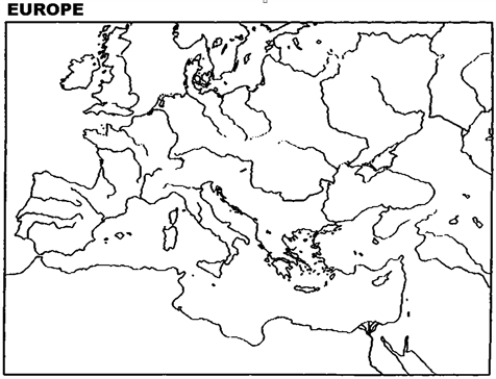 -One author has referred to art since the Renaissance as "a mirror of nature." How did artistic developments of the second half of the nineteenth century destroy this concept?
 (Essay)
4.7/5 (90)
(90) Modern artists would agree with each of the following except
(Multiple Choice)
4.7/5 (75)
(75) Please define the following key terms. Show Who? What? Where? When? Why Important?
-Friedrich Nietzsche
(Essay)
4.8/5 (82)
(82) Who of the following aimed to construct a system of sociology on the model of the physical sciences?
(Multiple Choice)
4.8/5 (85)
(85) Please define the following key terms. Show Who? What? Where? When? Why Important?
-anomie
(Short Answer)
4.9/5 (88)
(88) Why did Freud consider his theories a "great blow to human pride?"
(Multiple Choice)
4.7/5 (79)
(79) Please use this outline map of Europe to answer the question(s).
-On a map of Europe,locate the site each of these historical personalities or artists is associated with: Pareto,Nietzsche,Einstein,Picasso,Stravinsky,Weber,Freud,and Durkheim.
-On a map of Europe,locate the site each of these historical personalities or artists is associated with: Pareto,Nietzsche,Einstein,Picasso,Stravinsky,Weber,Freud,and Durkheim. (Essay)
4.8/5 (75)
(75) Please define the following key terms. Show Who? What? Where? When? Why Important?
-the unconscious
(Essay)
4.9/5 (86)
(86) Please define the following key terms. Show Who? What? Where? When? Why Important?
-Igor Stravinsky
(Essay)
4.7/5 (86)
(86) The Second Scientific Revolution destroyed or altered which major scientific theories or beliefs?
(Multiple Choice)
4.8/5 (83)
(83) Please define the following key terms. Show Who? What? Where? When? Why Important?
-Max Planck
(Short Answer)
4.8/5 (72)
(72) Please define the following key terms. Show Who? What? Where? When? Why Important?
-Second Scientific Revolution
(Essay)
4.8/5 (76)
(76) 
Filters
- Essay(0)
- Multiple Choice(0)
- Short Answer(0)
- True False(0)
- Matching(0)