



 Chat with AI
Exam 12: Experiments With More Than One Independent Variable

Exam 1: Psychology Is a Way of Thinking55 Questions
Exam 2: Sources of Information: Evaluating, finding, and Reading Information55 Questions
Exam 3: Three Claims, four Validities: Interrogation Tools for Consumers of Research55 Questions
Exam 4: Ethical Guidelines for Psychology Research55 Questions
Exam 5: Identifying Good Measurement55 Questions
Exam 6: Surveys and Observations: Describing What People Do51 Questions
Exam 7: Sampling: Estimating the Frequency of Behaviors and Beliefs55 Questions
Exam 8: Bivariate Correlational Research55 Questions
Exam 9: Multivariate Correlational Research55 Questions
Exam 10: Introduction to Simple Experiments55 Questions
Exam 11: More on Experiments: Confounding and Obscuring Variables55 Questions
Exam 12: Experiments With More Than One Independent Variable55 Questions
Exam 13: Quasi-Experiments and Small-N Designs55 Questions
Exam 14: Replicability, generalization, and the Real World55 Questions
Select questions type


According to the textbook,why is it important to study interactions?
(Multiple Choice)
4.8/5  (88)
(88) A "difference in the difference between the differences" would indicate which of the following?
(Multiple Choice)
4.9/5 (82)
(82)
Dr.Elder was interested in the way people recognize objects as members of categories.For example,what makes us recognize a dog as being a dog and not a cat? More specifically,he was curious as to whether people think about categories in a more complex way if they contemplate an "opposite" category first.For example,does a person think differently about the category of "southern" if they first think about the category of "northern"? He is also curious as to whether people categorize differently if they are exposed to category members compared with generating category members.Dr.Elder has four groups of participants (with 30 people in each group).In Group A,participants were told to cut out pictures of dogs and cats from magazines.In Group B,participants were told to cut out pictures of just dogs from magazines.In Group C,participants were told to draw pictures of cats and dogs.In Group D,participants were told to draw pictures of just dogs.After doing this for 30 minutes,participants in all groups were asked to list the attributes that define the "dog" category.Having a higher number of attributes listed was considered to be an indication of thinking about the category in a more complex way.The results of his study are below.
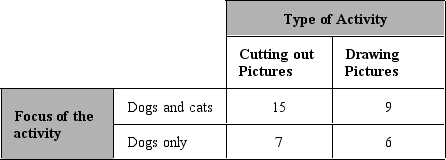 -In Dr.Elder's study,how many possible main effects exist?
 (Multiple Choice)
4.8/5 (77)
(77)
(The first paragraph is repeated from earlier.The second paragraph is specific to the new set of questions.The first paragraph is necessary to set up the original study. )
Dr.Elder was interested in the way people recognize objects as members of categories.For example,what makes us recognize a dog as being a dog and not a cat? More specifically,he was curious as to whether people think about categories in a more complex way if they contemplate an "opposite" category first.For example,does a person think more differently about the category of "southern" if they are also thinking about the category of "northern"? He is also curious as to whether people categorize differently if they are exposed to category members compared with generating category members.Dr.Elder has four groups of participants (with 30 people in each group).In Group A,participants were told to cut out pictures of dogs and cats from magazines.In Group B,participants were told to cut out pictures of just dogs from magazines.In Group C,participants were told to draw pictures of cats and dogs.In Group D,participants were told to draw pictures of just dogs.After doing this for 30 minutes,participants in all groups were asked to list the attributes that define the "dog" category.Having a higher number of attributes listed was considered to be an indication of thinking about the category in a more complex way.
Dr.Elder also is curious as to whether categorization happens similarly for children as it does for adults.As such,he recruits a group of 10-year-olds and a group of 20-year-olds to participate in the study.The results are below.
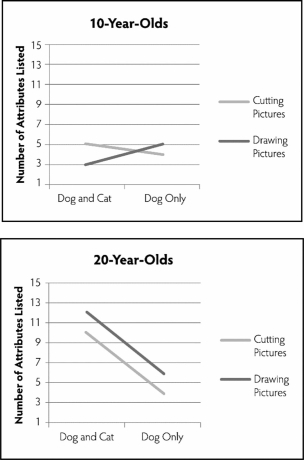 -Which of the following is the correct factorial notation for Dr.Elder's new study?
 (Multiple Choice)
4.9/5 (65)
(65)
Dr.Elder was interested in the way people recognize objects as members of categories.For example,what makes us recognize a dog as being a dog and not a cat? More specifically,he was curious as to whether people think about categories in a more complex way if they contemplate an "opposite" category first.For example,does a person think differently about the category of "southern" if they first think about the category of "northern"? He is also curious as to whether people categorize differently if they are exposed to category members compared with generating category members.Dr.Elder has four groups of participants (with 30 people in each group).In Group A,participants were told to cut out pictures of dogs and cats from magazines.In Group B,participants were told to cut out pictures of just dogs from magazines.In Group C,participants were told to draw pictures of cats and dogs.In Group D,participants were told to draw pictures of just dogs.After doing this for 30 minutes,participants in all groups were asked to list the attributes that define the "dog" category.Having a higher number of attributes listed was considered to be an indication of thinking about the category in a more complex way.The results of his study are below.
-In graphing the results of his study,which of the following would NOT be true for Dr.Elder?
-In graphing the results of his study,which of the following would NOT be true for Dr.Elder? (Multiple Choice)
4.7/5 (95)
(95) Dr.Gavin decides that instead of conducting a 2×4 independent-groups factorial design,he is going to conduct a 2×3×4 mixed factorial design.Which of the following things will NOT have to change?
(Multiple Choice)
4.9/5 (74)
(74)
To study the effects of physical discomfort on attention,Dr.Lopez conducted the following study: A group of participants were required to keep one hand submerged in cold water (52 degrees).Half of the participants kept their hand in the water for two minutes,and half of the participants kept their hand in the water for four minutes.In addition,half of the participants were given a placebo pill and told it would reduce the pain of the water (pain relief assumed).The other half were given a placebo pill and told that it would have no effect (no pain relief assumed).While their hands were in the water,participants were asked to watch a video where a ball is quickly passed between and underneath three cups.At the end of the video,participants were asked to indicate under which cup the ball could be found.Whether or not the participant picked the correct cup was recorded (as a measure of whether they were paying attention).The results are below.
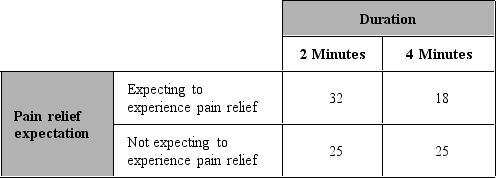 -Provide a graph of the possible interaction in Dr.Lopez's study and discuss whether Dr.Lopez should conclude that an interaction exists in his study.
 (Essay)
4.9/5 (84)
(84) Which of the following phrases might a person encounter in a popular press article that indicates an interaction?
(Multiple Choice)
4.9/5 (78)
(78)
Dr.Elder was interested in the way people recognize objects as members of categories.For example,what makes us recognize a dog as being a dog and not a cat? More specifically,he was curious as to whether people think about categories in a more complex way if they contemplate an "opposite" category first.For example,does a person think differently about the category of "southern" if they first think about the category of "northern"? He is also curious as to whether people categorize differently if they are exposed to category members compared with generating category members.Dr.Elder has four groups of participants (with 30 people in each group).In Group A,participants were told to cut out pictures of dogs and cats from magazines.In Group B,participants were told to cut out pictures of just dogs from magazines.In Group C,participants were told to draw pictures of cats and dogs.In Group D,participants were told to draw pictures of just dogs.After doing this for 30 minutes,participants in all groups were asked to list the attributes that define the "dog" category.Having a higher number of attributes listed was considered to be an indication of thinking about the category in a more complex way.The results of his study are below.
-In graphing the difference between the differences,which of the following values would Dr.Elder use?
-In graphing the difference between the differences,which of the following values would Dr.Elder use? (Multiple Choice)
4.9/5 (87)
(87)
Dr.Elder was interested in the way people recognize objects as members of categories.For example,what makes us recognize a dog as being a dog and not a cat? More specifically,he was curious as to whether people think about categories in a more complex way if they contemplate an "opposite" category first.For example,does a person think differently about the category of "southern" if they first think about the category of "northern"? He is also curious as to whether people categorize differently if they are exposed to category members compared with generating category members.Dr.Elder has four groups of participants (with 30 people in each group).In Group A,participants were told to cut out pictures of dogs and cats from magazines.In Group B,participants were told to cut out pictures of just dogs from magazines.In Group C,participants were told to draw pictures of cats and dogs.In Group D,participants were told to draw pictures of just dogs.After doing this for 30 minutes,participants in all groups were asked to list the attributes that define the "dog" category.Having a higher number of attributes listed was considered to be an indication of thinking about the category in a more complex way.The results of his study are below.
-How many participant variables exist in Dr.Elder's study?
-How many participant variables exist in Dr.Elder's study? (Multiple Choice)
5.0/5 (77)
(77)
Dr.Elder was interested in the way people recognize objects as members of categories.For example,what makes us recognize a dog as being a dog and not a cat? More specifically,he was curious as to whether people think about categories in a more complex way if they contemplate an "opposite" category first.For example,does a person think differently about the category of "southern" if they first think about the category of "northern"? He is also curious as to whether people categorize differently if they are exposed to category members compared with generating category members.Dr.Elder has four groups of participants (with 30 people in each group).In Group A,participants were told to cut out pictures of dogs and cats from magazines.In Group B,participants were told to cut out pictures of just dogs from magazines.In Group C,participants were told to draw pictures of cats and dogs.In Group D,participants were told to draw pictures of just dogs.After doing this for 30 minutes,participants in all groups were asked to list the attributes that define the "dog" category.Having a higher number of attributes listed was considered to be an indication of thinking about the category in a more complex way.The results of his study are below.
-To determine if there is a main effect for type of activity,Dr.Elder must examine how many marginal means?
-To determine if there is a main effect for type of activity,Dr.Elder must examine how many marginal means? (Multiple Choice)
4.9/5 (78)
(78)
To study the effects of physical discomfort on attention,Dr.Lopez conducted the following study: A group of participants were required to keep one hand submerged in cold water (52 degrees).Half of the participants kept their hand in the water for two minutes,and half of the participants kept their hand in the water for four minutes.In addition,half of the participants were given a placebo pill and told it would reduce the pain of the water (pain relief assumed).The other half were given a placebo pill and told that it would have no effect (no pain relief assumed).While their hands were in the water,participants were asked to watch a video where a ball is quickly passed between and underneath three cups.At the end of the video,participants were asked to indicate under which cup the ball could be found.Whether or not the participant picked the correct cup was recorded (as a measure of whether they were paying attention).The results are below.
-Imagine that Dr.Lopez decides to add another variable to his study.He is curious as to whether the results of the study vary based on sex (male and female).Using factorial notation,describe Dr.Lopez's study.Given this new study design,how does this change the number of cells,main effects,and interactions in Dr.Lopez's study?
-Imagine that Dr.Lopez decides to add another variable to his study.He is curious as to whether the results of the study vary based on sex (male and female).Using factorial notation,describe Dr.Lopez's study.Given this new study design,how does this change the number of cells,main effects,and interactions in Dr.Lopez's study? (Essay)
4.9/5 (88)
(88)
(The first paragraph is repeated from earlier.The second paragraph is specific to the new set of questions.The first paragraph is necessary to set up the original study. )
Dr.Elder was interested in the way people recognize objects as members of categories.For example,what makes us recognize a dog as being a dog and not a cat? More specifically,he was curious as to whether people think about categories in a more complex way if they contemplate an "opposite" category first.For example,does a person think more differently about the category of "southern" if they are also thinking about the category of "northern"? He is also curious as to whether people categorize differently if they are exposed to category members compared with generating category members.Dr.Elder has four groups of participants (with 30 people in each group).In Group A,participants were told to cut out pictures of dogs and cats from magazines.In Group B,participants were told to cut out pictures of just dogs from magazines.In Group C,participants were told to draw pictures of cats and dogs.In Group D,participants were told to draw pictures of just dogs.After doing this for 30 minutes,participants in all groups were asked to list the attributes that define the "dog" category.Having a higher number of attributes listed was considered to be an indication of thinking about the category in a more complex way.
Dr.Elder also is curious as to whether categorization happens similarly for children as it does for adults.As such,he recruits a group of 10-year-olds and a group of 20-year-olds to participate in the study.The results are below.
-Based on the graphs above,why should Dr.Elder conclude that there is a three-way interaction?
-Based on the graphs above,why should Dr.Elder conclude that there is a three-way interaction? (Multiple Choice)
4.9/5 (89)
(89)
To study the effects of physical discomfort on attention,Dr.Lopez conducted the following study: A group of participants were required to keep one hand submerged in cold water (52 degrees).Half of the participants kept their hand in the water for two minutes,and half of the participants kept their hand in the water for four minutes.In addition,half of the participants were given a placebo pill and told it would reduce the pain of the water (pain relief assumed).The other half were given a placebo pill and told that it would have no effect (no pain relief assumed).While their hands were in the water,participants were asked to watch a video where a ball is quickly passed between and underneath three cups.At the end of the video,participants were asked to indicate under which cup the ball could be found.Whether or not the participant picked the correct cup was recorded (as a measure of whether they were paying attention).The results are below.
-Using factorial notation,describe Dr.Lopez's study.Given this information,how many main effects and interactions will Dr.Lopez need to examine?
-Using factorial notation,describe Dr.Lopez's study.Given this information,how many main effects and interactions will Dr.Lopez need to examine? (Essay)
4.9/5 (82)
(82)
To study the effects of physical discomfort on attention,Dr.Lopez conducted the following study: A group of participants were required to keep one hand submerged in cold water (52 degrees).Half of the participants kept their hand in the water for two minutes,and half of the participants kept their hand in the water for four minutes.In addition,half of the participants were given a placebo pill and told it would reduce the pain of the water (pain relief assumed).The other half were given a placebo pill and told that it would have no effect (no pain relief assumed).While their hands were in the water,participants were asked to watch a video where a ball is quickly passed between and underneath three cups.At the end of the video,participants were asked to indicate under which cup the ball could be found.Whether or not the participant picked the correct cup was recorded (as a measure of whether they were paying attention).The results are below.
-Name the independent variables in this study and describe their levels.
-Name the independent variables in this study and describe their levels. (Essay)
4.8/5 (75)
(75) 
Filters
- Essay(0)
- Multiple Choice(0)
- Short Answer(0)
- True False(0)
- Matching(0)