



 Chat with AI
Exam 12: Experiments With More Than One Independent Variable

Exam 1: Psychology Is a Way of Thinking55 Questions
Exam 2: Sources of Information: Evaluating, finding, and Reading Information55 Questions
Exam 3: Three Claims, four Validities: Interrogation Tools for Consumers of Research55 Questions
Exam 4: Ethical Guidelines for Psychology Research55 Questions
Exam 5: Identifying Good Measurement55 Questions
Exam 6: Surveys and Observations: Describing What People Do51 Questions
Exam 7: Sampling: Estimating the Frequency of Behaviors and Beliefs55 Questions
Exam 8: Bivariate Correlational Research55 Questions
Exam 9: Multivariate Correlational Research55 Questions
Exam 10: Introduction to Simple Experiments55 Questions
Exam 11: More on Experiments: Confounding and Obscuring Variables55 Questions
Exam 12: Experiments With More Than One Independent Variable55 Questions
Exam 13: Quasi-Experiments and Small-N Designs55 Questions
Exam 14: Replicability, generalization, and the Real World55 Questions
Select questions type


The mathematical way to describe an interaction is:

Free
(Multiple Choice)
4.8/5  (76)
(76) Correct Answer: Verified
A
State the three types of factorial designs.
Free
(Essay)
4.9/5 (67)
(67) Correct Answer:Verified
VerifiedStudents should state that there are three types of factorial designs: independent-groups factorial designs,within-groups factorial designs,and mixed factorial designs.
Dr.Elder was interested in the way people recognize objects as members of categories.For example,what makes us recognize a dog as being a dog and not a cat? More specifically,he was curious as to whether people think about categories in a more complex way if they contemplate an "opposite" category first.For example,does a person think differently about the category of "southern" if they first think about the category of "northern"? He is also curious as to whether people categorize differently if they are exposed to category members compared with generating category members.Dr.Elder has four groups of participants (with 30 people in each group).In Group A,participants were told to cut out pictures of dogs and cats from magazines.In Group B,participants were told to cut out pictures of just dogs from magazines.In Group C,participants were told to draw pictures of cats and dogs.In Group D,participants were told to draw pictures of just dogs.After doing this for 30 minutes,participants in all groups were asked to list the attributes that define the "dog" category.Having a higher number of attributes listed was considered to be an indication of thinking about the category in a more complex way.The results of his study are below.
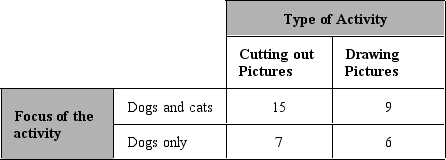 -Which of the following could NOT be said of the focus of activity variable in Dr.Elder's study?
Free
(Multiple Choice)
4.9/5 (67)
(67) Correct Answer:Verified
VerifiedD
Imagine that you read the following passage in a popular magazine.Should you conclude that the original article found evidence of an interaction? Why is or why isn't there evidence of an interaction?
"One study had participants watch a crime show.Half the participants watched a documentary of a murder that took place in rural Virginia,while the other half watched a movie adaptation of the same murder.The effect of viewing a crime show on people's fear of being a victim of crime depends on the participants' sex,with women in general being more fearful regardless of which show they saw,whereas men reported more fear after watching the documentary."
(Essay)
4.9/5 (84)
(84)
To study the effects of physical discomfort on attention,Dr.Lopez conducted the following study: A group of participants were required to keep one hand submerged in cold water (52 degrees).Half of the participants kept their hand in the water for two minutes,and half of the participants kept their hand in the water for four minutes.In addition,half of the participants were given a placebo pill and told it would reduce the pain of the water (pain relief assumed).The other half were given a placebo pill and told that it would have no effect (no pain relief assumed).While their hands were in the water,participants were asked to watch a video where a ball is quickly passed between and underneath three cups.At the end of the video,participants were asked to indicate under which cup the ball could be found.Whether or not the participant picked the correct cup was recorded (as a measure of whether they were paying attention).The results are below.
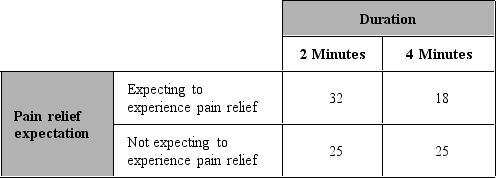 -Using Dr.Lopez's study as an example,explain why an interaction can be described as "a difference in differences."
 (Essay)
4.9/5 (72)
(72) The number of main effects that need to be examined is ________ the number of independent variables.
(Multiple Choice)
4.9/5 (90)
(90)
(The first paragraph is repeated from earlier.The second paragraph is specific to the new set of questions.The first paragraph is necessary to set up the original study. )
Dr.Elder was interested in the way people recognize objects as members of categories.For example,what makes us recognize a dog as being a dog and not a cat? More specifically,he was curious as to whether people think about categories in a more complex way if they contemplate an "opposite" category first.For example,does a person think more differently about the category of "southern" if they are also thinking about the category of "northern"? He is also curious as to whether people categorize differently if they are exposed to category members compared with generating category members.Dr.Elder has four groups of participants (with 30 people in each group).In Group A,participants were told to cut out pictures of dogs and cats from magazines.In Group B,participants were told to cut out pictures of just dogs from magazines.In Group C,participants were told to draw pictures of cats and dogs.In Group D,participants were told to draw pictures of just dogs.After doing this for 30 minutes,participants in all groups were asked to list the attributes that define the "dog" category.Having a higher number of attributes listed was considered to be an indication of thinking about the category in a more complex way.
Dr.Elder also is curious as to whether categorization happens similarly for children as it does for adults.As such,he recruits a group of 10-year-olds and a group of 20-year-olds to participate in the study.The results are below.
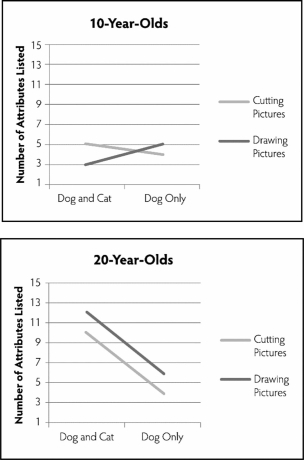 -In the study described above,Dr.Elder will need to examine ________ main effects and ________ interactions.
 (Multiple Choice)
4.9/5 (69)
(69)
To study the effects of physical discomfort on attention,Dr.Lopez conducted the following study: A group of participants were required to keep one hand submerged in cold water (52 degrees).Half of the participants kept their hand in the water for two minutes,and half of the participants kept their hand in the water for four minutes.In addition,half of the participants were given a placebo pill and told it would reduce the pain of the water (pain relief assumed).The other half were given a placebo pill and told that it would have no effect (no pain relief assumed).While their hands were in the water,participants were asked to watch a video where a ball is quickly passed between and underneath three cups.At the end of the video,participants were asked to indicate under which cup the ball could be found.Whether or not the participant picked the correct cup was recorded (as a measure of whether they were paying attention).The results are below.
-Imagine that Dr.Lopez decides to add an additional variable to his study.He is curious as to whether the results of the study vary based on sex (male and female).The graphs of the results are below.Discuss whether Dr.Lopez should conclude that a three-way interaction exists in his study.
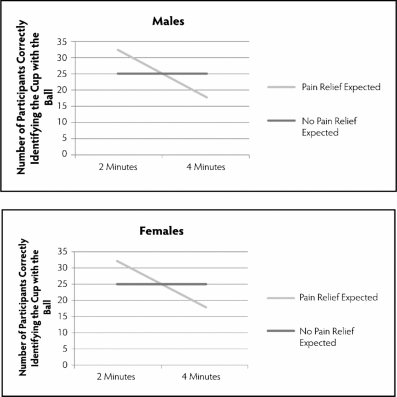
-Imagine that Dr.Lopez decides to add an additional variable to his study.He is curious as to whether the results of the study vary based on sex (male and female).The graphs of the results are below.Discuss whether Dr.Lopez should conclude that a three-way interaction exists in his study.
(Essay)
4.9/5 (80)
(80) What is the difference between a main effect and an overall effect?
(Multiple Choice)
4.7/5 (77)
(77) Imagine that you read the following passage in a journal article.Provide three pieces of information that this passage tells the reader about the study conducted.
"A 3×4 within-subjects design was specified that varied color of paper (blue,pink,white)and font size (10pt,12pt,14pt,16pt).The time it took participants to read the printed word was measured."
(Essay)
4.7/5 (58)
(58)
Dr.Elder was interested in the way people recognize objects as members of categories.For example,what makes us recognize a dog as being a dog and not a cat? More specifically,he was curious as to whether people think about categories in a more complex way if they contemplate an "opposite" category first.For example,does a person think differently about the category of "southern" if they first think about the category of "northern"? He is also curious as to whether people categorize differently if they are exposed to category members compared with generating category members.Dr.Elder has four groups of participants (with 30 people in each group).In Group A,participants were told to cut out pictures of dogs and cats from magazines.In Group B,participants were told to cut out pictures of just dogs from magazines.In Group C,participants were told to draw pictures of cats and dogs.In Group D,participants were told to draw pictures of just dogs.After doing this for 30 minutes,participants in all groups were asked to list the attributes that define the "dog" category.Having a higher number of attributes listed was considered to be an indication of thinking about the category in a more complex way.The results of his study are below.
-To make his study a 2×2×3 factorial design,which of the following would Dr.Elder need to do?
-To make his study a 2×2×3 factorial design,which of the following would Dr.Elder need to do? (Multiple Choice)
4.9/5 (77)
(77) Dr.Gavin is conducting a 2×4 independent-groups factorial design.How many independent variables are in his study?
(Multiple Choice)
4.8/5 (76)
(76) Explain why researchers care about interactions more than main effects.
(Essay)
4.8/5 (66)
(66)
To study the effects of physical discomfort on attention,Dr.Lopez conducted the following study: A group of participants were required to keep one hand submerged in cold water (52 degrees).Half of the participants kept their hand in the water for two minutes,and half of the participants kept their hand in the water for four minutes.In addition,half of the participants were given a placebo pill and told it would reduce the pain of the water (pain relief assumed).The other half were given a placebo pill and told that it would have no effect (no pain relief assumed).While their hands were in the water,participants were asked to watch a video where a ball is quickly passed between and underneath three cups.At the end of the video,participants were asked to indicate under which cup the ball could be found.Whether or not the participant picked the correct cup was recorded (as a measure of whether they were paying attention).The results are below.
-Using the marginal means,state whether it appears that the main effects in Dr.Lopez's study are important.(You do not need to say whether the main effects are statistically significant,but simply whether a difference appears to exist. )
-Using the marginal means,state whether it appears that the main effects in Dr.Lopez's study are important.(You do not need to say whether the main effects are statistically significant,but simply whether a difference appears to exist. ) (Essay)
4.7/5 (88)
(88)
(The first paragraph is repeated from earlier.The second paragraph is specific to the new set of questions.The first paragraph is necessary to set up the original study. )
Dr.Elder was interested in the way people recognize objects as members of categories.For example,what makes us recognize a dog as being a dog and not a cat? More specifically,he was curious as to whether people think about categories in a more complex way if they contemplate an "opposite" category first.For example,does a person think more differently about the category of "southern" if they are also thinking about the category of "northern"? He is also curious as to whether people categorize differently if they are exposed to category members compared with generating category members.Dr.Elder has four groups of participants (with 30 people in each group).In Group A,participants were told to cut out pictures of dogs and cats from magazines.In Group B,participants were told to cut out pictures of just dogs from magazines.In Group C,participants were told to draw pictures of cats and dogs.In Group D,participants were told to draw pictures of just dogs.After doing this for 30 minutes,participants in all groups were asked to list the attributes that define the "dog" category.Having a higher number of attributes listed was considered to be an indication of thinking about the category in a more complex way.
Dr.Elder also is curious as to whether categorization happens similarly for children as it does for adults.As such,he recruits a group of 10-year-olds and a group of 20-year-olds to participate in the study.The results are below.
-In the study described above,Dr.Elder will need to examine how many two-way interactions?
-In the study described above,Dr.Elder will need to examine how many two-way interactions? (Multiple Choice)
4.8/5 (83)
(83) Dr.Rhodes notices an interaction in his factorial study.In describing this,which statement might he use to explain the link between Independent Variable A and Independent Variable B in predicting the dependent variable?
(Multiple Choice)
4.9/5 (76)
(76)
(The first paragraph is repeated from earlier.The second paragraph is specific to the new set of questions.The first paragraph is necessary to set up the original study. )
Dr.Elder was interested in the way people recognize objects as members of categories.For example,what makes us recognize a dog as being a dog and not a cat? More specifically,he was curious as to whether people think about categories in a more complex way if they contemplate an "opposite" category first.For example,does a person think more differently about the category of "southern" if they are also thinking about the category of "northern"? He is also curious as to whether people categorize differently if they are exposed to category members compared with generating category members.Dr.Elder has four groups of participants (with 30 people in each group).In Group A,participants were told to cut out pictures of dogs and cats from magazines.In Group B,participants were told to cut out pictures of just dogs from magazines.In Group C,participants were told to draw pictures of cats and dogs.In Group D,participants were told to draw pictures of just dogs.After doing this for 30 minutes,participants in all groups were asked to list the attributes that define the "dog" category.Having a higher number of attributes listed was considered to be an indication of thinking about the category in a more complex way.
Dr.Elder also is curious as to whether categorization happens similarly for children as it does for adults.As such,he recruits a group of 10-year-olds and a group of 20-year-olds to participate in the study.The results are below.
-Which of the following reasons might Dr.Elder have for changing his study in this way?
-Which of the following reasons might Dr.Elder have for changing his study in this way? (Multiple Choice)
4.9/5 (69)
(69)
To study the effects of physical discomfort on attention,Dr.Lopez conducted the following study: A group of participants were required to keep one hand submerged in cold water (52 degrees).Half of the participants kept their hand in the water for two minutes,and half of the participants kept their hand in the water for four minutes.In addition,half of the participants were given a placebo pill and told it would reduce the pain of the water (pain relief assumed).The other half were given a placebo pill and told that it would have no effect (no pain relief assumed).While their hands were in the water,participants were asked to watch a video where a ball is quickly passed between and underneath three cups.At the end of the video,participants were asked to indicate under which cup the ball could be found.Whether or not the participant picked the correct cup was recorded (as a measure of whether they were paying attention).The results are below.
-Using the data table alone,discuss whether Dr.Lopez should conclude that an interaction exists in his study.
-Using the data table alone,discuss whether Dr.Lopez should conclude that an interaction exists in his study. (Essay)
5.0/5 (90)
(90) When reading popular press articles,why does the inclusion of participant variable information often denote a factorial design?
(Multiple Choice)
4.9/5 (67)
(67) Neely is examining the graph of an interaction and sees that one line is flat and one line rises sharply to the right.Which of the following should Neely conclude?
(Multiple Choice)
4.9/5 (77)
(77) 
Filters
- Essay(0)
- Multiple Choice(0)
- Short Answer(0)
- True False(0)
- Matching(0)