Multiple Choice
Dr.Elder was interested in the way people recognize objects as members of categories.For example,what makes us recognize a dog as being a dog and not a cat? More specifically,he was curious as to whether people think about categories in a more complex way if they contemplate an "opposite" category first.For example,does a person think differently about the category of "southern" if they first think about the category of "northern"? He is also curious as to whether people categorize differently if they are exposed to category members compared with generating category members.Dr.Elder has four groups of participants (with 30 people in each group) .In Group A,participants were told to cut out pictures of dogs and cats from magazines.In Group B,participants were told to cut out pictures of just dogs from magazines.In Group C,participants were told to draw pictures of cats and dogs.In Group D,participants were told to draw pictures of just dogs.After doing this for 30 minutes,participants in all groups were asked to list the attributes that define the "dog" category.Having a higher number of attributes listed was considered to be an indication of thinking about the category in a more complex way.The results of his study are below.
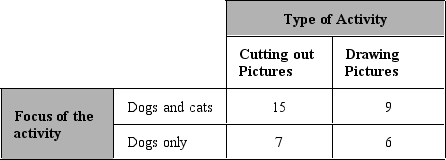
-In Dr.Elder's study,how many possible main effects exist?
A) 1
B) 2
C) 3
D) 4
Correct Answer:

Verified
Correct Answer:
Verified
Q5: Dr. Gavin is conducting a 2 ×
Q38: If a person describes the results of
Q44: <br>(The first paragraph is repeated from earlier.The
Q45: A "difference in the difference between the
Q45: <br>Dr.Elder was interested in the way people
Q47: <br>To study the effects of physical discomfort
Q48: Which of the following phrases might a
Q56: Dr. Gavin decides that instead of conducting
Q60: According to the textbook, why is it
Q64: Dr. Gavin is conducting a 2 ×