



 Chat with AI
Exam 21: Nutrition and Digestion

Exam 1: Biology: Exploring Life48 Questions
Exam 2: The Chemical Basis of Life72 Questions
Exam 3: The Molecules of Cells85 Questions
Exam 4: A Tour of the Cell90 Questions
Exam 5: The Working Cell80 Questions
Exam 6: How Cells Harvest Chemical Energy82 Questions
Exam 7: Photosynthesis: Using Light to Make Food81 Questions
Exam 8: The Cellular Basis of Reproduction and Inheritance78 Questions
Exam 9: Patterns of Inheritance77 Questions
Exam 10: Molecular Biology of the Gene82 Questions
Exam 11: How Genes Are Controlled81 Questions
Exam 12: DNA Technology and Genomics78 Questions
Exam 13: How Populations Evolve64 Questions
Exam 14: The Origin of Species58 Questions
Exam 15: Tracing Evolutionary History82 Questions
Exam 16: Microbial Life: Prokaryotes and Protists84 Questions
Exam 17: The Evolution of Plant and Fungal Diversity79 Questions
Exam 18: The Evolution of Invertebrate Diversity72 Questions
Exam 19: The Evolution of Vertebrate Diversity72 Questions
Exam 20: Unifying Concepts of Animal Structure and Function63 Questions
Exam 21: Nutrition and Digestion91 Questions
Exam 22: Gas Exchange66 Questions
Exam 23: Circulation77 Questions
Exam 24: the Immune System79 Questions
Exam 25: Control of Body Temperature and Water Balance63 Questions
Exam 26: Hormones and the Endocrine System60 Questions
Exam 27: Reproduction and Embryonic Development71 Questions
Exam 28: Nervous Systems70 Questions
Exam 29: the Senses60 Questions
Exam 30: How Animals Move69 Questions
Exam 31: Plant Structure, Growth, and Reproduction79 Questions
Exam 32: Plant Nutrition and Transport65 Questions
Exam 33: Control Systems in Plants58 Questions
Exam 34: the Biosphere: an Introduction to Earths Diverse Environments63 Questions
Exam 35: Behavioral Adaptations to the Environment52 Questions
Exam 36: Population Ecology53 Questions
Exam 37: Communities and Ecosystems60 Questions
Exam 38: Conservation Biology57 Questions
Select questions type


Which of the following choices lists the organs of the bird digestive system in the correct order, from first to last contact with food material?
(Multiple Choice)
4.9/5  (75)
(75) After reading the paragraph below, answer the questions that follow.
Malnutrition can cause a variety of health problems, including being underweight, due to unbalanced or insufficient diet. It is estimated that in 2015, approximately 14% of preschool-age children globally will be underweight (WHO and UNICEF Joint Global Nutrition Database, 2011). While this is a high percentage, it is a drop from approximately 25% just 25 years earlier.
Consider the data table below and answer the questions that follow.
 -The data for the developed countries category indicate that developed countries (e.g., the United States)have the lowest estimated prevalence (%)of underweight preschool children from 1990 to 2015. However, what is concerning about these data?
 (Multiple Choice)
4.8/5 (77)
(77) Nectarivores drink flower nectar that is a sugary sweet liquid. Nectarivores are an example of ________.
(Multiple Choice)
4.9/5 (82)
(82) Altogether, the body secretes about 7 liters of water into the alimentary canal each day. About what percentage of this water gets reabsorbed?
(Multiple Choice)
4.8/5 (87)
(87) 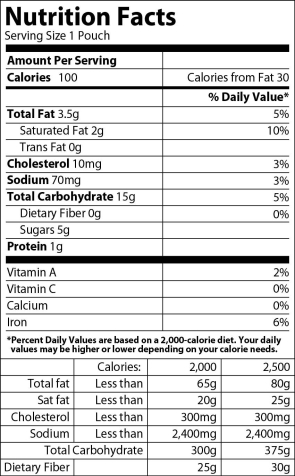 You are trying to cut down on the number of dessert foods that you eat as one effort toward losing weight. You don't feel ready to cut all sweets from your diet, so you decide to buy a dessert snack item that comes in small packages (hoping that the smaller amount will satisfy your cravings for sweet foods). In the grocery store, you study the label above for 100-calorie pouches of Krispy Krackers.
-What percentage of the daily value of water-soluble vitamins is provided by this package of cookies?
You are trying to cut down on the number of dessert foods that you eat as one effort toward losing weight. You don't feel ready to cut all sweets from your diet, so you decide to buy a dessert snack item that comes in small packages (hoping that the smaller amount will satisfy your cravings for sweet foods). In the grocery store, you study the label above for 100-calorie pouches of Krispy Krackers.
-What percentage of the daily value of water-soluble vitamins is provided by this package of cookies? (Multiple Choice)
4.9/5 (95)
(95) Which of the following is associated with a reduced risk of cardiovascular disease?
(Multiple Choice)
4.8/5 (68)
(68) Which of the following choices correctly pairs a mineral with one of its major functions in the body?
(Multiple Choice)
4.8/5 (78)
(78) After reading the paragraph below, answer the questions that follow.
Offering nutritious lunches in public schools is a popular health topic. School lunches have had to meet new nutrition standards since the fall of 2012. In 2013, the USDA (United States Department of Agriculture) reviewed data from the 2005 School Nutrition and Dietary Assessment to investigate whether students in schools that were already following the new standards (school group A) and that therefore offered more fruits and vegetables than other schools (school group B) actually ate more of them.
-Finding #3: Of all of the schools surveyed in 2005: 75% offered lunches that met new weekly standards for amounts of dark, green leafy vegetables
85% offered lunches that met new weekly standards for amounts for red/orange vegetables
21% offered lunches that met new weekly standards for legumes
97% offered lunches that met new weekly standards for amounts for "other" vegetables
This suggests that
(Multiple Choice)
4.9/5 (76)
(76) The secretory parietal cells of the stomach are responsible for producing
(Multiple Choice)
4.7/5 (91)
(91) Which of the following statements regarding animals is false?
(Multiple Choice)
4.8/5 (68)
(68) An animal digestive tract that consists of two openings (a mouth and anus)is called
(Multiple Choice)
4.8/5 (81)
(81) 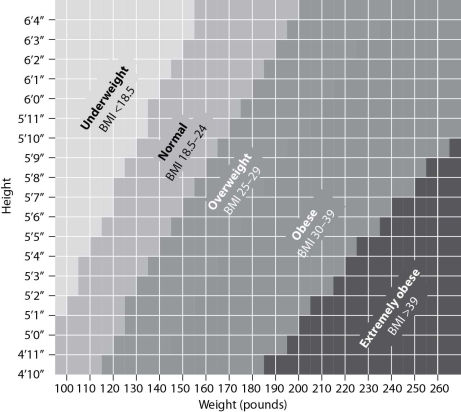 -A person who is 5' 7" and weighs 170 pounds would be considered
 (Multiple Choice)
4.8/5 (73)
(73) Which of the following nutrients is digested only after it reaches the small intestine?
(Multiple Choice)
4.8/5 (83)
(83) Bile produced in the liver is stored in the ________ before entering the intestine.
(Multiple Choice)
4.7/5 (82)
(82) Which of the following digestive system structures is greatly expanded in size in koalas, resulting in a very large surface area for prokaryotes to digest plant material?
(Multiple Choice)
4.9/5 (72)
(72) The minimal amount of nutrients needed every day by healthy people to prevent nutrient deficiencies is called the
(Multiple Choice)
4.7/5 (89)
(89) 
Filters
- Essay(0)
- Multiple Choice(0)
- Short Answer(0)
- True False(0)
- Matching(0)