



 Chat with AI
Exam 17: The Evolution of Plant and Fungal Diversity

Exam 1: Biology: Exploring Life48 Questions
Exam 2: The Chemical Basis of Life72 Questions
Exam 3: The Molecules of Cells85 Questions
Exam 4: A Tour of the Cell90 Questions
Exam 5: The Working Cell80 Questions
Exam 6: How Cells Harvest Chemical Energy82 Questions
Exam 7: Photosynthesis: Using Light to Make Food81 Questions
Exam 8: The Cellular Basis of Reproduction and Inheritance78 Questions
Exam 9: Patterns of Inheritance77 Questions
Exam 10: Molecular Biology of the Gene82 Questions
Exam 11: How Genes Are Controlled81 Questions
Exam 12: DNA Technology and Genomics78 Questions
Exam 13: How Populations Evolve64 Questions
Exam 14: The Origin of Species58 Questions
Exam 15: Tracing Evolutionary History82 Questions
Exam 16: Microbial Life: Prokaryotes and Protists84 Questions
Exam 17: The Evolution of Plant and Fungal Diversity79 Questions
Exam 18: The Evolution of Invertebrate Diversity72 Questions
Exam 19: The Evolution of Vertebrate Diversity72 Questions
Exam 20: Unifying Concepts of Animal Structure and Function63 Questions
Exam 21: Nutrition and Digestion91 Questions
Exam 22: Gas Exchange66 Questions
Exam 23: Circulation77 Questions
Exam 24: the Immune System79 Questions
Exam 25: Control of Body Temperature and Water Balance63 Questions
Exam 26: Hormones and the Endocrine System60 Questions
Exam 27: Reproduction and Embryonic Development71 Questions
Exam 28: Nervous Systems70 Questions
Exam 29: the Senses60 Questions
Exam 30: How Animals Move69 Questions
Exam 31: Plant Structure, Growth, and Reproduction79 Questions
Exam 32: Plant Nutrition and Transport65 Questions
Exam 33: Control Systems in Plants58 Questions
Exam 34: the Biosphere: an Introduction to Earths Diverse Environments63 Questions
Exam 35: Behavioral Adaptations to the Environment52 Questions
Exam 36: Population Ecology53 Questions
Exam 37: Communities and Ecosystems60 Questions
Exam 38: Conservation Biology57 Questions
Select questions type


The incomplete decay of dead plants during the Carboniferous period led to
(Multiple Choice)
4.8/5  (72)
(72) Which of the following statements correctly describes the alternation of generations in a plant life cycle?
(Multiple Choice)
4.8/5 (68)
(68) During the Carboniferous period, photosynthesis in immense swamp forests removed ________ from the atmosphere, which produced a drier, cooler global climate and promoted the success of ________.
(Multiple Choice)
4.8/5 (82)
(82) In all plants, the zygote and earliest stages of the developing embryo are
(Multiple Choice)
4.8/5 (78)
(78) After reading the paragraphs below, answer the questions that follow.
Scientists believe that a shift from pollination by insects to pollination by birds occurred several times over the course of angiosperm evolution. Two researchers designed an experiment to investigate how these shifts might evolve using two species of monkey flower (Mimulus spp.). M. lewisii has violet-pink flowers and is pollinated by bumblebees. M. cardinalis has orange-red flowers and is pollinated by hummingbirds.
The researchers switched flower-color genes between the two species. As a result of the gene transfer, they produced a variation of M. cardinalis with dark pink flowers (instead of the original orange-red) and a variation of M. lewisiis with orange flowers (instead of the original violet-pink). Plants of both genetically altered varieties were placed in their original habitats and observed. The genetically altered variety of M. cardinalis was visited by bumblebees 74 times more often than plants with the original color flowers. The genetically altered variety of M. lewisii was visited by hummingbirds 68 times more often than plants with the original color flowers.
-The evolution of easily modified flower colors that can make plants attractive to animals was an important factor in angiosperm evolution because
(Multiple Choice)
4.8/5 (88)
(88) Red maples and other wind-pollinated plants invest relatively little in producing ________ but must invest a great deal in producing ________ to achieve good pollination rates.
(Multiple Choice)
4.9/5 (73)
(73) Most familiar types of mushrooms, along with puffballs and shelf fungi, are
(Multiple Choice)
4.9/5 (84)
(84) According to this figure, at what time in the evolutionary history of plants did vascular systems likely first evolve? 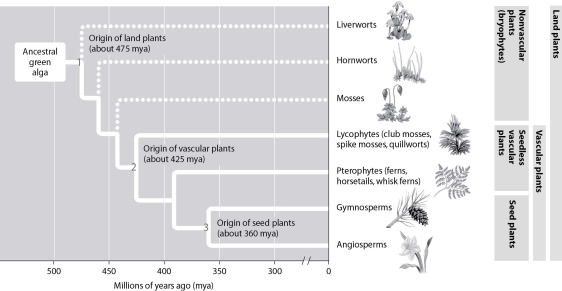
(Multiple Choice)
4.8/5 (85)
(85) A cocklebur is dispersed by ________, whereas most fleshy, edible fruits are eaten by animals that ________.
(Multiple Choice)
4.7/5 (71)
(71) Corn, rice, wheat, fleshy fruits such as apples and berries, and many spices are all produced by
(Multiple Choice)
4.9/5 (73)
(73) The ancestors of land plants were probably ________ that lived in ________.
(Multiple Choice)
4.9/5 (74)
(74) You enjoy learning about history by studying gravestones throughout North America. You notice that gravestones from 1900 and earlier usually host many types of lichens. But in one cemetery, lichens are entirely absent, even from old gravestones. Given what is known about lichens, the cemetery without lichens probably
(Multiple Choice)
4.8/5 (94)
(94) Two characteristics shared by gymnosperms and angiosperms that are absent from earlier plant groups and represent key adaptations to life on dry land are
(Multiple Choice)
4.9/5 (83)
(83) To cross-fertilize flowers A and B, one would first remove flower A's immature ________ and later transfer pollen from flower B to flower A's ________.
(Multiple Choice)
4.9/5 (67)
(67) Corn, peppers, tomatoes, and cucumbers all contain seeds and are derived from the ovary of a flowering plant. Therefore, in scientific terms, they are ________.
(Multiple Choice)
4.9/5 (82)
(82) Different kinds of mycorrhizae occur in different ecosystems. For example, as you walk up a mountain, you might find one type of mycorrhizae in lower regions and a second, different type of mycorrhizae in higher regions. Why are there mycorrhizae specific to certain ecosystems?
(Multiple Choice)
4.8/5 (75)
(75) One of the factors that helps animal-pollinated flowering plants transfer pollen to plants of the same species is that
(Multiple Choice)
4.8/5 (70)
(70) 
Filters
- Essay(0)
- Multiple Choice(0)
- Short Answer(0)
- True False(0)
- Matching(0)