



 Chat with AI
Exam 12: DNA Technology and Genomics

Exam 1: Biology: Exploring Life48 Questions
Exam 2: The Chemical Basis of Life72 Questions
Exam 3: The Molecules of Cells85 Questions
Exam 4: A Tour of the Cell90 Questions
Exam 5: The Working Cell80 Questions
Exam 6: How Cells Harvest Chemical Energy82 Questions
Exam 7: Photosynthesis: Using Light to Make Food81 Questions
Exam 8: The Cellular Basis of Reproduction and Inheritance78 Questions
Exam 9: Patterns of Inheritance77 Questions
Exam 10: Molecular Biology of the Gene82 Questions
Exam 11: How Genes Are Controlled81 Questions
Exam 12: DNA Technology and Genomics78 Questions
Exam 13: How Populations Evolve64 Questions
Exam 14: The Origin of Species58 Questions
Exam 15: Tracing Evolutionary History82 Questions
Exam 16: Microbial Life: Prokaryotes and Protists84 Questions
Exam 17: The Evolution of Plant and Fungal Diversity79 Questions
Exam 18: The Evolution of Invertebrate Diversity72 Questions
Exam 19: The Evolution of Vertebrate Diversity72 Questions
Exam 20: Unifying Concepts of Animal Structure and Function63 Questions
Exam 21: Nutrition and Digestion91 Questions
Exam 22: Gas Exchange66 Questions
Exam 23: Circulation77 Questions
Exam 24: the Immune System79 Questions
Exam 25: Control of Body Temperature and Water Balance63 Questions
Exam 26: Hormones and the Endocrine System60 Questions
Exam 27: Reproduction and Embryonic Development71 Questions
Exam 28: Nervous Systems70 Questions
Exam 29: the Senses60 Questions
Exam 30: How Animals Move69 Questions
Exam 31: Plant Structure, Growth, and Reproduction79 Questions
Exam 32: Plant Nutrition and Transport65 Questions
Exam 33: Control Systems in Plants58 Questions
Exam 34: the Biosphere: an Introduction to Earths Diverse Environments63 Questions
Exam 35: Behavioral Adaptations to the Environment52 Questions
Exam 36: Population Ecology53 Questions
Exam 37: Communities and Ecosystems60 Questions
Exam 38: Conservation Biology57 Questions
Select questions type


Which of the following statements about DNA technology is false?
(Multiple Choice)
4.9/5  (78)
(78) In the process of human gene cloning using plasmids, the bacterial plasmid
(Multiple Choice)
4.9/5 (68)
(68) The type of recombinant bacteria most often used to mass-produce genes is
(Multiple Choice)
4.8/5 (70)
(70) Which of the following statements about nucleic acid probes is false?
(Multiple Choice)
4.9/5 (79)
(79) Some restriction enzymes do not leave sticky ends when cutting DNA molecules; rather, they cut a restriction site down the middle and leave "blunt-ended" DNA molecules, which do not have any single-stranded nucleotide extensions. Which of the following is not a likely outcome when trying to insert a gene into a plasmid when have both been cut with the same "blunt-ended" restriction enzyme?
(Multiple Choice)
4.9/5 (79)
(79) Which of the following is an example of a genetically modified organism but not a transgenic organism?
(Multiple Choice)
4.9/5 (86)
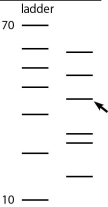
(86) Use the figure below to answer the following question. The bands in the ladder are in 10-base increments, starting with 10 bases at the bottom and going to 70 bases at the top. Approximately how many bases are in the DNA molecule that the arrow is pointing to?
(Multiple Choice)
5.0/5 (80)
(80) Which of the following pieces of evidence would be considered the best for establishing biological relatedness?
(Multiple Choice)
4.7/5 (78)
(78) Which step in this process requires use of restriction enzymes? 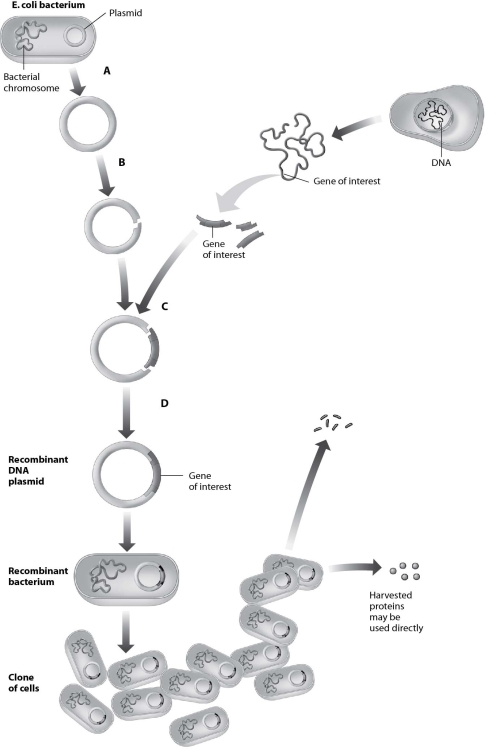
(Multiple Choice)
4.7/5 (67)
(67) The feature of "sticky ends" that makes them especially useful in DNA recombination is their ability to
(Multiple Choice)
4.9/5 (77)
(77) After reading the paragraph below, answer the questions that follow.
Four decades after the end of the Vietnam War, the remains of an Air Force pilot were discovered and returned to the United States. A search of Air Force records identified three families to which the remains might possibly belong. Each family had a surviving twin of a missing service member. The following STR profiles were obtained from the remains of the pilot and the surviving twins from the three families.
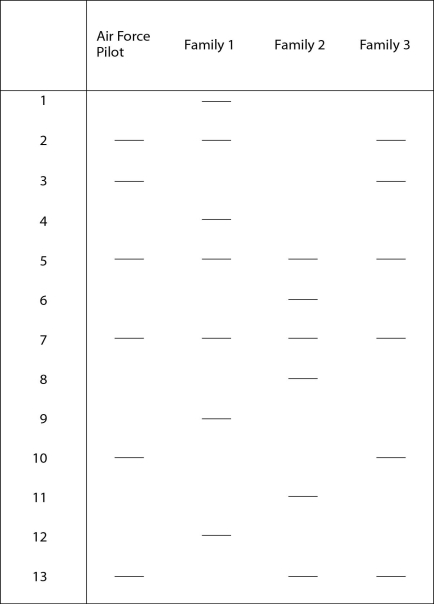 -Based on analysis of the STR sites shown, which family is the missing pilot least likely to belong to?
 (Multiple Choice)
4.9/5 (75)
(75) Why is the whole-genome shotgun method currently the tool of choice for analyzing genomes?
(Multiple Choice)
4.9/5 (70)
(70) The polymerase chain reaction relies upon unusual, heat-resistant ________ that were isolated from bacteria living in hot springs.
(Multiple Choice)
4.8/5 (86)
(86) After reading the paragraphs below, answer the questions that follow.
Cystic fibrosis is an autosomal recessive genetic disorder that most severely affects the lungs and respiratory tract. Cystic fibrosis is caused by a mutation in the gene for the protein cystic fibrosis transmembrane regulator (CFTR), which regulates the movement of chloride and sodium ions across epithelial cell membranes. When the CFTR gene is mutated in cystic fibrosis, the defective CFTR protein cannot transport ions properly, which results in too little water drawn across the membrane and the buildup of thick and sticky (viscous) mucus, especially in the airways. This leads to difficulty of breathing and frequent lung infections.
Research has shown that some of the increased thickness and viscosity of the mucus in the respiratory tract is due to the presence of human DNA. If DNA is present in high concentrations in solution, the DNA molecules can get entangled and lead to a thick, viscous solution. To combat this, pharmaceutical companies have developed recombinant forms of the human deoxyribonuclease I (DNase I) protein. DNase I, after being translated and modified with sugar groups, is normally produced in human cells and possibly plays a role in DNA breakdown during apoptosis (programmed cell death).
-A scientist produced a batch of recombinant DNase I in E. coli cells and a batch in mammalian cells. She placed 0.1 mg of the E. coli-derived DNase I in a vial containing a solution of DNA, and she placed 0.1 mg of the mammalian cell-derived DNase I in a separate vial containing the same solution of DNA. The initial viscosity of the DNA solutions was identical. What do you expect the viscosity of the DNA solutions to be after ten minutes have passed, and why?
(Multiple Choice)
4.8/5 (76)
(76) The restriction enzyme SacI has a recognition sequence of GAGCT^C, where the caret (^)indicates the cut site. Examine the DNA molecule below. AGAGCTCAGTCGAGAGCTCAGATCGATAGGAGCTCAGATCTCGATCACCTC
TCTCGAGTCAGCTCTCGAGTCTAGCTATCCTCGAGTCTAGAGCTAGTGGAG
How many separate molecules of DNA would you end up with if you treated the above DNA molecule with SacI?
(Multiple Choice)
4.7/5 (93)
(93) 
Filters
- Essay(0)
- Multiple Choice(0)
- Short Answer(0)
- True False(0)
- Matching(0)