



 Chat with AI
Exam 10: Molecular Biology of the Gene

Exam 1: Biology: Exploring Life48 Questions
Exam 2: The Chemical Basis of Life72 Questions
Exam 3: The Molecules of Cells85 Questions
Exam 4: A Tour of the Cell90 Questions
Exam 5: The Working Cell80 Questions
Exam 6: How Cells Harvest Chemical Energy82 Questions
Exam 7: Photosynthesis: Using Light to Make Food81 Questions
Exam 8: The Cellular Basis of Reproduction and Inheritance78 Questions
Exam 9: Patterns of Inheritance77 Questions
Exam 10: Molecular Biology of the Gene82 Questions
Exam 11: How Genes Are Controlled81 Questions
Exam 12: DNA Technology and Genomics78 Questions
Exam 13: How Populations Evolve64 Questions
Exam 14: The Origin of Species58 Questions
Exam 15: Tracing Evolutionary History82 Questions
Exam 16: Microbial Life: Prokaryotes and Protists84 Questions
Exam 17: The Evolution of Plant and Fungal Diversity79 Questions
Exam 18: The Evolution of Invertebrate Diversity72 Questions
Exam 19: The Evolution of Vertebrate Diversity72 Questions
Exam 20: Unifying Concepts of Animal Structure and Function63 Questions
Exam 21: Nutrition and Digestion91 Questions
Exam 22: Gas Exchange66 Questions
Exam 23: Circulation77 Questions
Exam 24: the Immune System79 Questions
Exam 25: Control of Body Temperature and Water Balance63 Questions
Exam 26: Hormones and the Endocrine System60 Questions
Exam 27: Reproduction and Embryonic Development71 Questions
Exam 28: Nervous Systems70 Questions
Exam 29: the Senses60 Questions
Exam 30: How Animals Move69 Questions
Exam 31: Plant Structure, Growth, and Reproduction79 Questions
Exam 32: Plant Nutrition and Transport65 Questions
Exam 33: Control Systems in Plants58 Questions
Exam 34: the Biosphere: an Introduction to Earths Diverse Environments63 Questions
Exam 35: Behavioral Adaptations to the Environment52 Questions
Exam 36: Population Ecology53 Questions
Exam 37: Communities and Ecosystems60 Questions
Exam 38: Conservation Biology57 Questions
Select questions type


After reading the paragraphs below, answer the questions that follow.
Diabetes mellitus is a metabolic disease that is characterized by the buildup of glucose in the blood, or hyperglycemia. Diabetes results either from the pancreas not being able to produce the hormone insulin (type 1 diabetes) or if the body's cells become resistant to insulin (type 2 diabetes). Insulin is a protein that binds to receptors on cell surfaces to allow glucose to enter the cell.
In order to manage the disease, type 1 diabetics require frequent insulin injections. Until the 1970s, insulin was obtained from processing the pancreases of large mammals such as cows and pigs; it was then purified for medicinal use. This all changed in the 1970s with the advent of recombinant DNA technology, which allows scientists to insert genes from other species into bacterial plasmids and have bacteria produce proteins from these other species' genes. In 1978, the gene that codes for human insulin was added to a bacterial plasmid and bacteria were used to produce human insulin. These bacteria acted as mini-factories that produced human insulin for type 1 diabetes patients. Today, the production of human insulin from bacteria is commonplace and is a multibillion dollar market for pharmaceutical companies.
-In order to add the gene for human insulin to a bacterial plasmid, the DNA molecules have to be "cut" with enzymes called restriction endonucleases and then pasted back together with enzymes called DNA ligases. Imagine that during this process, the first five nucleotides of the human insulin gene were accidentally cut out before it was pasted into the bacterial plasmid. What is the most likely outcome if this plasmid was added to bacterial cells?
(Multiple Choice)
4.9/5  (79)
(79) It is possible to synthesize proteins in vitro (in a test tube)without the use of living cells. If starting from a mature mRNA transcript, which of the following components would not be needed to do this?
(Multiple Choice)
4.9/5 (81)
(81) What is the transcription product of the sequence GCTAGCGATGAC?
(Multiple Choice)
5.0/5 (94)
(94) When one DNA molecule is copied to make two DNA molecules, the new DNA contains
(Multiple Choice)
4.9/5 (92)
(92) If Hershey and Chase had used radioactive oxygen in their experiments instead of phosphorus and sulfur, what results would they have likely obtained?
(Multiple Choice)
4.8/5 (73)
(73) You are interested in designing an experiment to test the hypothesis that frogs use the same genetic code as humans. Which of the following experiments would not give you useful data to test this hypothesis?
(Multiple Choice)
4.7/5 (80)
(80) The directions for each amino acid in a polypeptide are indicated by a codon that consists of ________ nucleotides in an RNA molecule.
(Multiple Choice)
4.9/5 (79)
(79) After reading the paragraphs below, answer the questions that follow.
Exposure to the HIV virus doesn't necessarily mean that a person will develop AIDS. Some people have genetic resistance to infection by HIV. Dr. Stephen O'Brien from the U.S. National Cancer Institute has recently identified a mutant form of a gene, called CCR5, that can protect against HIV infection. The mutation probably originated in Europe among survivors of the bubonic plague. The mutated gene prevents the plague bacteria from attaching to cell membranes and, therefore, from entering and infecting body cells.
Although the HIV virus is very different from the bacteria that causes the plague, both diseases affect the exact same cells and use the same method of infection. The presence of the mutated gene in descendants of plague survivors helps prevent them from contracting AIDS. Pharmaceutical companies are using this information as the basis for a new approach to AIDS prevention. This could be very important in areas of the world where the mutation is scarce or absent, such as Africa.
-The most likely method by which the mutated CCR5 gene prevents AIDS is by
(Multiple Choice)
5.0/5 (91)
(91) After reading the paragraphs below, answer the questions that follow.
Diabetes mellitus is a metabolic disease that is characterized by the buildup of glucose in the blood, or hyperglycemia. Diabetes results either from the pancreas not being able to produce the hormone insulin (type 1 diabetes) or if the body's cells become resistant to insulin (type 2 diabetes). Insulin is a protein that binds to receptors on cell surfaces to allow glucose to enter the cell.
In order to manage the disease, type 1 diabetics require frequent insulin injections. Until the 1970s, insulin was obtained from processing the pancreases of large mammals such as cows and pigs; it was then purified for medicinal use. This all changed in the 1970s with the advent of recombinant DNA technology, which allows scientists to insert genes from other species into bacterial plasmids and have bacteria produce proteins from these other species' genes. In 1978, the gene that codes for human insulin was added to a bacterial plasmid and bacteria were used to produce human insulin. These bacteria acted as mini-factories that produced human insulin for type 1 diabetes patients. Today, the production of human insulin from bacteria is commonplace and is a multibillion dollar market for pharmaceutical companies.
-In order for bacterial cells to be able to produce the human insulin protein, which of the following do not have to be true?
(Multiple Choice)
4.9/5 (84)
(84) If the left end of the daughter strand indicated by the arrow in the figure is being synthesized in one continuous piece, then 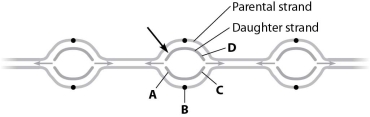
(Multiple Choice)
4.8/5 (74)
(74) Which of the following statements regarding the structure of DNA is false?
(Multiple Choice)
4.9/5 (76)
(76) ________ marks the end of a gene and causes transcription to stop.
(Multiple Choice)
4.9/5 (77)
(77) Which of the following statements characterizes the lytic cycle of a viral infection?
(Multiple Choice)
4.7/5 (67)
(67) Which of the following enzymes catalyzes the elongation of a new DNA strand?
(Multiple Choice)
4.8/5 (67)
(67) A friend accidentally sends an email to you that contains a computer virus from his computer. Without knowing it, you infect your computer with the virus when you open the email. This process of spreading the computer virus via email is most like which of the following processes?
(Multiple Choice)
4.9/5 (89)
(89) 
Filters
- Essay(0)
- Multiple Choice(0)
- Short Answer(0)
- True False(0)
- Matching(0)