



 Chat with AI
Exam 30: How Animals Move

Exam 1: Biology: Exploring Life48 Questions
Exam 2: The Chemical Basis of Life72 Questions
Exam 3: The Molecules of Cells85 Questions
Exam 4: A Tour of the Cell90 Questions
Exam 5: The Working Cell80 Questions
Exam 6: How Cells Harvest Chemical Energy82 Questions
Exam 7: Photosynthesis: Using Light to Make Food81 Questions
Exam 8: The Cellular Basis of Reproduction and Inheritance78 Questions
Exam 9: Patterns of Inheritance77 Questions
Exam 10: Molecular Biology of the Gene82 Questions
Exam 11: How Genes Are Controlled81 Questions
Exam 12: DNA Technology and Genomics78 Questions
Exam 13: How Populations Evolve64 Questions
Exam 14: The Origin of Species58 Questions
Exam 15: Tracing Evolutionary History82 Questions
Exam 16: Microbial Life: Prokaryotes and Protists84 Questions
Exam 17: The Evolution of Plant and Fungal Diversity79 Questions
Exam 18: The Evolution of Invertebrate Diversity72 Questions
Exam 19: The Evolution of Vertebrate Diversity72 Questions
Exam 20: Unifying Concepts of Animal Structure and Function63 Questions
Exam 21: Nutrition and Digestion91 Questions
Exam 22: Gas Exchange66 Questions
Exam 23: Circulation77 Questions
Exam 24: the Immune System79 Questions
Exam 25: Control of Body Temperature and Water Balance63 Questions
Exam 26: Hormones and the Endocrine System60 Questions
Exam 27: Reproduction and Embryonic Development71 Questions
Exam 28: Nervous Systems70 Questions
Exam 29: the Senses60 Questions
Exam 30: How Animals Move69 Questions
Exam 31: Plant Structure, Growth, and Reproduction79 Questions
Exam 32: Plant Nutrition and Transport65 Questions
Exam 33: Control Systems in Plants58 Questions
Exam 34: the Biosphere: an Introduction to Earths Diverse Environments63 Questions
Exam 35: Behavioral Adaptations to the Environment52 Questions
Exam 36: Population Ecology53 Questions
Exam 37: Communities and Ecosystems60 Questions
Exam 38: Conservation Biology57 Questions
Select questions type


If you inflate a balloon and then let it go, the air rushing out moves the balloon in a way that is similar to the way that a ________ moves.
(Multiple Choice)
4.8/5  (71)
(71) After reading the paragraph below, answer the questions that follow.
The "Ironman" is a version of the triathlon, a race that includes three events: swimming, bicycling, and running. In an Ironman, an athlete must swim 2.4 miles, bike 112 miles, and run 26.2 miles, in that order, without a break. The annual Ironman World Championship is held in Hawaii every year. The men's course record was set in 2011 by Australia's Craig Alexander with a time of 8 hours, 18 minutes, and 37 seconds, and the women's course record was set in 2009 by England's Chrissie Wellington with a time of 8 hours, 54 minutes, and 2 seconds.
-What type of energy would the leg muscles of athletes that enter this race use during the final 26.2-mile foot race?
(Multiple Choice)
4.9/5 (85)
(85) A tennis player serving the ball uses fast muscle fibers. The ATP needed to accomplish this comes from
(Multiple Choice)
4.9/5 (76)
(76) After reading the paragraph below, answer the questions that follow.
The "Ironman" is a version of the triathlon, a race that includes three events: swimming, bicycling, and running. In an Ironman, an athlete must swim 2.4 miles, bike 112 miles, and run 26.2 miles, in that order, without a break. The annual Ironman World Championship is held in Hawaii every year. The men's course record was set in 2011 by Australia's Craig Alexander with a time of 8 hours, 18 minutes, and 37 seconds, and the women's course record was set in 2009 by England's Chrissie Wellington with a time of 8 hours, 54 minutes, and 2 seconds.
-Which event of the Ironman would likely contribute the most to bone development and growth?
(Multiple Choice)
4.8/5 (84)
(84) You are cleaning out an old lab freezer and find a tube that contains the ground-up remains of an unknown animal. Your research advisor suggests that you perform chemical assays to determine what molecules made up the animal. After analyzing the data, you determine that the animal contained a large amount of chitin. What type of animal was in the tube?
(Multiple Choice)
4.9/5 (64)
(64) Which of the following statements about hydrostatic skeletons is true?
(Multiple Choice)
4.8/5 (82)
(82) Which part of this figure depicting a bone shows spongy bone tissue? 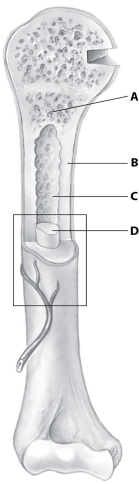
(Multiple Choice)
4.8/5 (76)
(76) 
Filters
- Essay(0)
- Multiple Choice(0)
- Short Answer(0)
- True False(0)
- Matching(0)