



 Chat with AI
Exam 30: How Animals Move

Exam 1: Biology: Exploring Life48 Questions
Exam 2: The Chemical Basis of Life72 Questions
Exam 3: The Molecules of Cells85 Questions
Exam 4: A Tour of the Cell90 Questions
Exam 5: The Working Cell80 Questions
Exam 6: How Cells Harvest Chemical Energy82 Questions
Exam 7: Photosynthesis: Using Light to Make Food81 Questions
Exam 8: The Cellular Basis of Reproduction and Inheritance78 Questions
Exam 9: Patterns of Inheritance77 Questions
Exam 10: Molecular Biology of the Gene82 Questions
Exam 11: How Genes Are Controlled81 Questions
Exam 12: DNA Technology and Genomics78 Questions
Exam 13: How Populations Evolve64 Questions
Exam 14: The Origin of Species58 Questions
Exam 15: Tracing Evolutionary History82 Questions
Exam 16: Microbial Life: Prokaryotes and Protists84 Questions
Exam 17: The Evolution of Plant and Fungal Diversity79 Questions
Exam 18: The Evolution of Invertebrate Diversity72 Questions
Exam 19: The Evolution of Vertebrate Diversity72 Questions
Exam 20: Unifying Concepts of Animal Structure and Function63 Questions
Exam 21: Nutrition and Digestion91 Questions
Exam 22: Gas Exchange66 Questions
Exam 23: Circulation77 Questions
Exam 24: the Immune System79 Questions
Exam 25: Control of Body Temperature and Water Balance63 Questions
Exam 26: Hormones and the Endocrine System60 Questions
Exam 27: Reproduction and Embryonic Development71 Questions
Exam 28: Nervous Systems70 Questions
Exam 29: the Senses60 Questions
Exam 30: How Animals Move69 Questions
Exam 31: Plant Structure, Growth, and Reproduction79 Questions
Exam 32: Plant Nutrition and Transport65 Questions
Exam 33: Control Systems in Plants58 Questions
Exam 34: the Biosphere: an Introduction to Earths Diverse Environments63 Questions
Exam 35: Behavioral Adaptations to the Environment52 Questions
Exam 36: Population Ecology53 Questions
Exam 37: Communities and Ecosystems60 Questions
Exam 38: Conservation Biology57 Questions
Select questions type


Mutations in the gene for troponin can result in the production of the troponin protein, which has varying affinities for Ca²⁺ ions. Suppose that in a muscle cell a mutant troponin is expressed that has such a high affinity for Ca²⁺ ions that once they bind to troponin they cannot unbind. What will likely happen in this muscle cell?
(Multiple Choice)
4.7/5  (75)
(75) After reading the paragraph below, answer the questions that follow.
When sarcomeres contract, they generate force (tension). However, the amount of force generated depends on the sarcomere length and the amount of thick and thin filament overlap. Below is a figure that details the force-generating properties of a single sarcomere. This figure was modified from a scientific paper by Al Gordon and colleagues from 1966 and is a classic illustration of the relationship between sarcomere length and force.
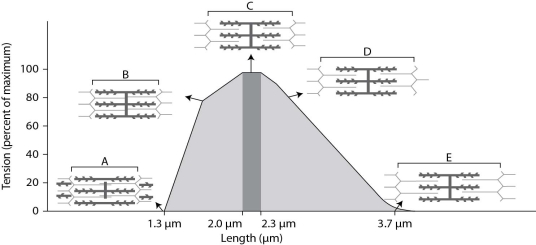 -At what point on the graph is the sarcomere the most extended?
 (Multiple Choice)
4.7/5 (72)
(72) Which of the following statements about skeletal muscle fibers is true?
(Multiple Choice)
4.8/5 (65)
(65) Your friend is complaining of middle back pain. She also says that she hurts the most near her spine. What part of her back may have been injured?
(Multiple Choice)
4.9/5 (80)
(80) Osteoporosis has long been recognized as a problem for women after menopause, but it is also emerging as a health concern for
(Multiple Choice)
4.9/5 (94)
(94) Fast muscle fibers contain a high proportion of myofibrils, which allows the fibers to generate high amounts of force. However, this leaves little room in the fibers for other cellular components, including mitochondria. The opposite is true for slow muscle fibers. Does this information support or refute what you know about the fatigue-susceptibility of fast and slow fibers? Why or why not?
(Multiple Choice)
4.8/5 (73)
(73) Suppose that the circular muscles in an earthworm have become selectively paralyzed such that they are not able to contract. How will this affect the earthworm's locomotion?
(Multiple Choice)
4.9/5 (87)
(87) Which of the following animals has an endoskeleton made entirely of cartilage?
(Multiple Choice)
4.9/5 (89)
(89) The shoulder joint where the humerus meets the shoulder girdle is an example of
(Multiple Choice)
4.9/5 (77)
(77) Which of the following statements about locomotion is true?
(Multiple Choice)
4.8/5 (82)
(82) A muscle fiber from the latissimus dorsi (one of the back muscles)of a chimpanzee has a lot of mitochondria and myoglobin and can generate relatively little force. Which type of muscle fiber is being described?
(Multiple Choice)
4.8/5 (96)
(96) The sequence of events that cause a sarcomere to contract can be summed up in the correct order as
(Multiple Choice)
4.9/5 (90)
(90) Which of the following statements best describes the molecular basis of muscle shortening?
(Multiple Choice)
4.7/5 (89)
(89) Which of the following objects is most like a hydrostatic skeleton?
(Multiple Choice)
4.9/5 (85)
(85) 
Filters
- Essay(0)
- Multiple Choice(0)
- Short Answer(0)
- True False(0)
- Matching(0)