



 Chat with AI
Exam 30: How Animals Move

Exam 1: Biology: Exploring Life48 Questions
Exam 2: The Chemical Basis of Life72 Questions
Exam 3: The Molecules of Cells85 Questions
Exam 4: A Tour of the Cell90 Questions
Exam 5: The Working Cell80 Questions
Exam 6: How Cells Harvest Chemical Energy82 Questions
Exam 7: Photosynthesis: Using Light to Make Food81 Questions
Exam 8: The Cellular Basis of Reproduction and Inheritance78 Questions
Exam 9: Patterns of Inheritance77 Questions
Exam 10: Molecular Biology of the Gene82 Questions
Exam 11: How Genes Are Controlled81 Questions
Exam 12: DNA Technology and Genomics78 Questions
Exam 13: How Populations Evolve64 Questions
Exam 14: The Origin of Species58 Questions
Exam 15: Tracing Evolutionary History82 Questions
Exam 16: Microbial Life: Prokaryotes and Protists84 Questions
Exam 17: The Evolution of Plant and Fungal Diversity79 Questions
Exam 18: The Evolution of Invertebrate Diversity72 Questions
Exam 19: The Evolution of Vertebrate Diversity72 Questions
Exam 20: Unifying Concepts of Animal Structure and Function63 Questions
Exam 21: Nutrition and Digestion91 Questions
Exam 22: Gas Exchange66 Questions
Exam 23: Circulation77 Questions
Exam 24: the Immune System79 Questions
Exam 25: Control of Body Temperature and Water Balance63 Questions
Exam 26: Hormones and the Endocrine System60 Questions
Exam 27: Reproduction and Embryonic Development71 Questions
Exam 28: Nervous Systems70 Questions
Exam 29: the Senses60 Questions
Exam 30: How Animals Move69 Questions
Exam 31: Plant Structure, Growth, and Reproduction79 Questions
Exam 32: Plant Nutrition and Transport65 Questions
Exam 33: Control Systems in Plants58 Questions
Exam 34: the Biosphere: an Introduction to Earths Diverse Environments63 Questions
Exam 35: Behavioral Adaptations to the Environment52 Questions
Exam 36: Population Ecology53 Questions
Exam 37: Communities and Ecosystems60 Questions
Exam 38: Conservation Biology57 Questions
Select questions type


Which of the following attaches the forelimbs to the axial skeleton in a human?
(Multiple Choice)
4.8/5  (63)
(63) The contacting surfaces of a moving joint, such as your hip joint, consist of
(Multiple Choice)
4.9/5 (84)
(84) A racehorse cannot stand on one leg, but when it runs it rarely has more than one leg on the ground. Why is a running horse more stable than a standing one?
(Multiple Choice)
4.8/5 (82)
(82) The neurotransmitter found at the synapse between nerves and human skeletal muscle cells is
(Multiple Choice)
4.8/5 (84)
(84) According to the sliding filament model of muscle contraction, a sarcomere contracts when its
(Multiple Choice)
4.9/5 (73)
(73) Which of the following treatments could possibly help to transform the bone on the right to the bone on the left? 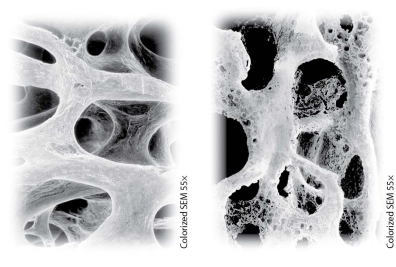
(Multiple Choice)
4.7/5 (75)
(75) After reading the paragraphs below, answer the questions that follow.
Rickets is a softening of the bones that can lead to frequent fractures and skeletal deformities. The legs of a person with rickets tend to bow outward under the force exerted by body weight and movement. British scientists recently found a serious increase in the incidence of rickets and other bone deficiencies among women in Middle Eastern countries who cover their bodies completely to express a form of religious belief, as well as among their breast-fed children.
Most of the body's vitamin D, which is necessary for calcium absorption by bone tissue, is obtained through sunlight acting on the skin. Doctors warn that women who completely cover their skin do not get enough sunlight to produce the vitamin D necessary for bone health. This lack of sun exposure also lowers the level of vitamin D in their breast milk, which means that their children may develop the same vitamin D deficiencies. Lack of calcium and phosphorous, which are needed for bone repair and replacement, can also lead to rickets. Rickets caused by a dietary lack of these minerals is more common in developing countries because dairy products and green vegetables, the best sources of calcium, are not commonly eaten.
-As a physician caring for a nursing woman who has chosen to dress in a way that covers her skin but who is concerned about rickets developing in her baby, you might advise her to
(Multiple Choice)
4.7/5 (94)
(94) An airfoil provides lift because air moving over a wing must travel
(Multiple Choice)
4.7/5 (73)
(73) Changes occur within a sarcomere during muscle contraction. One change is that the
(Multiple Choice)
4.8/5 (88)
(88) After reading the paragraph below, answer the questions that follow.
The "Ironman" is a version of the triathlon, a race that includes three events: swimming, bicycling, and running. In an Ironman, an athlete must swim 2.4 miles, bike 112 miles, and run 26.2 miles, in that order, without a break. The annual Ironman World Championship is held in Hawaii every year. The men's course record was set in 2011 by Australia's Craig Alexander with a time of 8 hours, 18 minutes, and 37 seconds, and the women's course record was set in 2009 by England's Chrissie Wellington with a time of 8 hours, 54 minutes, and 2 seconds.
-What type of muscle fibers would likely be found in the legs of athletes who attempt to complete this race?
(Multiple Choice)
4.9/5 (95)
(95) Functionally, the muscle fiber's fundamental unit of contraction is the
(Multiple Choice)
4.7/5 (81)
(81) An animal's locomotor muscle was dissected and the percentages of fast and slow fibers were determined and plotted in the figure below. Which of the following muscles is the likely source for this data? 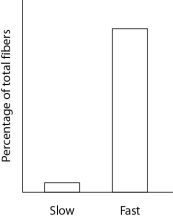
(Multiple Choice)
4.8/5 (78)
(78) After reading the paragraph below, answer the questions that follow.
When sarcomeres contract, they generate force (tension). However, the amount of force generated depends on the sarcomere length and the amount of thick and thin filament overlap. Below is a figure that details the force-generating properties of a single sarcomere. This figure was modified from a scientific paper by Al Gordon and colleagues from 1966 and is a classic illustration of the relationship between sarcomere length and force.
 -At what point on the graph are thick and thin filaments most overlapped?
 (Multiple Choice)
4.9/5 (75)
(75) After reading the paragraph below, answer the questions that follow.
When sarcomeres contract, they generate force (tension). However, the amount of force generated depends on the sarcomere length and the amount of thick and thin filament overlap. Below is a figure that details the force-generating properties of a single sarcomere. This figure was modified from a scientific paper by Al Gordon and colleagues from 1966 and is a classic illustration of the relationship between sarcomere length and force.
-At what point on the graph is the most tension generated?
-At what point on the graph is the most tension generated? (Multiple Choice)
4.8/5 (87)
(87) 
Filters
- Essay(0)
- Multiple Choice(0)
- Short Answer(0)
- True False(0)
- Matching(0)