



 Chat with AI
Exam 4: A Tour of the Cell

Exam 1: Biology: Exploring Life48 Questions
Exam 2: The Chemical Basis of Life72 Questions
Exam 3: The Molecules of Cells85 Questions
Exam 4: A Tour of the Cell90 Questions
Exam 5: The Working Cell80 Questions
Exam 6: How Cells Harvest Chemical Energy82 Questions
Exam 7: Photosynthesis: Using Light to Make Food81 Questions
Exam 8: The Cellular Basis of Reproduction and Inheritance78 Questions
Exam 9: Patterns of Inheritance77 Questions
Exam 10: Molecular Biology of the Gene82 Questions
Exam 11: How Genes Are Controlled81 Questions
Exam 12: DNA Technology and Genomics78 Questions
Exam 13: How Populations Evolve64 Questions
Exam 14: The Origin of Species58 Questions
Exam 15: Tracing Evolutionary History82 Questions
Exam 16: Microbial Life: Prokaryotes and Protists84 Questions
Exam 17: The Evolution of Plant and Fungal Diversity79 Questions
Exam 18: The Evolution of Invertebrate Diversity72 Questions
Exam 19: The Evolution of Vertebrate Diversity72 Questions
Exam 20: Unifying Concepts of Animal Structure and Function63 Questions
Exam 21: Nutrition and Digestion91 Questions
Exam 22: Gas Exchange66 Questions
Exam 23: Circulation77 Questions
Exam 24: the Immune System79 Questions
Exam 25: Control of Body Temperature and Water Balance63 Questions
Exam 26: Hormones and the Endocrine System60 Questions
Exam 27: Reproduction and Embryonic Development71 Questions
Exam 28: Nervous Systems70 Questions
Exam 29: the Senses60 Questions
Exam 30: How Animals Move69 Questions
Exam 31: Plant Structure, Growth, and Reproduction79 Questions
Exam 32: Plant Nutrition and Transport65 Questions
Exam 33: Control Systems in Plants58 Questions
Exam 34: the Biosphere: an Introduction to Earths Diverse Environments63 Questions
Exam 35: Behavioral Adaptations to the Environment52 Questions
Exam 36: Population Ecology53 Questions
Exam 37: Communities and Ecosystems60 Questions
Exam 38: Conservation Biology57 Questions
Select questions type


According to this figure, which of the following are large enough to see in the light microscope? 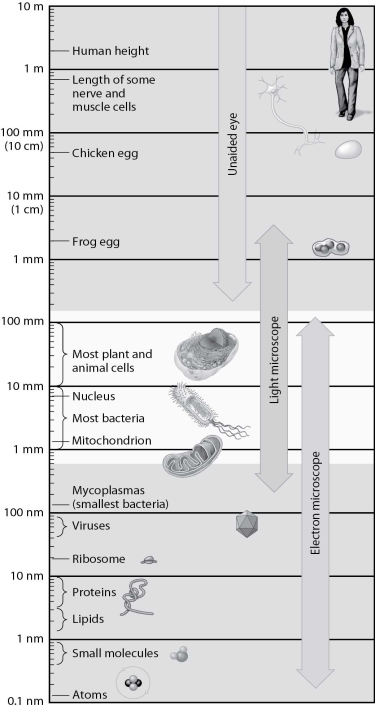
(Multiple Choice)
5.0/5  (66)
(66) Which of the following structures is exclusively associated with prokaryotic cells?
(Multiple Choice)
4.7/5 (85)
(85) Which of the following statements regarding the endomembrane system is false?
(Multiple Choice)
4.7/5 (87)
(87) After reading the paragraph below, answer the questions that follow.
The skin is the body's largest organ. It's made up of many different types of cells. Oils, produced by the sebaceous glands, prevent the skin from drying and splitting. The protein melanin, produced by melanocytes in the epidermis, protects the skin from the harmful effects of ultraviolet radiation. Sweat, released through ducts to the skin surface, helps to cool the body. The types of cells that produce these compounds have different numbers of specific organelles, depending on their function.
-The oil from the sebaceous glands is produced by which of the following cell organelles?
(Multiple Choice)
5.0/5 (67)
(67) Unlike animal cells, plant cells have ________ and ________. Unlike plant cells, animal cells have ________.
(Multiple Choice)
4.7/5 (78)
(78) After reading the paragraph below, answer the questions that follow.
Studies of the endomembrane system often involve the use of a protein that can emit a green fluorescence (glow). A researcher wants to make a video of cell behavior, so she initially tags the outer nuclear envelope of a cell with the fluorescent tag and records for several hours. Later, she sees that the tag is part of a secretory vesicle.
-The fluorescent tag likely did not become incorporated into which of the following organelles?
(Multiple Choice)
4.8/5 (88)
(88) A manufacturing company dumps its wastes into a nearby pond. One of the wastes is found to paralyze the contractile vacuoles of certain protists. A biologist looking at individual samples of these organisms taken from the pond would find that they
(Multiple Choice)
4.8/5 (86)
(86) 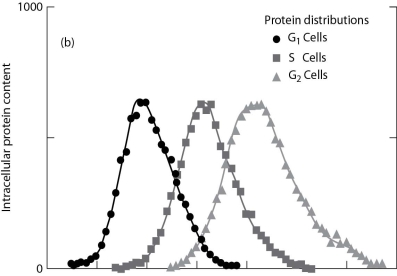 Much of the intracellular structure of a eukaryote cell is involved in protein synthesis. The figure shows the amounts of protein in cells at different parts of the cell cycle between two cell divisions. G₁ is a stage just after the cell has divided, and G₂ is the stage just before the cell divides again. S is a stage when the cell is synthesizing material such as DNA, mitochondria, and other organelles.
-Most of the protein measured in the cells was likely synthesized by
Much of the intracellular structure of a eukaryote cell is involved in protein synthesis. The figure shows the amounts of protein in cells at different parts of the cell cycle between two cell divisions. G₁ is a stage just after the cell has divided, and G₂ is the stage just before the cell divides again. S is a stage when the cell is synthesizing material such as DNA, mitochondria, and other organelles.
-Most of the protein measured in the cells was likely synthesized by (Multiple Choice)
4.7/5 (78)
(78) Which of the following cell structures are associated with the breakdown of harmful substances?
(Multiple Choice)
4.9/5 (92)
(92) A scanning electron microscope is used to study ________, whereas a transmission electron microscope is used to study ________.
(Multiple Choice)
4.8/5 (78)
(78) The endomembrane system includes all of the following organelles except the
(Multiple Choice)
4.9/5 (82)
(82) Which of the following statements regarding cells is false?
(Multiple Choice)
4.8/5 (70)
(70) 
Filters
- Essay(0)
- Multiple Choice(0)
- Short Answer(0)
- True False(0)
- Matching(0)