



 Chat with AI
Exam 4: A Tour of the Cell

Exam 1: Biology: Exploring Life48 Questions
Exam 2: The Chemical Basis of Life72 Questions
Exam 3: The Molecules of Cells85 Questions
Exam 4: A Tour of the Cell90 Questions
Exam 5: The Working Cell80 Questions
Exam 6: How Cells Harvest Chemical Energy82 Questions
Exam 7: Photosynthesis: Using Light to Make Food81 Questions
Exam 8: The Cellular Basis of Reproduction and Inheritance78 Questions
Exam 9: Patterns of Inheritance77 Questions
Exam 10: Molecular Biology of the Gene82 Questions
Exam 11: How Genes Are Controlled81 Questions
Exam 12: DNA Technology and Genomics78 Questions
Exam 13: How Populations Evolve64 Questions
Exam 14: The Origin of Species58 Questions
Exam 15: Tracing Evolutionary History82 Questions
Exam 16: Microbial Life: Prokaryotes and Protists84 Questions
Exam 17: The Evolution of Plant and Fungal Diversity79 Questions
Exam 18: The Evolution of Invertebrate Diversity72 Questions
Exam 19: The Evolution of Vertebrate Diversity72 Questions
Exam 20: Unifying Concepts of Animal Structure and Function63 Questions
Exam 21: Nutrition and Digestion91 Questions
Exam 22: Gas Exchange66 Questions
Exam 23: Circulation77 Questions
Exam 24: the Immune System79 Questions
Exam 25: Control of Body Temperature and Water Balance63 Questions
Exam 26: Hormones and the Endocrine System60 Questions
Exam 27: Reproduction and Embryonic Development71 Questions
Exam 28: Nervous Systems70 Questions
Exam 29: the Senses60 Questions
Exam 30: How Animals Move69 Questions
Exam 31: Plant Structure, Growth, and Reproduction79 Questions
Exam 32: Plant Nutrition and Transport65 Questions
Exam 33: Control Systems in Plants58 Questions
Exam 34: the Biosphere: an Introduction to Earths Diverse Environments63 Questions
Exam 35: Behavioral Adaptations to the Environment52 Questions
Exam 36: Population Ecology53 Questions
Exam 37: Communities and Ecosystems60 Questions
Exam 38: Conservation Biology57 Questions
Select questions type


Which part of the mitochondrion shown enhances its ability to produce ATP by increasing the surface area of a mitochondrial membrane? 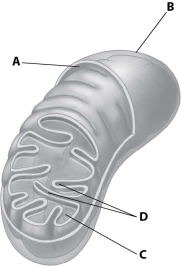
(Multiple Choice)
4.9/5  (76)
(76) The main function of the rough endoplasmic reticulum is the production of
(Multiple Choice)
4.8/5 (81)
(81) Which of the following statements about lysosomes is false?
(Multiple Choice)
4.9/5 (82)
(82) The endosymbiosis hypothesis is supported by all of the following pieces of evidence except the fact that
(Multiple Choice)
4.8/5 (73)
(73) Which of the following statements about cellular metabolism is false?
(Multiple Choice)
4.9/5 (79)
(79) Which of the following statements about internal membranes in eukaryotic cells is false?
(Multiple Choice)
4.8/5 (77)
(77) After reading the paragraph below, answer the questions that follow.
Studies of the endomembrane system often involve the use of a protein that can emit a green fluorescence (glow). A researcher wants to make a video of cell behavior, so she initially tags the outer nuclear envelope of a cell with the fluorescent tag and records for several hours. Later, she sees that the tag is part of a secretory vesicle.
-The ability to stain protein molecules with a fluorescent dye would most clearly allow researchers to go beyond what they could previously detect with a microscope by allowing them to
(Multiple Choice)
4.9/5 (78)
(78) 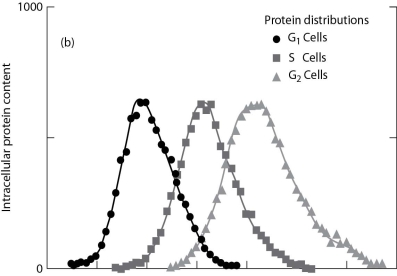 Much of the intracellular structure of a eukaryote cell is involved in protein synthesis. The figure shows the amounts of protein in cells at different parts of the cell cycle between two cell divisions. G₁ is a stage just after the cell has divided, and G₂ is the stage just before the cell divides again. S is a stage when the cell is synthesizing material such as DNA, mitochondria, and other organelles.
-The graph shows that
Much of the intracellular structure of a eukaryote cell is involved in protein synthesis. The figure shows the amounts of protein in cells at different parts of the cell cycle between two cell divisions. G₁ is a stage just after the cell has divided, and G₂ is the stage just before the cell divides again. S is a stage when the cell is synthesizing material such as DNA, mitochondria, and other organelles.
-The graph shows that (Multiple Choice)
4.9/5 (76)
(76)
Much of the intracellular structure of a eukaryote cell is involved in protein synthesis. The figure shows the amounts of protein in cells at different parts of the cell cycle between two cell divisions. G₁ is a stage just after the cell has divided, and G₂ is the stage just before the cell divides again. S is a stage when the cell is synthesizing material such as DNA, mitochondria, and other organelles.
-Which of the following can be concluded from the graph?
Much of the intracellular structure of a eukaryote cell is involved in protein synthesis. The figure shows the amounts of protein in cells at different parts of the cell cycle between two cell divisions. G₁ is a stage just after the cell has divided, and G₂ is the stage just before the cell divides again. S is a stage when the cell is synthesizing material such as DNA, mitochondria, and other organelles.
-Which of the following can be concluded from the graph? (Multiple Choice)
4.9/5 (92)
(92) A woman is having trouble becoming pregnant. Examination of her partner's sperm indicates that dynein feet are missing from the flagella in his sperm cells. A physician explains that this could interfere with fertility by
(Multiple Choice)
5.0/5 (73)
(73) 
Filters
- Essay(0)
- Multiple Choice(0)
- Short Answer(0)
- True False(0)
- Matching(0)