



 Chat with AI
Exam 3: The Molecules of Cells

Exam 1: Biology: Exploring Life48 Questions
Exam 2: The Chemical Basis of Life72 Questions
Exam 3: The Molecules of Cells85 Questions
Exam 4: A Tour of the Cell90 Questions
Exam 5: The Working Cell80 Questions
Exam 6: How Cells Harvest Chemical Energy82 Questions
Exam 7: Photosynthesis: Using Light to Make Food81 Questions
Exam 8: The Cellular Basis of Reproduction and Inheritance78 Questions
Exam 9: Patterns of Inheritance77 Questions
Exam 10: Molecular Biology of the Gene82 Questions
Exam 11: How Genes Are Controlled81 Questions
Exam 12: DNA Technology and Genomics78 Questions
Exam 13: How Populations Evolve64 Questions
Exam 14: The Origin of Species58 Questions
Exam 15: Tracing Evolutionary History82 Questions
Exam 16: Microbial Life: Prokaryotes and Protists84 Questions
Exam 17: The Evolution of Plant and Fungal Diversity79 Questions
Exam 18: The Evolution of Invertebrate Diversity72 Questions
Exam 19: The Evolution of Vertebrate Diversity72 Questions
Exam 20: Unifying Concepts of Animal Structure and Function63 Questions
Exam 21: Nutrition and Digestion91 Questions
Exam 22: Gas Exchange66 Questions
Exam 23: Circulation77 Questions
Exam 24: the Immune System79 Questions
Exam 25: Control of Body Temperature and Water Balance63 Questions
Exam 26: Hormones and the Endocrine System60 Questions
Exam 27: Reproduction and Embryonic Development71 Questions
Exam 28: Nervous Systems70 Questions
Exam 29: the Senses60 Questions
Exam 30: How Animals Move69 Questions
Exam 31: Plant Structure, Growth, and Reproduction79 Questions
Exam 32: Plant Nutrition and Transport65 Questions
Exam 33: Control Systems in Plants58 Questions
Exam 34: the Biosphere: an Introduction to Earths Diverse Environments63 Questions
Exam 35: Behavioral Adaptations to the Environment52 Questions
Exam 36: Population Ecology53 Questions
Exam 37: Communities and Ecosystems60 Questions
Exam 38: Conservation Biology57 Questions
Select questions type


Below are the structures of three fatty acids, palmitic acid, stearic acid, and oleic acid. What combination of these fatty acids could you use to make a fat that is liquid at room temperature? 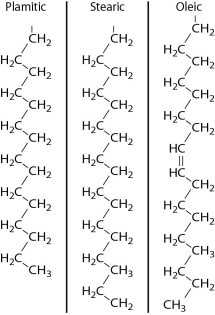
(Multiple Choice)
4.8/5  (75)
(75) Which of the following statements about the functional groups of organic compounds is false?
(Multiple Choice)
4.9/5 (70)
(70) In what part of the world did the mutation for lactose tolerance first appear?
(Multiple Choice)
4.9/5 (94)
(94) If you were to add olive oil to your food as part of a diet to lower your risk of atherosclerotic disease, you would use olive oil that
(Multiple Choice)
4.8/5 (81)
(81) These two molecules are structural isomers. What is the difference between them? 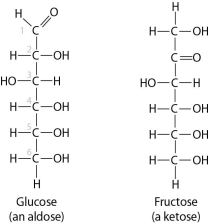
(Multiple Choice)
5.0/5 (82)
(82) After reading the paragraph below, answer the questions that follow.
You're the manager of a factory that produces enzyme-washed blue jeans (the enzymes lighten the color of the denim, giving a "faded" appearance). When the most recent batch of fabric came out of the enzyme wash, however, the color wasn't light enough to meet your standards. Your quality control laboratory wants to do some tests to determine why the wash enzymes didn't perform as expected.
-Which hypothesis is most likely to be productive for their initial investigation?
(Multiple Choice)
4.9/5 (78)
(78) After reading the paragraph below, answer the questions that follow.
You're the manager of a factory that produces enzyme-washed blue jeans (the enzymes lighten the color of the denim, giving a "faded" appearance). When the most recent batch of fabric came out of the enzyme wash, however, the color wasn't light enough to meet your standards. Your quality control laboratory wants to do some tests to determine why the wash enzymes didn't perform as expected.
-Based on your understanding of enzyme structure, which of the following would you recommend that they also investigate?
(Multiple Choice)
4.9/5 (75)
(75) Which of the following statements about animal cell lipids is false?
(Multiple Choice)
4.9/5 (81)
(81) Mad cow disease serves as an example of how interdependent ________ and ________ are to protein.
(Multiple Choice)
4.8/5 (93)
(93) Which of the following options correctly pairs a polymer and its monomer?
(Multiple Choice)
4.8/5 (88)
(88) High-fructose corn syrup is made from corn. The main carbohydrate in corn is a polysaccharide called
(Multiple Choice)
4.9/5 (76)
(76) 
Filters
- Essay(0)
- Multiple Choice(0)
- Short Answer(0)
- True False(0)
- Matching(0)