



 Chat with AI
Exam 10: The Restless Ocean

Exam 1: Matter and Minerals60 Questions
Exam 2: Rocks: Materials of the Solid Earth63 Questions
Exam 3: Landscapes Fashioned by Water68 Questions
Exam 4: Glacial and Arid Landscapes64 Questions
Exam 5: Plate Tectonics: A Scientific Revolution Unfolds64 Questions
Exam 6: Restless Earth: Earthquakes, Geologic Structures, and Mountain Building67 Questions
Exam 7: Volcanoes and Other Igneous Activity64 Questions
Exam 8: Geologic Time70 Questions
Exam 9: Oceans: The Last Frontier65 Questions
Exam 10: The Restless Ocean65 Questions
Exam 11: Heating the Atmosphere66 Questions
Exam 12: Moisture, Clouds, and Precipitation66 Questions
Exam 13: The Atmosphere in Motion68 Questions
Exam 14: Weather Patterns and Severe Weather66 Questions
Exam 15: The Nature of the Solar System67 Questions
Exam 16: Beyond Our Solar System66 Questions
Select questions type


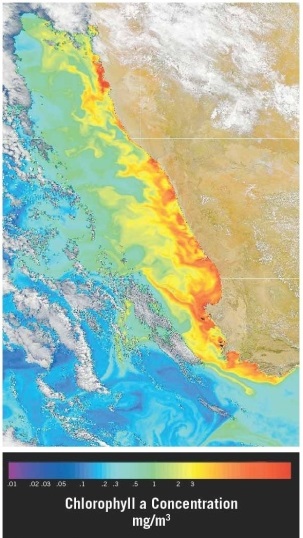 Examine the satellite view of chlorophyll concentrations in the southern Atlantic Ocean along the southwest coast of Africa (the nations of Namibia and South Africa). Which of the following statements offers the best explanation for the observed pattern(s)?
 (Multiple Choice)
4.9/5  (81)
(81) One result of wave refraction is that wave energy is concentrated ________.
(Multiple Choice)
4.8/5 (79)
(79) The center of each of Earth's five major gyres is found at about ________ latitude.
(Multiple Choice)
4.8/5 (75)
(75) The largest daily tidal range occurs in association with spring tides.
(True/False)
4.8/5 (84)
(84) Barrier islands are common on the Gulf Coast but rare or absent along the Pacific Coast of the United States.
(True/False)
4.8/5 (88)
(88) Waves begin to "feel bottom" when the depth of water is ________.
(Multiple Choice)
4.8/5 (83)
(83) Waves begin to "feel bottom" at a depth that is about one-half their wavelength.
(True/False)
4.8/5 (81)
(81) Because deep ocean circulation is driven largely by variations in water temperature and salinity, it is also called ________ circulation.
(Short Answer)
4.9/5 (72)
(72) Turbulent water created by breaking waves is known as ________.
(Short Answer)
4.8/5 (71)
(71) As the tide rises, water flows in toward the shore as the ebb tide.
(True/False)
4.7/5 (73)
(73) If a spit grows as it is deposited, and extends completely across the former mouth of an estuary, separating it from the open sea, it has become a(n)________.
(Short Answer)
4.9/5 (64)
(64) When viewed from above, the North Atlantic Gyre displays a clockwise sense of motion.
(True/False)
4.8/5 (71)
(71) Which of the following shoreline features is a result of deposition?
(Multiple Choice)
4.8/5 (77)
(77) A(n)________ is a place where fresh and salt water mix, such as a drowned river valley along a submergent coast.
(Short Answer)
4.8/5 (94)
(94) The daily tidal range is of the least magnitude during ________.
(Multiple Choice)
4.9/5 (78)
(78) Groins are constructed for the purpose of maintaining or widening beaches that are losing sand.
(True/False)
4.8/5 (75)
(75) A baymouth bar is an example of "hard stabilization," a feature constructed by people to control wave erosion.
(True/False)
4.8/5 (89)
(89) 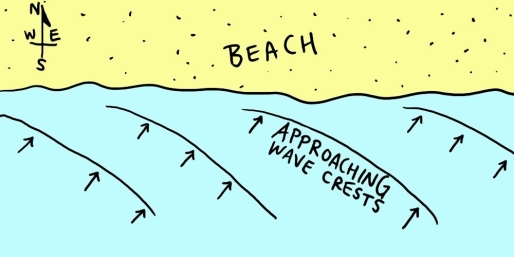 Examine the map shown in the figure. If you were to go swimming in the ocean along this shoreline, which way would the longshore current carry you? ________
 (Essay)
4.8/5 (65)
(65) When waves reach shallow water they tend to be ________, which makes them become parallel to the shore.
(Multiple Choice)
4.9/5 (70)
(70) 
Filters
- Essay(0)
- Multiple Choice(0)
- Short Answer(0)
- True False(0)
- Matching(0)