



 Chat with AI
Exam 4: Glacial and Arid Landscapes

Exam 1: Matter and Minerals60 Questions
Exam 2: Rocks: Materials of the Solid Earth63 Questions
Exam 3: Landscapes Fashioned by Water68 Questions
Exam 4: Glacial and Arid Landscapes64 Questions
Exam 5: Plate Tectonics: A Scientific Revolution Unfolds64 Questions
Exam 6: Restless Earth: Earthquakes, Geologic Structures, and Mountain Building67 Questions
Exam 7: Volcanoes and Other Igneous Activity64 Questions
Exam 8: Geologic Time70 Questions
Exam 9: Oceans: The Last Frontier65 Questions
Exam 10: The Restless Ocean65 Questions
Exam 11: Heating the Atmosphere66 Questions
Exam 12: Moisture, Clouds, and Precipitation66 Questions
Exam 13: The Atmosphere in Motion68 Questions
Exam 14: Weather Patterns and Severe Weather66 Questions
Exam 15: The Nature of the Solar System67 Questions
Exam 16: Beyond Our Solar System66 Questions
Select questions type


The Basin and Range region of the western United States is characterized by interior drainage with streams eroding uplifted mountain blocks and depositing sediment in interior basins.
(True/False)
4.8/5  (85)
(85) Till is unsorted sediment deposited directly from the melting glacial ice; stream action is not involved.
(True/False)
4.9/5 (80)
(80) About what percentage of Earth's land surface was covered by glaciers during the Quaternary period?
(Multiple Choice)
4.8/5 (68)
(68) Though ________ and ________ are sediments that can be picked up by the wind, ________ is too heavy, and gets left behind.
(Short Answer)
4.8/5 (81)
(81) 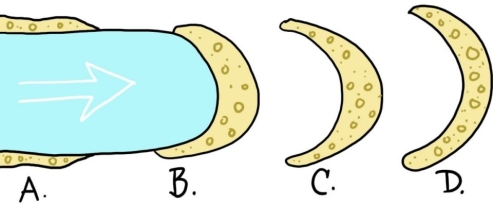 Which of the four lettered positions on this map-view sketch shows the location of the terminal end moraine?
 (Multiple Choice)
4.9/5 (86)
(86) Glaciers acquire sediment through plucking from the bedrock beneath the glacier.
(True/False)
4.9/5 (73)
(73) Hanging valleys are glacier-cut valleys that flooded as sea level rose in post-glacial times.
(True/False)
4.9/5 (67)
(67) When a valley glacier leaves the mountains and enters the relative flat lands below, it may spread out to form ________.
(Multiple Choice)
4.9/5 (72)
(72) Arêtes, horns, and U-shaped valleys are depositional features made of till.
(True/False)
4.8/5 (88)
(88) Match the items in the first column with the correct descriptions in the second column.
A)lifting and removal of loose material like soil or sediment by the wind.
B)wind-deposited sand that forms mounds or ridges.
C)a layer of coarse pebbles and cobbles that are too large to be moved by the wind overlying finer-grained sediment in desert regions.
D)preserved slip-faces that accumulate as a dune migrates.
E)shallow depressions where soil or sediment has been stripped away by the wind.
F)regions that are slightly more humid than desert.
G)wind-deposited silt.
H)the leeward side of a dune.
-1)deflation
2)dunes
3)blowout
4)loess
5)slip face
6)cross-bedding
7)steppe
8)desert pavement
(Short Answer)
4.9/5 (75)
(75) In a sequence of sedimentary rocks, you find a layer of poorly-sorted sedimentary rock that includes many scratched cobbles. Below this layer is a body of granite that has a polished upper surface bearing many striations. How would you interpret such a rock sequence?
(Essay)
4.8/5 (78)
(78) If the planet were to cool in the future, snow may begin to accumulate near the head of a glacier more rapidly than it would melt in the zone of wastage. In these circumstances, the terminus of the glacier would ________.
(Short Answer)
4.9/5 (83)
(83) 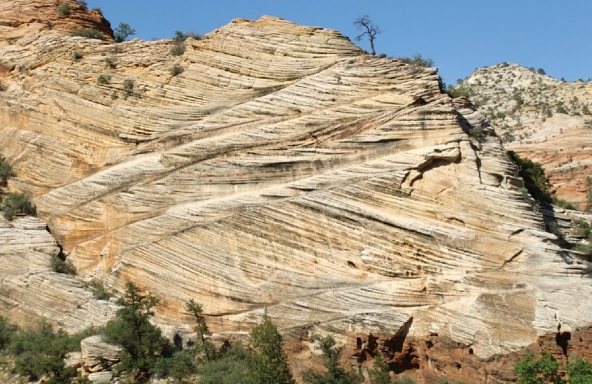 Examine the photo. Is it true or false to say, "the dunes that deposited these cross beds were moving from the left to the right"?
 (True/False)
4.9/5 (87)
(87) When a glacial trough is "drowned" by the sea, the result is a(n)________.
(Short Answer)
4.8/5 (79)
(79) 
Filters
- Essay(0)
- Multiple Choice(0)
- Short Answer(0)
- True False(0)
- Matching(0)