



 Chat with AI
Exam 5: Biodiversity, Species Interactions, and Population Control

Exam 1: Environmental Problems, Their Causes, and Sustainability100 Questions
Exam 2: Science, Matter, Energy, and Systems102 Questions
Exam 3: Ecosystems: What Are They and How Do They Work110 Questions
Exam 4: Biodiversity and Evolution104 Questions
Exam 5: Biodiversity, Species Interactions, and Population Control100 Questions
Exam 6: The Human Population and Its Impact111 Questions
Exam 7: Climate and Biodiversity100 Questions
Exam 8: Aquatic Biodiversity109 Questions
Exam 9: Sustaining Biodiversity: the Species Approach100 Questions
Exam 10: Sustaining Terrestrial Biodiversity: the Ecosystem Approach108 Questions
Exam 11: Sustaining Aquatic Biodiversity122 Questions
Exam 12: Food, Soil, and Pest Management118 Questions
Exam 13: Water Resources115 Questions
Exam 14: Geology and Nonrenewable Mineral Resources115 Questions
Exam 15: Nonrenewable Energy102 Questions
Exam 16: Energy Efficiency and Renewable Energy103 Questions
Exam 17: Environmental Hazards and Human Health103 Questions
Exam 18: Air Pollution112 Questions
Exam 19: Climate Disruption and Ozone Depletion111 Questions
Exam 20: Water Pollution114 Questions
Exam 21: Solid and Hazardous Waste108 Questions
Exam 22: Cities and Sustainability99 Questions
Exam 23: Economics, Environment, and Sustainability104 Questions
Exam 24: Politics, Environment, and Sustainability90 Questions
Exam 25: Environmental Worldviews, Ethics, and Sustainability55 Questions
Select questions type


When two or more species compete with one another their niches are said to ____________________.
(Short Answer)
4.9/5  (84)
(84) Animal predators tend to kill the sick, weak, aged, and least fit members of a species, therefore increasing the fitness of the prey species.
(True/False)
4.8/5 (73)
(73) 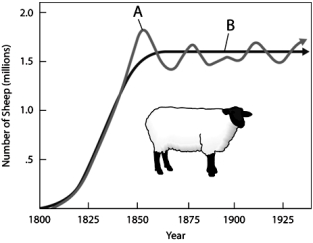 Use the Figure above to answer the following question(s).
-Choose the portion of the curve that results from the interaction of reproductive ability and environmental resistance.
Use the Figure above to answer the following question(s).
-Choose the portion of the curve that results from the interaction of reproductive ability and environmental resistance. (Short Answer)
4.9/5 (82)
(82) Which of the following would cause a population to overshoot its carrying capacity?
(Multiple Choice)
4.8/5 (66)
(66) Humans compete with many other species for space, food, and other resources.
(True/False)
4.9/5 (87)
(87) Which of the following refers to the ability of a living system to be restored after a period of moderate to severe disturbance?
(Multiple Choice)
4.9/5 (83)
(83) Vast armies of ____________________ inhabit the digestive tracts of humans and help break down or digest their food.
(Short Answer)
4.9/5 (72)
(72) Species whose ecological niches overlap will be in competition for whatever the resource is in the overlap.
(True/False)
4.8/5 (77)
(77) The southern sea otter has been classified as a(n) ____________________ species.
(Short Answer)
4.8/5 (80)
(80) Plants such as bromeliads share a commensalism interaction with large trees in tropical and subtropical forests.The bromeliads are an example of
(Multiple Choice)
4.8/5 (94)
(94) Which of the following is not a general type of population change?
(Multiple Choice)
4.8/5 (83)
(83) When plotting the number of individuals in a population against time the data yield a J-shaped curve, which indicates which of the following?
(Multiple Choice)
4.9/5 (82)
(82) Basic to the theory of evolution are the concepts of environmental resistance and biotic potential.Explain how these concepts are central to natural selection.
(Essay)
4.7/5 (74)
(74) Some prey species make themselves larger, startle the predator, or mimic a predator, all of which are called ____________________.
(Short Answer)
4.8/5 (67)
(67) Exponential growth followed by a steady decrease in population growth until the population size levels off is typical of
(Multiple Choice)
5.0/5 (80)
(80) In communities and ecosystems the types and numbers of species change in response to changing environmental conditions.
(True/False)
4.8/5 (81)
(81) When populations of two different species interact over long periods of time, changes in the gene pool of one species can lead to changes in the gene pool of the other.This is called
(Multiple Choice)
4.9/5 (78)
(78) 
Filters
- Essay(0)
- Multiple Choice(0)
- Short Answer(0)
- True False(0)
- Matching(0)