



 Chat with AI
Exam 5: Biodiversity, Species Interactions, and Population Control

Exam 1: Environmental Problems, Their Causes, and Sustainability100 Questions
Exam 2: Science, Matter, Energy, and Systems102 Questions
Exam 3: Ecosystems: What Are They and How Do They Work110 Questions
Exam 4: Biodiversity and Evolution104 Questions
Exam 5: Biodiversity, Species Interactions, and Population Control100 Questions
Exam 6: The Human Population and Its Impact111 Questions
Exam 7: Climate and Biodiversity100 Questions
Exam 8: Aquatic Biodiversity109 Questions
Exam 9: Sustaining Biodiversity: the Species Approach100 Questions
Exam 10: Sustaining Terrestrial Biodiversity: the Ecosystem Approach108 Questions
Exam 11: Sustaining Aquatic Biodiversity122 Questions
Exam 12: Food, Soil, and Pest Management118 Questions
Exam 13: Water Resources115 Questions
Exam 14: Geology and Nonrenewable Mineral Resources115 Questions
Exam 15: Nonrenewable Energy102 Questions
Exam 16: Energy Efficiency and Renewable Energy103 Questions
Exam 17: Environmental Hazards and Human Health103 Questions
Exam 18: Air Pollution112 Questions
Exam 19: Climate Disruption and Ozone Depletion111 Questions
Exam 20: Water Pollution114 Questions
Exam 21: Solid and Hazardous Waste108 Questions
Exam 22: Cities and Sustainability99 Questions
Exam 23: Economics, Environment, and Sustainability104 Questions
Exam 24: Politics, Environment, and Sustainability90 Questions
Exam 25: Environmental Worldviews, Ethics, and Sustainability55 Questions
Select questions type


Which of the following is the most common interaction between species?
(Multiple Choice)
4.8/5  (90)
(90) Hawaiian honeycreepers have evolved into species with specialized niches, which has increased the competition between these species.
(True/False)
4.9/5 (72)
(72) Species can, over a long period of time, develop adaptations that allow them to reduce or avoid competition by sharing resources.This is called
(Multiple Choice)
4.8/5 (78)
(78) Five warblers in the state of Maine have evolved to share food resources and reduce food competition through ____________________.
(Short Answer)
4.8/5 (80)
(80) Large mammals, such as humans, whales, and elephants, are especially vulnerable to extinction because of their reproductive patterns.
(True/False)
4.8/5 (77)
(77) All of the following are forms of nondestructive behavior between species except
(Multiple Choice)
4.8/5 (74)
(74) Which of the following is not one of the age structure categories?
(Multiple Choice)
4.8/5 (77)
(77) "The maximum population of a given species that a particular habitat can sustain indefinitely without being degraded" is the definition of
(Multiple Choice)
4.8/5 (83)
(83) At the present time the global human population approaches 7 billion persons.If we exceed the carrying capacity of the earth, the human population may suffer a substantial collapse.Given the following formula for population change:
Population change = (births + immigration) ─ (deaths + immigration)
What will be required of humans in order to stabilize or reduce our population?
(Essay)
4.9/5 (83)
(83) A group of interbreeding individuals of the same species in the same geographic region is called a(n)
(Multiple Choice)
4.7/5 (92)
(92) The non-poisonous ____ butterfly gains protection by looking like the bad-tasting ____ butterfly, which is a protective device known as ____.
(Multiple Choice)
4.9/5 (86)
(86) If multiple species find themselves competing for the same resource, the competition can be reduced by which of the following?
(Multiple Choice)
4.7/5 (84)
(84) Succession leads inevitably toward an ideally adapted climax plant community or ecosystem.
(True/False)
4.7/5 (90)
(90) 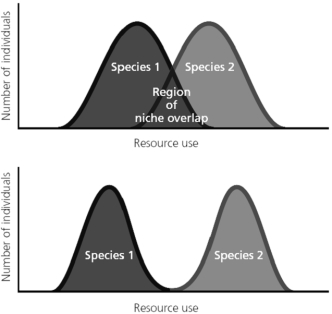 -Observe the Figure above.Notice that in the upper graph the two species overlap.That region of niche overlap places the species in competition for the shared resource.Explain why this is not useful and how the niches of the two species have come to be separated as shown in the lower graph.
 (Essay)
4.7/5 (59)
(59) If the resilience of a damaged area is low enough, the degraded area may not be restored by secondary succession. When this happens, the damaged area has reached
(Multiple Choice)
4.8/5 (80)
(80) Scientists have changed their view about a stable type of climax community as the end product of succession and are now suggesting we can not predict the course of succession.
(True/False)
4.8/5 (83)
(83)  Use the Figure above to answer the following question(s).
-Choose the portion of the graph that represents the number of reindeer that exceeded the capacity of their environment.
Use the Figure above to answer the following question(s).
-Choose the portion of the graph that represents the number of reindeer that exceeded the capacity of their environment. (Short Answer)
4.9/5 (75)
(75) 
Filters
- Essay(0)
- Multiple Choice(0)
- Short Answer(0)
- True False(0)
- Matching(0)