



 Chat with AI
Exam 5: Biodiversity, Species Interactions, and Population Control

Exam 1: Environmental Problems, Their Causes, and Sustainability100 Questions
Exam 2: Science, Matter, Energy, and Systems102 Questions
Exam 3: Ecosystems: What Are They and How Do They Work110 Questions
Exam 4: Biodiversity and Evolution104 Questions
Exam 5: Biodiversity, Species Interactions, and Population Control100 Questions
Exam 6: The Human Population and Its Impact111 Questions
Exam 7: Climate and Biodiversity100 Questions
Exam 8: Aquatic Biodiversity109 Questions
Exam 9: Sustaining Biodiversity: the Species Approach100 Questions
Exam 10: Sustaining Terrestrial Biodiversity: the Ecosystem Approach108 Questions
Exam 11: Sustaining Aquatic Biodiversity122 Questions
Exam 12: Food, Soil, and Pest Management118 Questions
Exam 13: Water Resources115 Questions
Exam 14: Geology and Nonrenewable Mineral Resources115 Questions
Exam 15: Nonrenewable Energy102 Questions
Exam 16: Energy Efficiency and Renewable Energy103 Questions
Exam 17: Environmental Hazards and Human Health103 Questions
Exam 18: Air Pollution112 Questions
Exam 19: Climate Disruption and Ozone Depletion111 Questions
Exam 20: Water Pollution114 Questions
Exam 21: Solid and Hazardous Waste108 Questions
Exam 22: Cities and Sustainability99 Questions
Exam 23: Economics, Environment, and Sustainability104 Questions
Exam 24: Politics, Environment, and Sustainability90 Questions
Exam 25: Environmental Worldviews, Ethics, and Sustainability55 Questions
Select questions type


Which of the following is said to occur when one organism feeds on another organism by living on or in the other organism?
(Multiple Choice)
5.0/5  (87)
(87) In _______________ two species behave in ways that benefit both by providing each with needed resources.
(Short Answer)
4.8/5 (74)
(74) Considering the different types of interactions mentioned at the beginning of the chapter, what kind of relationship do you think we have with most of the natural world?
(Essay)
4.8/5 (93)
(93) ____________________ involves the gradual establishment of biotic communities in lifeless areas where there is no soil.
(Short Answer)
4.8/5 (76)
(76) Which of the following exhibits secondary ecological succession?
(Multiple Choice)
5.0/5 (88)
(88) The most common form of population dispersion found in nature is ____________________.
(Short Answer)
4.9/5 (87)
(87) A population will most likely increase if it is made up mostly of individuals in the 'reproductive' or 'near reproductive' stages.
(True/False)
4.8/5 (78)
(78) Individuals in populations with a high intrinsic rate of growth typically reproduce ____________________ and have short ____________________ times.
(Short Answer)
4.8/5 (80)
(80)  Use the Figure above to answer the following question(s).
-Choose the portion of the graph that represents the number of reindeer that can be sustained indefinitely in a given area.
Use the Figure above to answer the following question(s).
-Choose the portion of the graph that represents the number of reindeer that can be sustained indefinitely in a given area. (Short Answer)
4.9/5 (85)
(85) Using a small rodent, such as a field mouse, and a predator, such as a snake, explain how coevolution works.
(Essay)
4.8/5 (83)
(83) The ability of a living system to survive moderate disturbances is called
(Multiple Choice)
4.8/5 (74)
(74) Grasslands have a high resilience and therefore can quickly recover following a fire.
(True/False)
4.7/5 (88)
(88) ____________________ is like an arms race between interacting populations of different species.
(Short Answer)
4.8/5 (76)
(76) 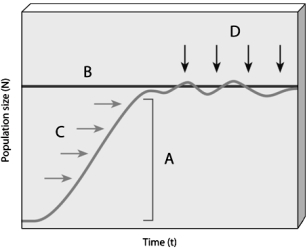 Use the Figure above to answer the following question(s).
-Choose the letter that represents limiting abiotic factors.
Use the Figure above to answer the following question(s).
-Choose the letter that represents limiting abiotic factors. (Short Answer)
4.7/5 (92)
(92)
Use the Figure above to answer the following question(s).
-Choose the letter that represents when resources are not limiting and a population can grow at its intrinsic rate of increase.
Use the Figure above to answer the following question(s).
-Choose the letter that represents when resources are not limiting and a population can grow at its intrinsic rate of increase. (Short Answer)
4.8/5 (86)
(86) Which of the following is not a limiting factor for populations in aquatic life zones?
(Multiple Choice)
4.9/5 (76)
(76) When two different species interact over a long time, changes in the gene pool help both species to become more competitive or avoid competition. This is called _______________,
(Short Answer)
4.8/5 (84)
(84) Which of the following is said to occur when members of two or more species interact to gain access to the same limited resources?
(Multiple Choice)
4.8/5 (83)
(83) An example of top-down population regulation in predator-prey species is predation.
(True/False)
4.9/5 (78)
(78) 
Filters
- Essay(0)
- Multiple Choice(0)
- Short Answer(0)
- True False(0)
- Matching(0)