



 Chat with AI
Exam 6: The Muscular System

Exam 1: The Human Body: An Orientation128 Questions
Exam 2: Basic Chemistry118 Questions
Exam 3: Cells and Tissues142 Questions
Exam 4: Skin and Body Membranes108 Questions
Exam 5: The Skeletal System124 Questions
Exam 6: The Muscular System129 Questions
Exam 7: The Nervous System161 Questions
Exam 8: Special Senses128 Questions
Exam 9: The Endocrine System149 Questions
Exam 10: Blood116 Questions
Exam 11: The Cardiovascular System160 Questions
Exam 12: The Lymphatic System and Body Defenses135 Questions
Exam 13: The Respiratory System150 Questions
Exam 14: The Digestive System and Body Metabolism162 Questions
Exam 15: The Urinary System138 Questions
Exam 16: The Reproductive System169 Questions
Select questions type


Fascicle arrangements produce skeletal muscles with different structures and functional properties, and determine their individual range of motion and power. List the seven different fascicle arrangements of human skeletal muscles and give a specific example of each.
(Essay)
4.9/5  (84)
(84) Describe where and how dorsiflexion and plantar flexion occur. Which muscle is the prime mover of plantar flexion and which muscle do you think is its antagonist?
(Essay)
5.0/5 (77)
(77) Match the following:
-Chemical that enters a muscle cell upon excitation
(Multiple Choice)
4.9/5 (82)
(82) The heads of the myosin myofilaments are called ________ when they link the thick and thin filaments together during skeletal muscle contraction.
(Multiple Choice)
4.8/5 (80)
(80) What is the unstoppable electrical current that travels down the length of the entire surface of a sarcolemma?
(Multiple Choice)
4.8/5 (83)
(83) A neuromuscular junction consists of one neuron and all the skeletal muscles it stimulates.
(True/False)
4.9/5 (73)
(73) Which of the following is NOT a function of the muscular system?
(Multiple Choice)
4.9/5 (83)
(83) You have lost the labels to your muscle tissue slides in laboratory. Explain the characteristics that allow you to distinguish among skeletal muscle, smooth muscle, and cardiac muscle tissue.
(Essay)
4.7/5 (80)
(80) Which of these muscles is located on the ventral (anterior) side of the body?
(Multiple Choice)
4.8/5 (65)
(65) Match the following:
-The sarcoplasmic reticulum stores this chemical
(Multiple Choice)
4.9/5 (91)
(91) What is released by axon terminals into the synaptic cleft to stimulate a muscle to contract?
(Multiple Choice)
4.8/5 (77)
(77) What creates the alternating light and dark bands that provides the striation pattern on skeletal muscle tissue?
(Multiple Choice)
5.0/5 (86)
(86) The striations seen in skeletal muscle are actually alternating dark A and light I bands.
(True/False)
4.9/5 (74)
(74) Match the following:
-Type of movement that points the toes
(Multiple Choice)
4.8/5 (83)
(83) 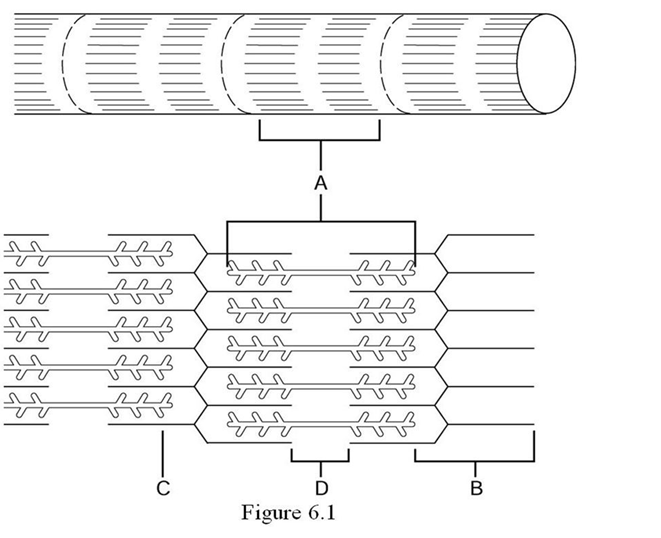 Using Figure 6.1, match the following:
-The myofilament composed of actin is indicated by ________.
Using Figure 6.1, match the following:
-The myofilament composed of actin is indicated by ________. (Multiple Choice)
4.7/5 (93)
(93) Match the following:
-Primary action of the adductor muscles
(Multiple Choice)
5.0/5 (81)
(81)
Using Figure 6.1, match the following:
-The H zone, located within the A band, lacks thin filaments and is represented by ________.
Using Figure 6.1, match the following:
-The H zone, located within the A band, lacks thin filaments and is represented by ________. (Multiple Choice)
4.7/5 (76)
(76) 
Filters
- Essay(0)
- Multiple Choice(0)
- Short Answer(0)
- True False(0)
- Matching(0)