



 Chat with AI
Exam 16: The Reproductive System

Exam 1: The Human Body: An Orientation128 Questions
Exam 2: Basic Chemistry118 Questions
Exam 3: Cells and Tissues142 Questions
Exam 4: Skin and Body Membranes108 Questions
Exam 5: The Skeletal System124 Questions
Exam 6: The Muscular System129 Questions
Exam 7: The Nervous System161 Questions
Exam 8: Special Senses128 Questions
Exam 9: The Endocrine System149 Questions
Exam 10: Blood116 Questions
Exam 11: The Cardiovascular System295 Questions
Exam 13: The Respiratory System150 Questions
Exam 14: The Digestive System and Body Metabolism162 Questions
Exam 15: The Urinary System138 Questions
Exam 16: The Reproductive System169 Questions
Select questions type


The hymen is a thin fold of mucosa that encloses the distal end of the vagina.
(True/False)
4.9/5  (87)
(87) Match each description with the appropriate female reproductive structure:
-External genitalia of a female
(Multiple Choice)
4.9/5 (71)
(71) Failure of the testes to descend into the scrotum is a condition known as ________.
(Multiple Choice)
4.8/5 (69)
(69) The cyclic changes that occur monthly in the ovary constitute the ovarian cycle.
(True/False)
4.8/5 (82)
(82)  Using Figure 16.1, identify the following:
-The epididymis is indicated by ________.
Using Figure 16.1, identify the following:
-The epididymis is indicated by ________. (Multiple Choice)
4.8/5 (81)
(81) During ejaculation, peristalsis moves sperm from the epididymis and ductus (vas) deferens into the urethra.
(True/False)
4.8/5 (75)
(75) The hormone produced by the placenta that causes the pelvic ligaments and pubic symphysis to relax, widen, and become more flexible to ease birth passage is called ________.
(Multiple Choice)
4.9/5 (83)
(83) The hormone that promotes a small number of primary follicles within the ovary to grow and mature each month is ________.
(Multiple Choice)
4.9/5 (71)
(71) What hormone(s) stimulates the growth of the endometrium during the proliferative phase of the uterine (menstrual) cycle?
(Multiple Choice)
4.8/5 (81)
(81) Which one of the following is NOT one of the secondary sex characteristics seen in young women?
(Multiple Choice)
4.7/5 (93)
(93) The process that streamlines spermatids into sperm is known as ________.
(Multiple Choice)
4.9/5 (74)
(74) Days 6-14 of the uterine (menstrual) cycle are known as the ________ phase. This phase concludes with ovulation.
(Multiple Choice)
5.0/5 (76)
(76) Identify the cell or stage of production:
A) urethra
B) secondary oocyte
C) ductus (vas) deferens
D) spermatogonium
E) oogonium
F) scrotum
G) spermiogenesis
H) polar body
I) sperm
J) ovum
K) oogenesis
L) prostate
M) Testis
N) spermatid
-Organ that produces testosterone and sperm
(Essay)
4.8/5 (78)
(78) Describe the events of embryonic development from conception until the fetal stage, including development of the primary germ layers.
(Essay)
4.7/5 (88)
(88) The seminal glands (vesicles) produce a milky fluid that activates sperm.
(True/False)
4.8/5 (79)
(79)
Using Figure 16.1, identify the following:
-The testis is indicated by ________.
Using Figure 16.1, identify the following:
-The testis is indicated by ________. (Multiple Choice)
4.8/5 (95)
(95) Parturition includes delivery of both the infant and the placenta.
(True/False)
4.9/5 (76)
(76) Identify the cell or stage of production:
A) urethra
B) secondary oocyte
C) ductus (vas) deferens
D) spermatogonium
E) oogonium
F) scrotum
G) spermiogenesis
H) polar body
I) sperm
J) ovum
K) oogenesis
L) prostate
M) Testis
N) spermatid
-Process that creates ova in females
(Essay)
4.7/5 (78)
(78) 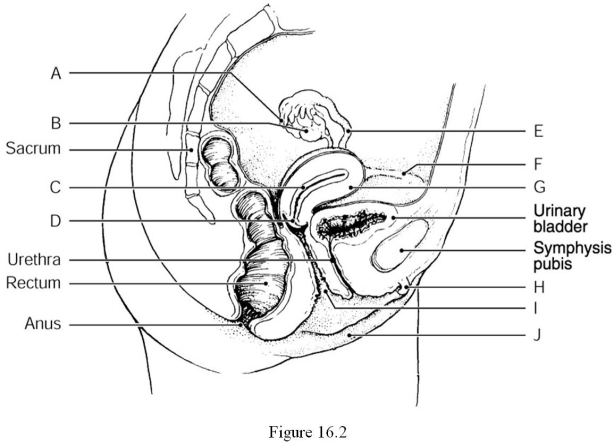 Using Figure 16.2, identify the following:
-The uterine (fallopian) tube is indicated by ________.
Using Figure 16.2, identify the following:
-The uterine (fallopian) tube is indicated by ________. (Multiple Choice)
4.9/5 (72)
(72) 
Filters
- Essay(0)
- Multiple Choice(0)
- Short Answer(0)
- True False(0)
- Matching(0)