



 Chat with AI
Exam 14: The Digestive System and Body Metabolism

Exam 1: The Human Body: An Orientation128 Questions
Exam 2: Basic Chemistry118 Questions
Exam 3: Cells and Tissues142 Questions
Exam 4: Skin and Body Membranes108 Questions
Exam 5: The Skeletal System124 Questions
Exam 6: The Muscular System129 Questions
Exam 7: The Nervous System161 Questions
Exam 8: Special Senses128 Questions
Exam 9: The Endocrine System149 Questions
Exam 10: Blood116 Questions
Exam 11: The Cardiovascular System295 Questions
Exam 13: The Respiratory System150 Questions
Exam 14: The Digestive System and Body Metabolism162 Questions
Exam 15: The Urinary System138 Questions
Exam 16: The Reproductive System169 Questions
Select questions type


Match the following phrases with the appropriate process:
-Transport of food products from the lumen of the GI tract to the blood or lymph
(Multiple Choice)
4.8/5  (75)
(75) The tongue is anchored to the floor of the mouth by the lingual frenulum.
(True/False)
4.9/5 (77)
(77) The organ responsible for drying out indigestible food residue through water absorption and the elimination of feces is the ________.
(Multiple Choice)
5.0/5 (84)
(84) Bacteria in the small intestine make some vitamins, such as some B and K.
(True/False)
4.8/5 (70)
(70) Predict the effect on digestion if the pancreas is unable to make and release pancreatic juices.
(Essay)
4.8/5 (70)
(70) The submucosal and myenteric nerve plexuses that help regulate the mobility and secretory activity of the GI tract organs are both part of the ________.
(Multiple Choice)
4.8/5 (90)
(90) What is the difference between the basal metabolic rate (BMR) and the total metabolic rate (TMR)? Which one should dieters focus on for weight loss?
(Essay)
5.0/5 (74)
(74) The pylorus region of the stomach is continuous with the small intestine through the pyloric sphincter (valve).
(True/False)
4.9/5 (71)
(71) Identify the digestive organ that is primarily associated with each of the following functions:
A) stomach
B) esophagus
C) small intestine
D) large intestine
E) mouth
-Tube through which food is propelled to the stomach but lacks a digestive role
(Essay)
4.8/5 (71)
(71) 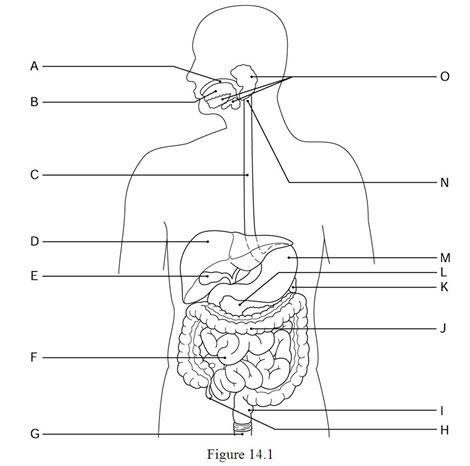 Using Figure 14.1, identify the following:
-The small intestine is indicated by ________.
Using Figure 14.1, identify the following:
-The small intestine is indicated by ________. (Multiple Choice)
4.8/5 (73)
(73) A nutrient may be a carbohydrate, lipid, protein, vitamin, mineral or water.
(True/False)
4.8/5 (82)
(82) Which one of the following alimentary segments has NO digestive function?
(Multiple Choice)
4.8/5 (69)
(69) Pancreatic enzymes are released into the stomach to break down all categories of digestible foods.
(True/False)
4.9/5 (83)
(83) The total amount of kilocalories the body must consume to fuel all ongoing activities, which increases dramatically during physical exertion, is called the ________.
(Multiple Choice)
4.8/5 (76)
(76)
Using Figure 14.1, identify the following:
-The large intestine is indicated by ________.
Using Figure 14.1, identify the following:
-The large intestine is indicated by ________. (Multiple Choice)
5.0/5 (87)
(87) What sphincter regulates the passage of food from the esophagus into the stomach?
(Multiple Choice)
4.8/5 (81)
(81) 
Filters
- Essay(0)
- Multiple Choice(0)
- Short Answer(0)
- True False(0)
- Matching(0)