



 Chat with AI
Exam 9: The Endocrine System

Exam 1: The Human Body: An Orientation128 Questions
Exam 2: Basic Chemistry118 Questions
Exam 3: Cells and Tissues142 Questions
Exam 4: Skin and Body Membranes108 Questions
Exam 5: The Skeletal System124 Questions
Exam 6: The Muscular System129 Questions
Exam 7: The Nervous System161 Questions
Exam 8: Special Senses128 Questions
Exam 9: The Endocrine System149 Questions
Exam 10: Blood116 Questions
Exam 11: The Cardiovascular System295 Questions
Exam 13: The Respiratory System150 Questions
Exam 14: The Digestive System and Body Metabolism162 Questions
Exam 15: The Urinary System138 Questions
Exam 16: The Reproductive System169 Questions
Select questions type


The most common stimulus for prodding endocrine glands into action is ________.
(Multiple Choice)
4.8/5  (78)
(78) Glucocorticoids, glucagon, and epinephrine are hyperglycemic hormones.
(True/False)
5.0/5 (74)
(74) Match the following hormones with the endocrine gland or structure that produces it:
-Aldosterone
(Multiple Choice)
4.7/5 (79)
(79) Match the following hormones with the endocrine gland or structure that produces it:
-Parathyroid hormone (PTH)
(Multiple Choice)
4.7/5 (92)
(92) Calcitonin is antagonistic to parathyroid hormone (PTH) in the regulation of blood calcium concentration.
(True/False)
4.9/5 (80)
(80) Water-soluble hormones, such as proteins and peptide hormones, activate target cells using ________.
(Multiple Choice)
4.8/5 (81)
(81) 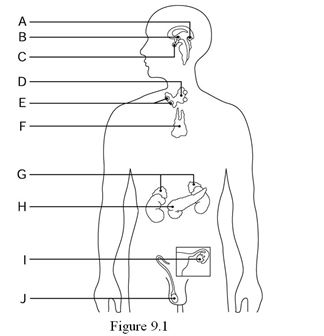 Using Figure 9.1, identify the following:
-The gland that is primarily responsible for regulating metabolism is indicated by ________.
Using Figure 9.1, identify the following:
-The gland that is primarily responsible for regulating metabolism is indicated by ________. (Multiple Choice)
5.0/5 (79)
(79) Match the following hormones with the endocrine gland or structure that produces it:
-Releasing and inhibiting hormones
(Multiple Choice)
5.0/5 (78)
(78) 
Filters
- Essay(0)
- Multiple Choice(0)
- Short Answer(0)
- True False(0)
- Matching(0)