



 Chat with AI
Exam 2: Basic Chemistry

Exam 1: The Human Body: An Orientation128 Questions
Exam 2: Basic Chemistry118 Questions
Exam 3: Cells and Tissues142 Questions
Exam 4: Skin and Body Membranes108 Questions
Exam 5: The Skeletal System124 Questions
Exam 6: The Muscular System129 Questions
Exam 7: The Nervous System161 Questions
Exam 8: Special Senses128 Questions
Exam 9: The Endocrine System149 Questions
Exam 10: Blood116 Questions
Exam 11: The Cardiovascular System295 Questions
Exam 13: The Respiratory System150 Questions
Exam 14: The Digestive System and Body Metabolism162 Questions
Exam 15: The Urinary System138 Questions
Exam 16: The Reproductive System169 Questions
Select questions type


Match the following:
-Antibodies, some hormones, and enzymes are examples
(Multiple Choice)
4.9/5  (83)
(83) Nerve impulses involve the flow of an electrical current, a type of energy known as ________ energy.
(Multiple Choice)
4.7/5 (84)
(84) The number of protons in an atom equals the atomic number for that element.
(True/False)
4.8/5 (76)
(76) Exchange reactions in which an acid and a base interact are known as ________.
(Multiple Choice)
4.8/5 (81)
(81) Phospholipids are composed of three fatty acid chains attached to one glycerol molecule.
(True/False)
4.8/5 (87)
(87) When a solution produces equal numbers of hydrogen and hydroxyl ions, it is said to be neutral.
(True/False)
4.8/5 (71)
(71) Which of these vitamins is produced in skin upon exposure to ultraviolet (UV) radiation?
(Multiple Choice)
4.9/5 (79)
(79) Match the following:
-Isotopes are atoms of the same element that have varying numbers of these subatomic particles.
(Multiple Choice)
4.8/5 (80)
(80) Trans fats are oils that have been solidified by the addition of ________.
(Multiple Choice)
5.0/5 (74)
(74) The atomic number of an atom reveals the number of ________.
(Multiple Choice)
4.7/5 (63)
(63) Atomic mass is equivalent to the number of ________ in an atom.
(Multiple Choice)
4.8/5 (86)
(86) Discuss radioisotopes and explain why they are studied in anatomy and physiology.
(Essay)
4.9/5 (66)
(66) Describe the difference between the roles of functional, or globular, proteins and structural, or fibrous, proteins.
(Essay)
4.8/5 (84)
(84) 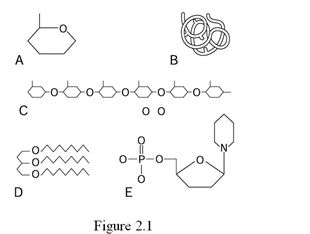 Using Figure 2.1, identify the following:
-Which letter represents a carbohydrate polymer?
Using Figure 2.1, identify the following:
-Which letter represents a carbohydrate polymer? (Multiple Choice)
4.7/5 (76)
(76) Which of the following is classified as an inorganic compound?
(Multiple Choice)
4.8/5 (79)
(79) 
Filters
- Essay(0)
- Multiple Choice(0)
- Short Answer(0)
- True False(0)
- Matching(0)