



 Chat with AI
Exam 23: The Respiratory System

Exam 1: An Introduction to Anatomy and Physiology95 Questions
Exam 2: The Chemical Level of Organization183 Questions
Exam 3: The Cellular Level of Organization190 Questions
Exam 4: The Tissue Level of Organization139 Questions
Exam 5: The Integumentary System118 Questions
Exam 6: Bones and Bone Structure165 Questions
Exam 7: The Axial Skeleton146 Questions
Exam 8: The Appendicular Skeleton119 Questions
Exam 9: Joints134 Questions
Exam 10: Muscle Tissue137 Questions
Exam 11: The Muscular System152 Questions
Exam 12: Nervous Tissue158 Questions
Exam 13: The Spinal Cord, Spinal Nerves, and Spinal Reflexes115 Questions
Exam 14: The Brain and Cranial Nerves187 Questions
Exam 15: Sensory Pathways and the Somatic Nervous System125 Questions
Exam 16: The Autonomic Nervous System and Higher-Order Functions129 Questions
Exam 17: The Special Senses170 Questions
Exam 18: The Endocrine System188 Questions
Exam 19: Blood162 Questions
Exam 20: The Heart178 Questions
Exam 21: Blood Vessels and Circulation225 Questions
Exam 22: The Lymphatic System and Immunity167 Questions
Exam 23: The Respiratory System200 Questions
Exam 24: The Digestive System213 Questions
Exam 25: Metabolism, Nutrition, and Energetics140 Questions
Exam 26: The Urinary System137 Questions
Exam 27: Fluid, Electrolyte, and Acid-Base Balance66 Questions
Exam 28: The Reproductive System203 Questions
Exam 29: Development and Inheritance146 Questions
Select questions type


Prolonged inspirations can result from stimulating the ________ center.
(Multiple Choice)
4.7/5  (84)
(84) Primary bronchi enter their respective lungs along with pulmonary vessels, nerves, and lymphatics at whichregion?
(Multiple Choice)
4.9/5 (74)
(74) The process by which dissolved gases are exchanged between the cells and interstitial fluids is
(Multiple Choice)
4.9/5 (69)
(69) The larynx, trachea, bronchi, and bronchioles all make up the
(Multiple Choice)
4.9/5 (93)
(93) ________ is the most common lethal inherited disease affecting individuals of Northern European descent.
(Multiple Choice)
4.7/5 (81)
(81) ________ is the amount of air that you can inhale above the resting tidal volume.
(Multiple Choice)
5.0/5 (76)
(76) Figure 23-1 The Upper Airways
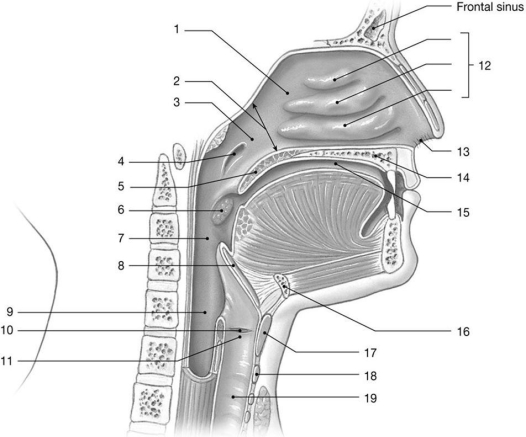 Use Figure 23-1 to answer the following questions:
-Identify the structure labeled "7."
Use Figure 23-1 to answer the following questions:
-Identify the structure labeled "7." (Multiple Choice)
4.8/5 (85)
(85) The largest cartilage of the larynx is the ________ cartilage.
(Multiple Choice)
4.9/5 (87)
(87) The laryngeal cartilage which is not composed of hyaline cartilage is the
(Multiple Choice)
4.9/5 (79)
(79) Tina is singing a song. At a certain point in the song, she forces a large volume of air out of the glottisand at the same time increases the tension on her vocal cords. The sound that she produces is
(Multiple Choice)
5.0/5 (73)
(73) At a PO2 of 70 mm Hg and normal temperature and pH, hemoglobin is ________ percent saturated with oxygen.
(Multiple Choice)
4.9/5 (78)
(78) The C shape of the tracheal cartilages is important because
(Multiple Choice)
4.8/5 (76)
(76) ________ is the amount of air that moves into the respiratory system during a single respiratory cycle.
(Multiple Choice)
4.7/5 (69)
(69) The right lung is to ________ as the left lung is to ________.
(Multiple Choice)
4.8/5 (77)
(77) Each 100 ml of blood leaving the alveolar capillaries carries away roughly ________ ml of oxygen.
(Multiple Choice)
4.8/5 (72)
(72) 
Filters
- Essay(0)
- Multiple Choice(0)
- Short Answer(0)
- True False(0)
- Matching(0)