



 Chat with AI
Exam 23: The Respiratory System

Exam 1: An Introduction to Anatomy and Physiology95 Questions
Exam 2: The Chemical Level of Organization183 Questions
Exam 3: The Cellular Level of Organization190 Questions
Exam 4: The Tissue Level of Organization139 Questions
Exam 5: The Integumentary System118 Questions
Exam 6: Bones and Bone Structure165 Questions
Exam 7: The Axial Skeleton146 Questions
Exam 8: The Appendicular Skeleton119 Questions
Exam 9: Joints134 Questions
Exam 10: Muscle Tissue137 Questions
Exam 11: The Muscular System152 Questions
Exam 12: Nervous Tissue158 Questions
Exam 13: The Spinal Cord, Spinal Nerves, and Spinal Reflexes115 Questions
Exam 14: The Brain and Cranial Nerves187 Questions
Exam 15: Sensory Pathways and the Somatic Nervous System125 Questions
Exam 16: The Autonomic Nervous System and Higher-Order Functions129 Questions
Exam 17: The Special Senses170 Questions
Exam 18: The Endocrine System188 Questions
Exam 19: Blood162 Questions
Exam 20: The Heart178 Questions
Exam 21: Blood Vessels and Circulation225 Questions
Exam 22: The Lymphatic System and Immunity167 Questions
Exam 23: The Respiratory System200 Questions
Exam 24: The Digestive System213 Questions
Exam 25: Metabolism, Nutrition, and Energetics140 Questions
Exam 26: The Urinary System137 Questions
Exam 27: Fluid, Electrolyte, and Acid-Base Balance66 Questions
Exam 28: The Reproductive System203 Questions
Exam 29: Development and Inheritance146 Questions
Select questions type


Ralph is taking scuba diving classes and is warned not to hold his breath when ascending from depth but to continuously release air from his mouth. What is the basis of this instruction and what is the risk if it is ignored?
(Essay)
4.9/5  (70)
(70) Which of the following descriptions best matches the term bronchiolar smooth muscle?
(Multiple Choice)
4.8/5 (71)
(71) The following is a list of some airways. What is the order in which air passes through them?
1) lobar bronchus
2) bronchioles
3) alveolar ducts
4) primary bronchus
5) respiratory bronchiole
6) alveoli
7) terminal bronchiole
(Multiple Choice)
4.9/5 (75)
(75) In which direction does carbon dioxide move during internal respiration?
(Multiple Choice)
4.9/5 (80)
(80) The partial pressure of carbon dioxide in the interstitial space of peripheral tissues is approximately
(Multiple Choice)
4.8/5 (79)
(79) In-Text Figure Based Questions
-The inspiratory capacity is a total of what two pulmonary volumes? (Figure 23-16)
(Multiple Choice)
4.9/5 (76)
(76) When the inspiratory muscles relax, the rib cage returns to its original position as a result of
(Multiple Choice)
4.8/5 (76)
(76) Figure 23-1 The Upper Airways
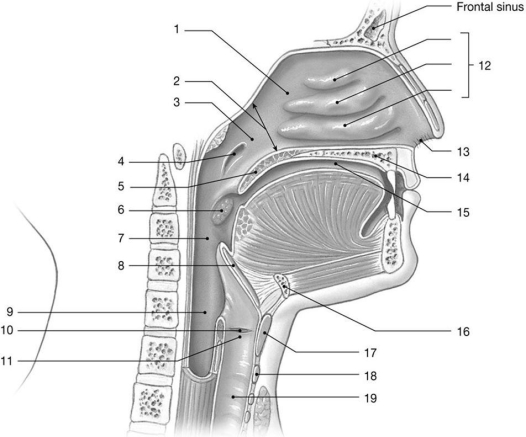 Use Figure 23-1 to answer the following questions:
-Identify the structure labeled "5."
Use Figure 23-1 to answer the following questions:
-Identify the structure labeled "5." (Multiple Choice)
4.7/5 (88)
(88) Figure 23-2 Mechanics of Ventilation
 Use Figure 23-2 to answer the following questions:
-What is the relationship between the pressures at label "3"?
Use Figure 23-2 to answer the following questions:
-What is the relationship between the pressures at label "3"? (Multiple Choice)
4.9/5 (88)
(88) A pair of ligaments covered by laryngeal epithelium that function in sound production are the
(Multiple Choice)
4.9/5 (84)
(84) Use of the accessory respiratory muscles is characteristic of forced breathing, or
(Multiple Choice)
5.0/5 (77)
(77) The ________ of the lungs is an indication of their expandability, how easily the lungs expand and contract.
(Multiple Choice)
4.8/5 (58)
(58) Which bone does not form part of the lateral or superior walls of the nasal cavity?
(Multiple Choice)
4.8/5 (84)
(84) 
Filters
- Essay(0)
- Multiple Choice(0)
- Short Answer(0)
- True False(0)
- Matching(0)