



 Chat with AI
Exam 18: The Endocrine System

Exam 1: An Introduction to Anatomy and Physiology95 Questions
Exam 2: The Chemical Level of Organization183 Questions
Exam 3: The Cellular Level of Organization190 Questions
Exam 4: The Tissue Level of Organization139 Questions
Exam 5: The Integumentary System118 Questions
Exam 6: Bones and Bone Structure165 Questions
Exam 7: The Axial Skeleton146 Questions
Exam 8: The Appendicular Skeleton119 Questions
Exam 9: Joints134 Questions
Exam 10: Muscle Tissue137 Questions
Exam 11: The Muscular System152 Questions
Exam 12: Nervous Tissue158 Questions
Exam 13: The Spinal Cord, Spinal Nerves, and Spinal Reflexes115 Questions
Exam 14: The Brain and Cranial Nerves187 Questions
Exam 15: Sensory Pathways and the Somatic Nervous System125 Questions
Exam 16: The Autonomic Nervous System and Higher-Order Functions129 Questions
Exam 17: The Special Senses170 Questions
Exam 18: The Endocrine System188 Questions
Exam 19: Blood162 Questions
Exam 20: The Heart178 Questions
Exam 21: Blood Vessels and Circulation225 Questions
Exam 22: The Lymphatic System and Immunity167 Questions
Exam 23: The Respiratory System200 Questions
Exam 24: The Digestive System213 Questions
Exam 25: Metabolism, Nutrition, and Energetics140 Questions
Exam 26: The Urinary System137 Questions
Exam 27: Fluid, Electrolyte, and Acid-Base Balance66 Questions
Exam 28: The Reproductive System203 Questions
Exam 29: Development and Inheritance146 Questions
Select questions type


Excess production of hormones by the zona reticularis may lead to which disorder?
(Multiple Choice)
4.9/5  (79)
(79) All of the following are known effects of thyroid hormone on peripheral tissues except
(Multiple Choice)
4.9/5 (76)
(76) In persons with untreated diabetes mellitus all of the following are true, except
(Multiple Choice)
4.8/5 (93)
(93) Changes in blood osmotic pressure would most affect the secretion of
(Multiple Choice)
4.9/5 (69)
(69) At about 4pm in the afternoon, you could expect that ________ will be released if you have not eaten since12pm.
(Multiple Choice)
4.7/5 (72)
(72) Hormones can be divided into different groups based on their chemistry. These categories include all ofthefollowing except
(Multiple Choice)
4.8/5 (72)
(72) Which of the following hormones increases and prolongs effects of the sympathetic nervous system?
(Multiple Choice)
4.8/5 (80)
(80) Receptors for ________, peptide hormones, and eicosanoids are found in the cell membranes of target cells.
(Multiple Choice)
4.9/5 (77)
(77) When patients who are receiving glucocorticoid therapy (for example, with prednisone need to stop takingit,the doctor will prescribe a series of doses of tapering size to gradually lower the dose rather than suddenly stop it. Explain this dosage strategy in terms of the negative feedback control of cortisol secretion.
(Essay)
4.8/5 (78)
(78) Figure 18-1 Pituitary Hormones and Their Targets
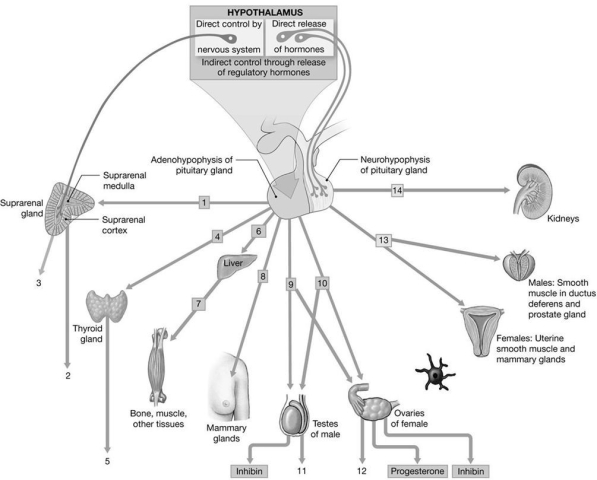 Use Figure 18-1 to answer the following questions:
-Identify the hormone labeled "13."
Use Figure 18-1 to answer the following questions:
-Identify the hormone labeled "13." (Multiple Choice)
4.7/5 (83)
(83) Which of the following is not an antagonistic hormone pair?
(Multiple Choice)
4.9/5 (68)
(68) Which of the following is not true regarding Type 1 Diabetes?
(Multiple Choice)
4.9/5 (91)
(91) When a catecholamine or peptide hormone binds to receptors on the surface of a cell, the
(Multiple Choice)
4.8/5 (79)
(79) 
Filters
- Essay(0)
- Multiple Choice(0)
- Short Answer(0)
- True False(0)
- Matching(0)