



 Chat with AI
Exam 5: Externalities, Environmental Policy, and Public Goods

Exam 1: Economics: Foundations and Models234 Questions
Exam 2: Trade-Offs, Comparative Advantage, and the Market System258 Questions
Exam 3: Where Prices Come From: the Interaction of Demand and Supply242 Questions
Exam 4: Economic Efficiency, Government Price Setting, and Taxes208 Questions
Exam 5: Externalities, Environmental Policy, and Public Goods263 Questions
Exam 6: Elasticity: the Responsiveness of Demand and Supply295 Questions
Exam 7: The Economics of Health Care171 Questions
Exam 8: Firms, the Stock Market, and Corporate Governance264 Questions
Exam 9: Comparative Advantage and the Gains From International Trade188 Questions
Exam 10: Consumer Choice and Behavioral Economics300 Questions
Exam 11: Technology, Production, and Costs328 Questions
Exam 12: Firms in Perfectly Competitive Markets296 Questions
Exam 13: Monopolistic Competition: the Competitive Model in a More Realistic Setting274 Questions
Exam 14: Oligopoly: Firms in Less Competitive Markets259 Questions
Exam 15: Monopoly and Antitrust Policy279 Questions
Exam 16: Pricing Strategy261 Questions
Exam 17: The Markets for Labor and Other Factors of Production281 Questions
Exam 18: Public Choice, Taxes, and the Distribution of Income258 Questions
Select questions type


Figure 5-15
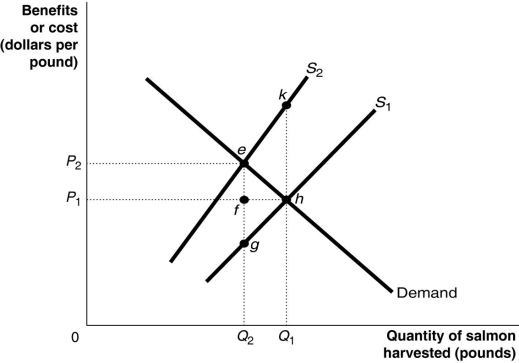 Figure 5-15 shows the market for Atlantic salmon, a common resource.The current market equilibrium output of Q₁ is not the economically efficient output.The economically efficient output is Q₂.
-Refer to Figure 5-15.The current market equilibrium output is partly the result of overfishing.In that case, what does S₂ represent?
Figure 5-15 shows the market for Atlantic salmon, a common resource.The current market equilibrium output of Q₁ is not the economically efficient output.The economically efficient output is Q₂.
-Refer to Figure 5-15.The current market equilibrium output is partly the result of overfishing.In that case, what does S₂ represent? (Multiple Choice)
4.9/5  (86)
(86) Consider a situation in which a utility company emits high levels of sulfur dioxide and the company is not liable for the damages its pollution causes.According to the Coase theorem, government action is ________ to achieve an ________ amount of pollution.
(Multiple Choice)
4.9/5 (91)
(91) How does the construction of a market demand curve for a private good differ from that for a public good?
(Multiple Choice)
4.9/5 (83)
(83) It is difficult for a private market to provide the economically efficient quantity of a public good because
(Multiple Choice)
4.9/5 (73)
(73) Economic incentives are designed to make individual self-interest coincide with social interest.According to economists, which of the following methods of pollution control best uses economic incentives to reduce pollution?
(Multiple Choice)
4.9/5 (83)
(83) Consider the following methods of pollution reduction:
A.the government sets a target for maximum emissions
B.the government mandates the installation of specific pollution abatement equipment
C.the government imposes a per unit tax on the good that creates pollution
D.the government gives firms a tax rebate for every unit of pollution abated
Which of the above is an example of a command-and-control approach to reducing pollution?
(Multiple Choice)
4.7/5 (81)
(81) Figure 5-15
Figure 5-15 shows the market for Atlantic salmon, a common resource.The current market equilibrium output of Q₁ is not the economically efficient output.The economically efficient output is Q₂.
-Refer to Figure 5-15.The current market equilibrium output is partly the result of overfishing.In that case, what does S₁ represent?
Figure 5-15 shows the market for Atlantic salmon, a common resource.The current market equilibrium output of Q₁ is not the economically efficient output.The economically efficient output is Q₂.
-Refer to Figure 5-15.The current market equilibrium output is partly the result of overfishing.In that case, what does S₁ represent? (Multiple Choice)
4.9/5 (61)
(61) Figure 5-9
 Companies producing toilet paper bleach the paper to make it white.The bleach is discharged into rivers and lakes and causes substantial environmental damage.Figure 5-9 illustrates the situation in the toilet paper market.
-Refer to Figure 5-9.The private profit-maximizing output level is
Companies producing toilet paper bleach the paper to make it white.The bleach is discharged into rivers and lakes and causes substantial environmental damage.Figure 5-9 illustrates the situation in the toilet paper market.
-Refer to Figure 5-9.The private profit-maximizing output level is (Multiple Choice)
4.9/5 (76)
(76) Explain how mandatory seat belt laws may reduce the negative externalities of risky behavior.
(Essay)
4.8/5 (73)
(73) Figure 5-7
 -Refer to Figure 5-7.Which of the following statements is true?
 (Multiple Choice)
4.9/5 (77)
(77) Medical research that results in a cure for a serious disease produces positive externalities.What is the impact of this positive externality on economic efficiency?
(Multiple Choice)
4.8/5 (76)
(76) In economics, the optimal level of pollution is the level for which the net benefit from reducing the pollution is the greatest.
(True/False)
4.9/5 (71)
(71) Which of the following describes how a positive externality affects a competitive market?
(Multiple Choice)
5.0/5 (88)
(88) State and local governments subsidize college students with grants and low-interest loans.The loans and subsidies are examples of
(Multiple Choice)
4.9/5 (71)
(71) Figure 5-2
 Figure 5-2 shows a market with a negative externality.
-Refer to Figure 5-2.The efficient output level is
Figure 5-2 shows a market with a negative externality.
-Refer to Figure 5-2.The efficient output level is (Multiple Choice)
4.9/5 (82)
(82) Assume that production from an electric utility caused acid rain and that the government imposed a tax on the utility equal to the cost of the acid rain.This is an example of
(Multiple Choice)
4.8/5 (77)
(77) Figure 5-8
 Consider a chemical plant that discharges toxic fumes over a nearby community.To reduce the emissions of toxic fumes the firm can install pollution abatement devices.Figure 5-8 shows the marginal benefit and the marginal cost from reducing the toxic fumes emissions.
-Refer to Figure 5-8.Suppose the emissions reduction target is currently established at 8 million tons.What is the area that represents the cost of eliminating an additional 1 million tons?
Consider a chemical plant that discharges toxic fumes over a nearby community.To reduce the emissions of toxic fumes the firm can install pollution abatement devices.Figure 5-8 shows the marginal benefit and the marginal cost from reducing the toxic fumes emissions.
-Refer to Figure 5-8.Suppose the emissions reduction target is currently established at 8 million tons.What is the area that represents the cost of eliminating an additional 1 million tons? (Multiple Choice)
4.8/5 (81)
(81) 
Filters
- Essay(0)
- Multiple Choice(0)
- Short Answer(0)
- True False(0)
- Matching(0)