



 Chat with AI
Exam 5: Externalities, Environmental Policy, and Public Goods

Exam 1: Economics: Foundations and Models234 Questions
Exam 2: Trade-Offs, Comparative Advantage, and the Market System258 Questions
Exam 3: Where Prices Come From: the Interaction of Demand and Supply242 Questions
Exam 4: Economic Efficiency, Government Price Setting, and Taxes208 Questions
Exam 5: Externalities, Environmental Policy, and Public Goods263 Questions
Exam 6: Elasticity: the Responsiveness of Demand and Supply295 Questions
Exam 7: The Economics of Health Care171 Questions
Exam 8: Firms, the Stock Market, and Corporate Governance264 Questions
Exam 9: Comparative Advantage and the Gains From International Trade188 Questions
Exam 10: Consumer Choice and Behavioral Economics300 Questions
Exam 11: Technology, Production, and Costs328 Questions
Exam 12: Firms in Perfectly Competitive Markets296 Questions
Exam 13: Monopolistic Competition: the Competitive Model in a More Realistic Setting274 Questions
Exam 14: Oligopoly: Firms in Less Competitive Markets259 Questions
Exam 15: Monopoly and Antitrust Policy279 Questions
Exam 16: Pricing Strategy261 Questions
Exam 17: The Markets for Labor and Other Factors of Production281 Questions
Exam 18: Public Choice, Taxes, and the Distribution of Income258 Questions
Select questions type


The private cost of a good or service is the cost borne by the producer.
(True/False)
4.7/5  (85)
(85) If there are no externalities, a competitive market achieves economic efficiency.If there is a negative externality, economic efficiency will not be achieved because
(Multiple Choice)
4.8/5 (84)
(84) Figure 5-5
 Figure 5-5 shows a market with an externality.The current market equilibrium output of Q₁ is not the economically efficient output.The economically efficient output is Q₂.
-Refer to Figure 5-5.If, because of an externality, the economically efficient output is Q₂ and not the current equilibrium output of Q₁, what does D₁ represent?
Figure 5-5 shows a market with an externality.The current market equilibrium output of Q₁ is not the economically efficient output.The economically efficient output is Q₂.
-Refer to Figure 5-5.If, because of an externality, the economically efficient output is Q₂ and not the current equilibrium output of Q₁, what does D₁ represent? (Multiple Choice)
4.8/5 (65)
(65) Figure 5-3
 -Refer to Figure 5-3.The size of marginal external benefits can be determined by
 (Multiple Choice)
4.9/5 (75)
(75) Governments can increase the consumption of a product that creates positive externalities by
(Multiple Choice)
4.8/5 (88)
(88) One difference between the demand for a private good and that for a public good is that
(Multiple Choice)
4.8/5 (77)
(77) The basic cause of deadweight losses from the existence of common resources and externalities is
(Multiple Choice)
5.0/5 (87)
(87) Which of the following displays these two characteristics: rivalry and nonexcludability?
(Multiple Choice)
4.8/5 (79)
(79) Which of the following exemplifies the tragedy of the commons?
(Multiple Choice)
4.8/5 (80)
(80) Figure 5-6
 Figure 5-6 shows the market for measles vaccinations, a product whose use generates positive externalities.
-Refer to Figure 5-6.What does D₂ represent?
Figure 5-6 shows the market for measles vaccinations, a product whose use generates positive externalities.
-Refer to Figure 5-6.What does D₂ represent? (Multiple Choice)
4.9/5 (89)
(89) Figure 5-15
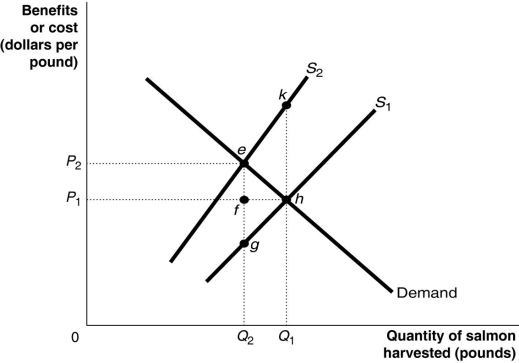 Figure 5-15 shows the market for Atlantic salmon, a common resource.The current market equilibrium output of Q₁ is not the economically efficient output.The economically efficient output is Q₂.
-Refer to Figure 5-15.Identify the area that shows the deadweight loss from overfishing.
Figure 5-15 shows the market for Atlantic salmon, a common resource.The current market equilibrium output of Q₁ is not the economically efficient output.The economically efficient output is Q₂.
-Refer to Figure 5-15.Identify the area that shows the deadweight loss from overfishing. (Multiple Choice)
4.8/5 (61)
(61) Which of the following is an example of a common resource?
(Multiple Choice)
4.9/5 (85)
(85) Suppose a tax equal to the value of the marginal external cost at the optimal output is imposed on a pollution generating good.All of the following will result from the tax except
(Multiple Choice)
4.8/5 (83)
(83) Kenneth Chay and Michael Greenstone examined the impact of reductions in air pollution since the passage of the Clean Air Act of 1970.Which of the following statements summarizes their findings?
(Multiple Choice)
4.8/5 (90)
(90) Which of the following would result in a positive externality?
(Multiple Choice)
4.9/5 (86)
(86) Which of the following criteria should be used to evaluate if government intervention in a market for the purpose of environmental protection is justified?
(Multiple Choice)
4.9/5 (82)
(82) Figure 5-3
-Refer to Figure 5-3.The private profit-maximizing output level is
-Refer to Figure 5-3.The private profit-maximizing output level is (Multiple Choice)
4.7/5 (82)
(82) Which of the following is an example of a common resource?
(Multiple Choice)
4.8/5 (80)
(80) 
Filters
- Essay(0)
- Multiple Choice(0)
- Short Answer(0)
- True False(0)
- Matching(0)