



 Chat with AI
Exam 5: Externalities, Environmental Policy, and Public Goods

Exam 1: Economics: Foundations and Models234 Questions
Exam 2: Trade-Offs, Comparative Advantage, and the Market System258 Questions
Exam 3: Where Prices Come From: the Interaction of Demand and Supply242 Questions
Exam 4: Economic Efficiency, Government Price Setting, and Taxes208 Questions
Exam 5: Externalities, Environmental Policy, and Public Goods263 Questions
Exam 6: Elasticity: the Responsiveness of Demand and Supply295 Questions
Exam 7: The Economics of Health Care171 Questions
Exam 8: Firms, the Stock Market, and Corporate Governance264 Questions
Exam 9: Comparative Advantage and the Gains From International Trade188 Questions
Exam 10: Consumer Choice and Behavioral Economics300 Questions
Exam 11: Technology, Production, and Costs328 Questions
Exam 12: Firms in Perfectly Competitive Markets296 Questions
Exam 13: Monopolistic Competition: the Competitive Model in a More Realistic Setting274 Questions
Exam 14: Oligopoly: Firms in Less Competitive Markets259 Questions
Exam 15: Monopoly and Antitrust Policy279 Questions
Exam 16: Pricing Strategy261 Questions
Exam 17: The Markets for Labor and Other Factors of Production281 Questions
Exam 18: Public Choice, Taxes, and the Distribution of Income258 Questions
Select questions type


Which of the following represents the true economic cost of production when firms produce goods that cause negative externalities?
(Multiple Choice)
4.9/5  (88)
(88) When there is a negative externality, the competitive output is greater than the economically efficient output level.
(True/False)
4.9/5 (80)
(80) Assume that emissions from electric utilities contribute to pollution in the form of acid rain.Which of the following describes how this affects the market for electricity?
(Multiple Choice)
4.7/5 (77)
(77) Conceptually, the efficient level of carbon emissions is the level for which
(Multiple Choice)
4.8/5 (84)
(84) Suppose the government mandates the installation of a certain type of pollution abatement equipment for the leather tannery industry.For some firms in the industry, installing this equipment may not be the most cost effective method of reducing pollution.
(True/False)
4.7/5 (73)
(73) For certain public projects such as building a dam on a river or a bridge to an island, what procedure is a government likely to use to determine what quantity of a public good should be supplied?
(Multiple Choice)
4.8/5 (88)
(88) Briefly explain the command-and-control approach in dealing with an externality such as pollution.Give an example of the U.S.government using the command-and-control approach to deal with the pollution problem.
(Essay)
4.8/5 (81)
(81) A major problem with using a tradable emission allowances system to control pollution is
(Multiple Choice)
4.8/5 (73)
(73) A.C.Pigou argued that the government can deal with a positive externality in consumption by giving consumers a subsidy equal to the value of the externality.
(True/False)
4.9/5 (92)
(92) How does a negative externality in production reduce economic efficiency?
(Essay)
4.9/5 (83)
(83) In the past the federal government often employed what is called a "command-and-control" approach to the reduction of pollution emissions.Many economists are critical of this approach because
(Multiple Choice)
4.9/5 (88)
(88) Figure 5-7
 -Refer to Figure 5-7.The marginal benefit of reducing pollution curve is the same curve as
 (Multiple Choice)
4.8/5 (81)
(81) Consider the stock of ocean tuna which is massively overfished.It is rational for an individual to exploit the resource rather than to conserve the stock because
(Multiple Choice)
5.0/5 (74)
(74) Because producers do not bear the external cost of pollution,
(Multiple Choice)
4.8/5 (72)
(72) What is the rationale behind a marketable emission allowance scheme?
(Multiple Choice)
4.9/5 (87)
(87) Economists generally favor the use of tradable emission allowances to reduce pollution.However, the use of these allowances has been criticized by some environmentalists.Which of the following describes this criticism?
(Multiple Choice)
4.9/5 (83)
(83) Figure 5-14
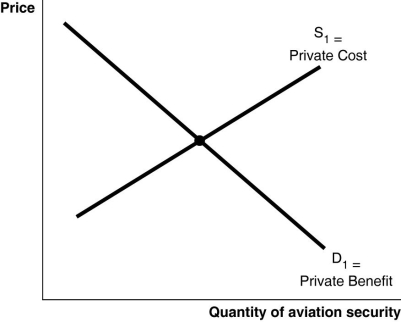 Figure 5-14 shows the market for aviation security.Aviation security generates a positive externality because people who are not airline passengers benefit from aviation security.
-Refer to Figure 5-14 to answer the following questions.
a.In the absence of any government intervention what is the equilibrium level of security that airlines will supply? Using the diagram, denote this level, Q*.Briefly explain why this quantity is not the economically efficient level of aviation security.
b.In the diagram, illustrate the presence of positive externalities in the aviation security market.Label any new curve that you draw.
c.On your diagram identify the economically efficient level of aviation security.Denote this level Qe.
d.Explain how a government subsidy for the airlines can bring about the economically efficient aviation security level.Be sure to identify the size of the subsidy.
Figure 5-14 shows the market for aviation security.Aviation security generates a positive externality because people who are not airline passengers benefit from aviation security.
-Refer to Figure 5-14 to answer the following questions.
a.In the absence of any government intervention what is the equilibrium level of security that airlines will supply? Using the diagram, denote this level, Q*.Briefly explain why this quantity is not the economically efficient level of aviation security.
b.In the diagram, illustrate the presence of positive externalities in the aviation security market.Label any new curve that you draw.
c.On your diagram identify the economically efficient level of aviation security.Denote this level Qe.
d.Explain how a government subsidy for the airlines can bring about the economically efficient aviation security level.Be sure to identify the size of the subsidy. (Essay)
4.7/5 (83)
(83) Goods differ on the basis of whether their consumption is rival and excludable.Explain the terms "rivalry" and "excludability" as they are used to define goods.List the four categories of goods, and define these categories in terms of rivalry and excludability.
(Essay)
4.7/5 (85)
(85) If the marginal benefit of reducing emissions of some air pollutant is less than the marginal cost
(Multiple Choice)
4.7/5 (87)
(87) Figure 5-3
 -Refer to Figure 5-3.At the competitive market equilibrium, for the last unit produced
 (Multiple Choice)
4.8/5 (89)
(89) 
Filters
- Essay(0)
- Multiple Choice(0)
- Short Answer(0)
- True False(0)
- Matching(0)