



 Chat with AI
Exam 5: Externalities, Environmental Policy, and Public Goods

Exam 1: Economics: Foundations and Models234 Questions
Exam 2: Trade-Offs, Comparative Advantage, and the Market System258 Questions
Exam 3: Where Prices Come From: the Interaction of Demand and Supply242 Questions
Exam 4: Economic Efficiency, Government Price Setting, and Taxes208 Questions
Exam 5: Externalities, Environmental Policy, and Public Goods263 Questions
Exam 6: Elasticity: the Responsiveness of Demand and Supply295 Questions
Exam 7: The Economics of Health Care171 Questions
Exam 8: Firms, the Stock Market, and Corporate Governance264 Questions
Exam 9: Comparative Advantage and the Gains From International Trade188 Questions
Exam 10: Consumer Choice and Behavioral Economics300 Questions
Exam 11: Technology, Production, and Costs328 Questions
Exam 12: Firms in Perfectly Competitive Markets296 Questions
Exam 13: Monopolistic Competition: the Competitive Model in a More Realistic Setting274 Questions
Exam 14: Oligopoly: Firms in Less Competitive Markets259 Questions
Exam 15: Monopoly and Antitrust Policy279 Questions
Exam 16: Pricing Strategy261 Questions
Exam 17: The Markets for Labor and Other Factors of Production281 Questions
Exam 18: Public Choice, Taxes, and the Distribution of Income258 Questions
Select questions type


Figure 5-13
 Figure 5-13 illustrates the market for gasoline before and after the government imposes a tax to bring about the efficient level of gasoline production.
-Refer to Figure 5-13.The actual price of gasoline paid by consumers after the tax is implemented is ________ per gallon.
Figure 5-13 illustrates the market for gasoline before and after the government imposes a tax to bring about the efficient level of gasoline production.
-Refer to Figure 5-13.The actual price of gasoline paid by consumers after the tax is implemented is ________ per gallon. (Multiple Choice)
4.9/5  (81)
(81) A product is considered to be excludable if it is jointly owned by all members of a community.
(True/False)
4.8/5 (77)
(77) Figure 5-5
 Figure 5-5 shows a market with an externality.The current market equilibrium output of Q₁ is not the economically efficient output.The economically efficient output is Q₂.
-Refer to Figure 5-5.If, because of an externality, the economically efficient output is Q₂ and not the current equilibrium output of Q₁, what does D₂ represent?
Figure 5-5 shows a market with an externality.The current market equilibrium output of Q₁ is not the economically efficient output.The economically efficient output is Q₂.
-Refer to Figure 5-5.If, because of an externality, the economically efficient output is Q₂ and not the current equilibrium output of Q₁, what does D₂ represent? (Multiple Choice)
4.9/5 (66)
(66) Offering to pay the passenger in front of you to keep her from reclining her airplane seat is an example of
(Multiple Choice)
4.7/5 (65)
(65) Figure 5-8
 Consider a chemical plant that discharges toxic fumes over a nearby community.To reduce the emissions of toxic fumes the firm can install pollution abatement devices.Figure 5-8 shows the marginal benefit and the marginal cost from reducing the toxic fumes emissions.
-Refer to Figure 5-8.Suppose the emissions reduction target is currently established at 8 million tons.Should society undertake to reduce an additional 1 million tons so that the total reduction is 9 million tons?
Consider a chemical plant that discharges toxic fumes over a nearby community.To reduce the emissions of toxic fumes the firm can install pollution abatement devices.Figure 5-8 shows the marginal benefit and the marginal cost from reducing the toxic fumes emissions.
-Refer to Figure 5-8.Suppose the emissions reduction target is currently established at 8 million tons.Should society undertake to reduce an additional 1 million tons so that the total reduction is 9 million tons? (Multiple Choice)
4.7/5 (78)
(78) Figure 5-4
 Suppose there are several paper mills producing paper for a market.These mills, located upstream from a fishing village, discharge a large amount of wastewater into the river.The waste material affects the number of fish in the river and the use of the river for recreation and as a public water supply source.Figure 5-4 shows the paper market.Use this Figure to answer the following question(s).
-Refer to Figure 5-4.What does S₂ represent?
Suppose there are several paper mills producing paper for a market.These mills, located upstream from a fishing village, discharge a large amount of wastewater into the river.The waste material affects the number of fish in the river and the use of the river for recreation and as a public water supply source.Figure 5-4 shows the paper market.Use this Figure to answer the following question(s).
-Refer to Figure 5-4.What does S₂ represent? (Multiple Choice)
4.9/5 (74)
(74) Figure 5-12
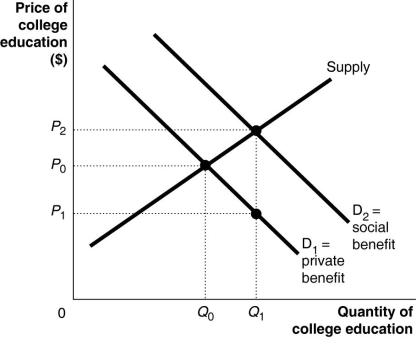 College education benefits society by producing a more employable workforce, reducing crime, and creating a better informed citizenry.Thus, the marginal social benefits of college education exceed the marginal private benefits for any level of college education.This is illustrated in Figure 5-12.
-Refer to Figure 5-12.One way to obtain the economically efficient amount of college education is for governments to subsidize college education.What is the size of the per-student Pigovian subsidy that the government must provide to internalize the external benefits? (Note that the subsidy can be granted to the education institutions or to the students directly or indirectly; for example, through low-interest student loans.)
College education benefits society by producing a more employable workforce, reducing crime, and creating a better informed citizenry.Thus, the marginal social benefits of college education exceed the marginal private benefits for any level of college education.This is illustrated in Figure 5-12.
-Refer to Figure 5-12.One way to obtain the economically efficient amount of college education is for governments to subsidize college education.What is the size of the per-student Pigovian subsidy that the government must provide to internalize the external benefits? (Note that the subsidy can be granted to the education institutions or to the students directly or indirectly; for example, through low-interest student loans.) (Multiple Choice)
4.8/5 (80)
(80) Public goods are distinguished by two primary characteristics.What are they?
(Multiple Choice)
4.9/5 (81)
(81) Figure 5-4
Suppose there are several paper mills producing paper for a market.These mills, located upstream from a fishing village, discharge a large amount of wastewater into the river.The waste material affects the number of fish in the river and the use of the river for recreation and as a public water supply source.Figure 5-4 shows the paper market.Use this Figure to answer the following question(s).
-Refer to Figure 5-4.What does S₁ represent?
Suppose there are several paper mills producing paper for a market.These mills, located upstream from a fishing village, discharge a large amount of wastewater into the river.The waste material affects the number of fish in the river and the use of the river for recreation and as a public water supply source.Figure 5-4 shows the paper market.Use this Figure to answer the following question(s).
-Refer to Figure 5-4.What does S₁ represent? (Multiple Choice)
4.9/5 (87)
(87) Figure 5-4
Suppose there are several paper mills producing paper for a market.These mills, located upstream from a fishing village, discharge a large amount of wastewater into the river.The waste material affects the number of fish in the river and the use of the river for recreation and as a public water supply source.Figure 5-4 shows the paper market.Use this Figure to answer the following question(s).
-Refer to Figure 5-4.Why is there a deadweight loss?
Suppose there are several paper mills producing paper for a market.These mills, located upstream from a fishing village, discharge a large amount of wastewater into the river.The waste material affects the number of fish in the river and the use of the river for recreation and as a public water supply source.Figure 5-4 shows the paper market.Use this Figure to answer the following question(s).
-Refer to Figure 5-4.Why is there a deadweight loss? (Multiple Choice)
4.8/5 (83)
(83) Figure 5-6
 Figure 5-6 shows the market for measles vaccinations, a product whose use generates positive externalities.
-Refer to Figure 5-6.Why is there a deadweight loss?
Figure 5-6 shows the market for measles vaccinations, a product whose use generates positive externalities.
-Refer to Figure 5-6.Why is there a deadweight loss? (Multiple Choice)
4.8/5 (86)
(86) Figure 5-6
Figure 5-6 shows the market for measles vaccinations, a product whose use generates positive externalities.
-Refer to Figure 5-6.What is the economically efficient output level?
Figure 5-6 shows the market for measles vaccinations, a product whose use generates positive externalities.
-Refer to Figure 5-6.What is the economically efficient output level? (Multiple Choice)
4.9/5 (82)
(82) Define the tragedy of the commons.Give three examples of common resources.Briefly explain why common property resources are subject to overuse.
(Essay)
4.8/5 (78)
(78) Issuing tradable emission allowances to polluting firms will result in those firms polluting more than is socially desirable.
(True/False)
4.8/5 (79)
(79) For-profit producers will produce only private goods because
(Multiple Choice)
5.0/5 (83)
(83) What are transactions costs? Why do transactions costs create difficulties in finding a private solution to the problem of pollution?
(Essay)
4.8/5 (70)
(70) A modern example of the tragedy of the commons is the forests in many poor countries.
(True/False)
4.7/5 (75)
(75) 
Filters
- Essay(0)
- Multiple Choice(0)
- Short Answer(0)
- True False(0)
- Matching(0)